
Brain-computer interface for Second Life

While recent developments in brain-computer interface (BCI) technology have given humans the power to mentally control computers, nobody has used the technology in conjunction with the Second Life online virtual world — until now.
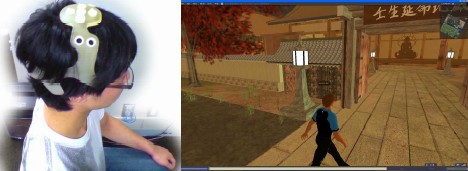
A research team led by professor Jun’ichi Ushiba of the Keio University Biomedical Engineering Laboratory has developed a BCI system that lets the user walk an avatar through the streets of Second Life while relying solely on the power of thought. To control the avatar on screen, the user simply thinks about moving various body parts — the avatar walks forward when the user thinks about moving his/her own feet, and it turns right and left when the user imagines moving his/her right and left arms.
The system consists of a headpiece equipped with electrodes that monitor activity in three areas of the motor cortex (the region of the brain involved in controlling the movement of the arms and legs). An EEG machine reads and graphs the data and relays it to the BCI, where a brain wave analysis algorithm interprets the user’s imagined movements. A keyboard emulator then converts this data into a signal and relays it to Second Life, causing the on-screen avatar to move. In this way, the user can exercise real-time control over the avatar in the 3D virtual world without moving a muscle.
Future plans are to improve the BCI so that users can make Second Life avatars perform more complex movements and gestures. The researchers hope the mind-controlled avatar, which was created through a joint medical engineering project involving Keio’s Department of Rehabilitation Medicine and the Tsukigase Rehabilitation Center, will one day help people with serious physical impairments communicate and do business in Second Life.
(For video of the Second Life BCI, check the links on the Ushida & Tomita Laboratory news page, right above the first photo.)
[Source: Nikkei Net]


Trouble is, *thinking* about performing an action is still different than actually doing it. You still won’t have the sense of “being there” that this kind of research suggests. Worse yet, that kind of experience is impossible without somehow suppressing your real-world responses. If I raise my hand, my actual hand will go up, regardless of how my avatar responds to the impulse.
Interesting, but not anywhere close to the sort of thing most people will assume it implies (IMHO).
[…] Brain-computer interface for Second Life […]
[…] El profesor Jun’ichi Ushiba de la Universidad de Biomedical Engineering Laboratory ha creado el sistema BCI, que es capaz de mover el avatar del Second Life con el cerebro y una serie de movimientos corporales… […]
Brain-computer interface is used in Second Life online virtual world…
With the brain-computer interface (BCI) technology has empowered humans to mentally control computers. Up till now no one thought of exploiting this technology in concurrence with the Second Life online virtual world. A research team led by professor …
@Mac: What you are thinking of, and what subsequently leads you to assume everyone is, is full immersion: transfer or your consciousness into the avatar. You are correct to say that one should not confuse that with this, which is direct control of an external entity (be the avatar a purely software based one, such as your double in Second Life) or a phsyical one (we already have implant tech that allows monkeys to control robotic hands) via EEG monitoring… which is still damn cool, IMHO. ;)
[…] - Brain-computer interface for Second Life “A research team […] has developed a BCI system that lets the user walk an avatar […]
[…] Life is Now Brain-Powered Source: Pink Tentacle Company: Tanishita Laboratory, KEIO […]
[…] PinkTentacle] postato da Cristian il sabato 13 ottobre 2007 […]
[…] Brain-computer interface for Second Life […]
[…] Brain-computer interface for Second Life ::: Pink Tentacle: Brain-computer interface for Second Life […]
[…] When the user just thinks about moving his arm or leg the BCI system correlates the movements to a keyboard emulator, which then controls the action in Second Life. Since the system is limited to basic actions, there are plans to improve the BCI for more elaborate movements. Even though the researchers hope this will help psychically impaired people communicate and do business in Second Life, we still think the first life, real life, is more important. [Nikkei Net via Pink Tentacle] […]
[…] brain-computer interactions within virtual environments is currently being developed in Tokyo by Keio University Biomedical Engineering Laboratory. Here is the main webpage for Keio […]
[…] Life client and this video shows the device in action. There ismore on the development over at Pink Tentacle (English) or at the Keio University […]
[…] Pink Tentacle Comparte este post Categorías: Ciencia, Joysticks, Noticias Artículos […]
[…] Brain-computer interface for Second Life. A research team led by professor Jun’ichi Ushiba of the Keio University Biomedical Engineering […]
[…] Researchers at the Tomita and Ushida Laboratory of Keio University in Japan have developed a brain-computer interface that allows a person to control a Second Life avatar just by thinking. (link) […]
[…] Pink Tentacle points out to a recent research where BCI technology is used to control second life avatar. While recent developments in brain-computer interface (BCI) technology have given humans the power to mentally control computers, nobody has used the technology in conjunction with the Second Life online virtual world — until now. […]
[…] In Second Life Gets Brain Controls a “brain computer interface” is described that has been developed to allow a person to control their own avatar in Second Life via thought. [via Smart Mobs and Pink Tentacle] […]
[…] Oh please! Oh please! Oh please! Brain-computer interface for Second Life […]
[…] walk an avatar through the streets of Second Life while relying solely on the power of thought. Read all about it! Published […]
[…] interface for Second Life (didn’t I talk about something similar to this in the past?). A bit more about this research over on Pink Tentacle. Apparently, the researchers are aiming this project at the physically handicapped so that they too […]
[…] the links on the Ushida & Tomita Laboratory news page, right above the first photo.) Source: Pink Tentacle You can learn more about Brain-computer interfaces on the wiki: Brain-computer interface - […]
[…] Kotaku via Computer Interface Tag: Second Life Permalink | Comments: none | Share This […]
[…] at the Keio University Biomedical Engineering Laboratory, in Japan, have created a brain-computer interface that allows people to use their thoughts to control the movements of their Second Life […]
[…] La noticia completa en: http://www.pinktentacle.com/2007/10/brain-computer-interface-for-second-life/ […]
[…] this from a colleague here at work (thanks Teddy!) - the Pink Tentacle Blog says that a BCI (brain-computer interface) for SL has been developed by researchers at Keio University, one of the oldest private universities in Japan. For details, […]
[…] October 15th, 2007 in Metaverse General When i first saw the headline I thought it was a joke. But they’re serious - and with a serious intent, namely to help […]
I would love to have that.
this is amazing and will lead to improvements in the quality of life for many with limited physical capabilities. sl already has done this with paraplegic friends. just amazing work
[…] more! […]
[…] this amazing story here. By Rodion in Articles .::. You can follow any responses to this entry through […]
[…] passt es ganz gut, dass es japanischen Forschern gelungen ist, Avatare in Second Life mittels “Gedankenübertragung” direkt aus dem Gehirn zu steuern. Wer es nicht glauben […]
[…] to an article that was thrust into my inbox with the force of David Bowie’s codpiece ripping free - all […]
Would be cool to have virtual keyboard and type away using your mind.
I can’t wait this to support battelfield 2/2142.
[…] Read more at Pink Tentacle. […]
[…] USA LA TESTA PER GIOCARE Podcast Video: Download Cellulare: Download Standard Podcast: Download […]
[…] Sumber berita […]
[…] Pink Tentacle] No Comments so far Leave a comment RSS feed for comments on this post. TrackBack URI […]
Mac’s post that “… *thinking* about performing an action is still different than actually doing it.” is actually both correct and incorrect. When we walk to the shop we don’t think about our balance, about breathing, about the movement of feet. When we were young we had to (well maybe not breathing but perhaps if you go back early enough….). We do this things automatically as we have learnt how to string such thoughts/impulses together. Games are actually how children learn and improve balance and motion and so on. Having such a tool integrated into a game is a good way to help this technology advance.
I think this is a great news. As a disabled myself, I think it’s great there are people working on technologies like this one. I play massive multiplayer online role-playing games, not Second Life though, and I do not have too much trouble but with my disease it can make me worse and I fear I would lose my favorite hobby where I get the chance to socialize online and do all those things regular people do which I wouldn’t be able to do in real life. I get to be at the same level for once with everyone else. I have troubles though with other videogames where the devs have made over complicated controls, they have completely forgotten that games are supposed to be FUN. Such a device would be great.
[…] Pink Tentacle […]
[…] More over at the excellent Pink Tentacle. […]
[…] activities of every day life. My friend Jeff Lundquist linked this experimental device described on Pink Tentacle that has great promise for people with debilitating movement disorders. Scientists in Japan have […]
[…] all’inizio e’ in giapponese: non l’ho tradotta, io riporto quanto scritto da Pink Tentacle. Condividi: Queste icone linkano i siti di social bookmarking sui quali i lettori possono […]
[…] A research team led by professor Jun’ichi Ushiba of the Keio University Biomedical Engineering Laboratory has developed a BCI system […]
[…] Get your brain-computer interface yet? Good if you lost your […]
[…] [source: pinktentacle.com] […]
[…] interface (BCI)–a helmet type doodad that records brain signals–that allows someone to control a Second Life avatar. Just by thinking about moving forward, you get your SL avatar to move forward. Think […]
[…] The team led by professor Jun’ichi Ushiba (at Keio University Biomedical Engineering Laboratory) has ideated a BCI tool to move an avatar of Second Life, using an EEG apparatus to monitorate the activity in three areas of motor cortex and implementing an algorithm to produce the imagined motion pattern: “the avatar walks forward when the user thinks about moving his/her own feet, and it turns right and left when the user imagines moving his/her right and left arms”. [Source: Pinktentacle.com] […]
That’s AMAZING… Making machinima in SL will be easier– just think
Japanese Machinima http://www.youtube.com/watch?v=en1nzven7jA
[…] silicon can model the brain to a sufficient level of complexity, and an interesting story about brain-computer interface for Second Life. Indeed, I’m going to add Future Scanner to my […]
[…] game Second Life to control their virtual avatars using the BCI. According to the descriptions on this site, it works by enabling the user to imagine moving their legs to walk forward or backward, while […]
[…] Brain-computer interface for Second Life ::: Pink Tentacle - 2007-10-12 (tags: secondlife interface brain navigation) […]
[…] Life is Now Brain-Powered Source: Pink Tentacle Company: Tanishita Laboratory, KEIO […]
[…] If I remember correctly, I think the Japanese are also researching Hands Free movement and control in Second Life using brain signals. […]
[…] clues can be added…tags, etc… brain/computer interfaces (exist now!…read here) will allow users to navigate virtual worlds at speed of […]