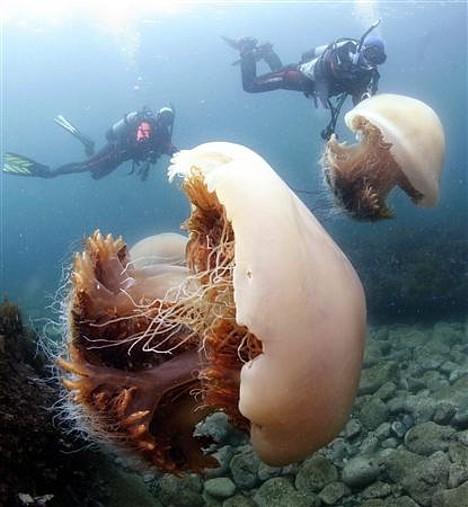
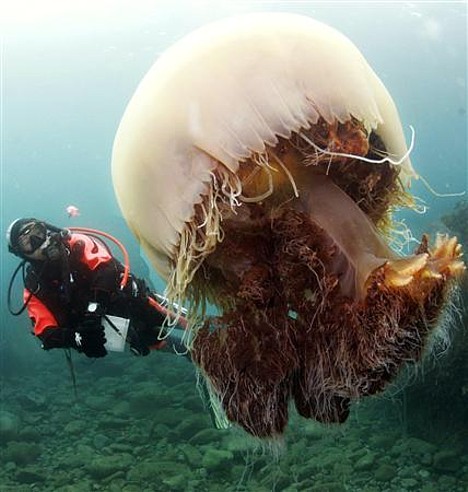
To the delight of divers, and to the chagrin of fishermen, the swarms of giant Echizen kurage jellyfish (Nomura’s jellyfish) that invade the coast of the Sea of Japan each autumn are back.
These photos were taken 5 meters underwater just offshore from the coastal town of Echizen in Fukui prefecture, where the jellyfish mobs began to arrive about a month later than normal.
Manabu Nakamata, a 38-year-old diver from Nagoya and an admirer of the monster jellyfish, says, “They are surprisingly hard to the touch. They are big, and extremely impressive.” Big indeed — Echizen kurage can grow up to 2 meters (6 ft. 7 in.) in diameter and weigh up to 200 kilograms (440 lb.) each.
The local fishermen, however, are not impressed. Each year, the giant jellyfish wreak havoc on the fishing industry by destroying nets and crushing, poisoning and sliming other fish in the catches. In the latest move in the war on jellyfish, Fukui prefecture is developing new and efficient weapons designed to pulverize those that threaten their shores.
A team of University of Tokyo researchers led by professors Hitoshi Sakano and Ko Kobayakawa have announced they have genetically engineered a mouse that does not fear cats, simply by controlling its sense of smell. By tweaking genes to disable certain functions of the olfactory bulb — the area of the brain that receives information about smells directly from olfactory receptors in the nose — the researchers were able to create a “fearless” mouse that does not try to flee when it smells cats, foxes and other predators.
In studying the genetically modified mouse, the researchers have concluded that the evasive behavior exhibited by mammals when they smell predators may be genetically hardwired into the olfactory bulb from birth, and not learned through experience as commonly believed. The research suggests that the mechanism by which mammals determine whether or not to fear another animal they smell — and whether or not to flee — is not a higher-order cerebral function. Instead, that decision is made based on a lower-order function that is hardwired into the neural circuitry of the olfactory bulb. However, in other experiments, the researchers demonstrated that mice with impaired olfactory functions can also be taught to fear their predators.
According to Professor Sakano, the research indicates that behavior in the mammalian brain is determined both by instincts coded into the genes and by “associative circuitry” that allows responses to be learned through the environment.
The results of the research, which are to be published in the November 8 online edition of the British science journal Nature, are expected to help scientists better understand the structure of the brain’s neural circuitry responsible for processing information about the outside world.
An octopus with nine tentacles was spotted at the Marusan Seafood Shop in Marugame, Japan (Kagawa prefecture) on October 26, one day after it was caught in the Seto Inland Sea. Masa Koita, the 60-year-old shop manager, noticed the abnormal Common Octopus (Octopus vulgaris) after he had boiled it in preparation for market. “In 40 years of handling seafood, I’ve never seen an octopus like this,” he said.
A spokesperson for the Akashi Seafood Council in nearby Hyogo prefecture confirmed the unusual nature of the extra-tentacled creature: “In Akashi, we might see one every 20 years or so. They are extremely rare.”
Koita says he will show off the octopus for a few days before selling it to a lucky customer.
Mayu Yamamoto, a former researcher at the International Medical Center of Japan, has won this year’s Ig Nobel Chemistry Prize for developing a method for extracting vanillin — an ingredient in vanilla fragrance and flavoring — from cow dung.
According to an AFP report, Yamamoto, who attended the award ceremony at Harvard University on October 4, said, “At first I thought it was a joke, but I came to the award ceremony hoping my research would become more widely known.” Yamamoto says that widespread adoption of her method could help the environment because companies would make greater use of cow dung, which arguably contributes to global warming.
As a bonus prize, Toscanini’s Ice Cream in Cambridge, Massachusetts has invented a new flavor — Yum-A-Moto Vanilla Twist — to honor Yamamoto, and is offering a free public tasting to its customers on October 5.
The annual Ig Nobel Prizes are meant to honor scientific achievements that “first make people laugh, and then make them think,” according to the founders at science humor magazine Annals of Improbable Research.
Yamamoto is 12th Japanese person to receive an Ig Nobel Prize since the awards were established in 1991. Previous award-winning achievements from Japan include the invention of karaoke, which received the Peace Prize, and the Tamagotchi, which received the Economics Prize.
On October 3, a team of American and Japanese researchers from the Audubon Center for Research of Endangered Species (New Orleans) and the Kato Ladies Clinic (Tokyo) announced success in producing what they are calling the world’s first kittens born from the frozen egg cells of a domestic cat, thanks to a special method of cryopreservation. Feline ova have long proved difficult to freeze properly because of their high fat content.
The breakthrough is expected to help protect endangered and threatened cat species, say the researchers, who obtained a total of 28 egg cells from ovaries removed from a female pet cat undergoing a desexing operation. After preserving the eggs through vitrification — a rapid cooling technique that prevents the fluid inside the eggs from forming into ice — and placing them in cold storage for 3 weeks, the researchers thawed 18 of the eggs, fertilized them through micro-insemination, and implanted the embryos into the womb of a surrogate mother cat. Two months later, at the end of August, three healthy “ice kittens” (two females and one male) were born at the Audubon Center, where they remain in good condition.
The researchers are now preparing to test their cryopreservation technique on the ova of canine species such as the Mexican wolf, as well as on lion ova. Noriko Kagawa, a researcher at Kato Ladies Clinic, says, “We hope to one day make it possible to preserve every type of animal.”
A research team led by professor Masayuki Sumida at Hiroshima University’s Institute for Amphibian Biology has created a type of transparent frog whose internal organs are visible through its skin. The researchers say the see-through frogs can help in the study of diseases and in the development of medical treatments by allowing laboratory scientists to check the status of internal organs and blood vessels while the frogs are alive and without having to dissect them.
According to Sumida, the transparent frog is the result of breeding two specimens of Japanese brown frog (Rana japonica) that had a genetic mutation giving them pale skin. By selectively breeding their offspring, the researchers were able to create a frog that remains transparent for its entire life cycle. Most of the world’s known transparent creatures live underwater, and transparent four-legged animals are extremely rare.
The researchers also say that by fusing the genes of fluorescent proteins to the frog’s genes, they can create frogs that glow. Glowing frogs can help scientists study specific “problem” genes by providing a real-time visual indication (i.e. the frogs glow) when those genes become active.
Professor Sumida says, “Transparent frogs will prove useful as laboratory animals because they make it easier and cheaper to observe the development and progress of cancer, the growth and aging of internal organs, and the effects of chemicals on organs.”
The results of the research will be announced at a meeting of the Zoological Society of Japan on September 22.
When Osaka resident Kana Yamaguchi’s neighbors cut the grass in a nearby field, a number of fleeing insects sought refuge in her flower bed. Among them was an odd pair of grasshopper-like bugs — one pink, one white. Osaka Museum of Natural History entomologist Itaru Kanazawa identifies them as the larvae of Euconocephalus thunbergi (”kubikirigisu” in Japanese), a close relative of the katydid. While he says it is normal for these insects to change between green and brown to match their surroundings, pink and white are considered abnormal. Speculation is that the pink is an extreme variation of the brown coloration, and the white specimen is believed to be an albino, though nobody will know for sure until it becomes an adult. Regardless, says Kanazawa, “It is quite rare to find three different colors at the same time.”
Kiri-origami artist Taketori cuts and folds paper to make realistic-looking insects. Each critter is crafted from a single sheet, without glue, and paint is often used to add to the realism. Check out his gallery of 60+ beasties (click the “写真の一覧” link on the right side of the page to display the thumbnail images).
Stag beetle
Lucanus maculifemoratus vs. Japanese rhinoceros beetle
This video clip from Japanese TV program “Best House 123″ shows the top three glow-in-the-dark sea creatures selected by Hokkaido University professor Yoshihiro Omiya, a specialist in the study of bioluminescent organisms.
3. Firefly squid: This blue-glowing squid, Japan’s most famous bioluminescent creature, measures 5 to 7 centimeters long and is often found at depths greater than 200 meters. In spring, when firefly squid rise to the surface to spawn en masse, they become Toyama’s great tourist attraction and end up on dinner plates nationwide. One reason the firefly squid glows is to hide itself from predatory fish swimming below. When the squid lights up its bottom surface, fish looking up have a hard time seeing it because it blends with the sky above.
2. Bioluminescent plankton: Measuring 0.1 centimeter long and found in oceans around the world, this type of dinoflagellate glows blue when disturbed. Professor Omiya keeps a flask of the light-emitting plankton in his fridge, because just looking at the cool blue glow helps him relax when he’s feeling stressed. While bioluminescent creatures are generally believed to emit light in order to intimidate their enemies, attract mates or defend themselves from predators, it is not entirely clear why this plankton glows.
1. Bioluminescent comb jelly: This 10 to 15 centimeter long gelatinous deep-sea creature, found at dark ocean depths of more than 200 meters, glows seven different colors in an otherworldly display of light. Many questions remain unanswered about why this comb jelly glows, making it a fantastic rainbow-colored mystery.
This video clip from Trivia no Izumi shows how frogs cope with severe indigestion. After a disagreeable meal, a frog can empty its stomach by ejecting the entire organ inside-out through its mouth and washing it with its front legs before swallowing it back down.
The host of the show explains that a frog throws up in much the same way that humans do, but its stomach pops out because of its relatively wide and soft esophagus. Incidentally, some people believe frogs are right-handed because the ejected stomach protrudes to the right and they mainly use their right front leg to wash it.