
Cameras aboard JAMSTEC's Hyper-Dolphin ROV have captured footage of something strange lurking on the floor of Sagami Bay, southwest of Tokyo.
+ Video
Giant sea frog? Ningen? Smiling rock with sea sponge eyes? You be the judge.
Cameras aboard JAMSTEC's Hyper-Dolphin ROV have captured footage of something strange lurking on the floor of Sagami Bay, southwest of Tokyo.
+ Video
Giant sea frog? Ningen? Smiling rock with sea sponge eyes? You be the judge.
Japanese researchers monitoring the activity of giant jellyfish in Chinese waters are warning of a potentially historic and catastrophic invasion this year.
Marine surveys conducted in late June have revealed alarming numbers of Nomura's jellyfish -- massive creatures that grow up to 2 meters (6 ft 7 in) in diameter and weigh as much as to 220 kilograms (about 450 lbs) -- lurking in the Yellow Sea and East China Sea. The researchers warn that ocean currents may bring swarms of the monster jellies to Japan, which has been plagued by similar invasions in recent years.
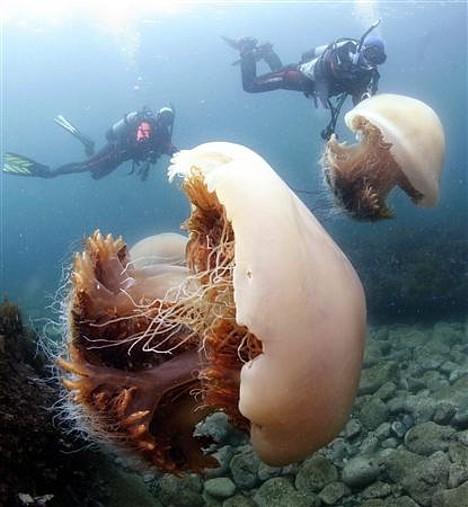
Nomura's jellyfish, 2007 (Photo: Sankei)
Based on what they have seen so far, the researchers warn this year's onslaught of Nomura's jellyfish (Nemopilema nomurai, or Echizen kurage in Japanese) could deliver a massive blow to Japan's fishing industry, rivaling even the devastating 2005 deluge that caused tens of billions of yen (hundreds of millions of dollars) in damage nationwide.
The surveys are being conducted by a team led by Shinichi Ue, a professor of biological oceanography at Hiroshima University who also chairs a government research committee tasked with developing technology to predict and control jellyfish explosions. Ue has been monitoring the population density of Nomura's jellyfish in the southern Yellow Sea and northern East China Sea since 2006.
Between June 20 and 24, 2009, Ue's team observed numerous specimens with umbrellas measuring 10 to 50 centimeters across, and they calculated an average distribution of 2.14 jellyfish per 100 square meters. This figure is more than 200 times higher than the 0.01 jellyfish per 100 square meters observed in the same region in 2008. It is also nearly triple the 0.77 jellyfish per 100 square meters observed in 2007, when the fishing industry in the Sea of Japan suffered widespread damage.
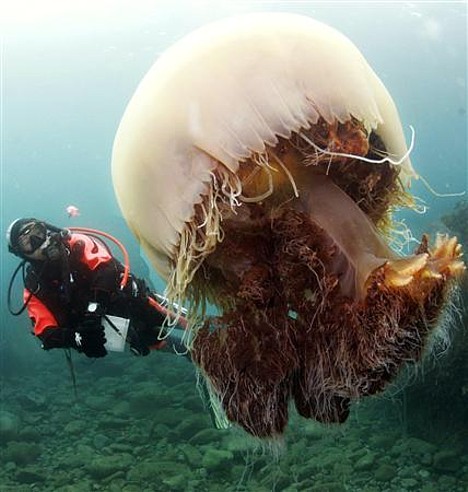
Nomura's jellyfish, 2007 (Photo: Sankei)
To make matters worse, this year's swarms appear to be taking a more direct and southerly route to Japan, unlike in 2007 when the jellyfish appeared to take a more northerly route, approaching the Sea of Japan coast from the direction of Korea. According to the researchers, the ocean currents could bring unprecedented numbers of Nomura's jellyfish to Japan's Pacific coast, which typically sees far fewer of the monster blobs than the Sea of Japan coast.
Nomura's jellyfish typically bloom in Chinese waters in spring, and they mature into adults as ocean currents slowly carry them north. By July, when the first swarms reach Tsushima (just north of the southern island of Kyushu), many jellyfish are as large as sumo wrestlers. At this size, it only takes about 5 or 10 of them to destroy a commercial fishing net.
In addition to damaging nets, the giant jellyfish are blamed for killing other fish with their venom, lowering the quality and quantity of catches, increasing the risk of capsizing trawlers, and stinging fishermen.
In 2005, the fishing industry reported over 100,000 cases of jellyfish-related damage nationwide. At the peak of the invasion that year, an estimated 300 to 500 million monster jellyfish passed through the Tsushima Strait into the Sea of Japan each day.
[Source: Asahi]

Tadpole rain, Hiroshima prefecture, June 15
Over the past few weeks, people in Japan have been witnessing tadpoles, fish and frogs fall from the sky. Ever since the strange phenomenon was first observed in Ishikawa prefecture on June 4, reports of animal rain have been pouring in from prefectures across the country.
So far, nobody has come up with a plausible explanation for the animal rain. Although some people believe the tadpole showers may be the result of weather disturbances such as waterspouts, no meteorological agencies have observed strong wind or unstable weather conditions in any of the areas where the rain has occurred. Others believe birds may be spitting up large quantities of tadpoles, although many ornithologists dispute this claim. Still others have suggested it may be the work of human pranksters, or even extraterrestrials.
Here is a brief timeline of the occurrences reported so far. This page will be updated as new reports emerge.
* * * * *
June 4, Ishikawa prefecture -- At 4:30 PM in the town of Nanao, witnesses discovered approximately 100 dead tadpoles in a 300 square meter area in and around the parking lot outside the Nakajima Civic Center. Witnesses described hearing a strange sound outside before finding the tadpoles.

Tadpoles on car windshield, Ishikawa prefecture, June 4
June 6, Ishikawa prefecture -- At 7:00 AM in the town of Hakusan, a 75-year-old resident found a handful of tadpole carcasses on the hood of her car. More were found scattered in nearby yards and parking lots.
June 9, Ishikawa prefecture -- In the town of Nakanoto, a number of small fish were found scattered over a residential area. About 10 fish recovered from roadsides and the tops of cars appeared to be Crucian carp measuring 3 to 5 centimeters long.


Crucian carp, Ishikawa prefecture, June 9
June 13, Iwate prefecture -- At about 6:00 PM in the town of Shiwa, a 67-year-old farmer was tending her field when she heard what sounded like hailstones hitting the ground around her. She found 15 tadpole carcasses. The local meteorological agency reported the weather was calm at the time, and a local ornithologist said he found it improbable that birds dropped them.
June 15, Nagano prefecture -- In the morning, about 40 tadpole carcasses were found on the premises of an elementary school in the town of Suzaka.
June 15, Hiroshima prefecture -- At 8:30 AM in the town of Miyoshi, a 60-year-old resident found the carcasses of 13 tadpoles and one frog scattered in the yard and on the roof of her home. (See photo above.)
June 15, Miyagi prefecture -- At about 5:00 PM in the town of Taiwa, a 74-year-old resident heard what sounded like rain outside her home. She stepped outside to find about 50 tadpoles scattered in the yard and on the roof. The tadpoles were wet, but none of them were alive. According to the woman, the sky was clear and there was no wind. She saw no birds in the sky.


Left: Miyagi prefecture, June 15 // Right: Iwate prefecture, June 17
June 16, Aichi prefecture -- At around 8:00 AM, a 45-year-old company employee was driving through the town of Chiryu on his way to work, when he heard the sound of something pelting the roof of his car. When he arrived at work, he found 25 tadpole carcasses, each about 5 centimeters long, splattered on the top and sides of his vehicle.

Aichi prefecture, June 16
Some of the tadpoles were bloody and looked as if they had fallen from a great height. According to the man, there were no tall buildings nearby and the sky was clear. "At first I though birds had crapped on my car," he said. "I was surprised to find tadpoles."
June 16, Saitama prefecture -- At 1:00 PM in the town of Kuki, a 77-year-old man reportedly found over 20 carcasses of tadpoles and small fish in his yard. The man lives about 1 kilometer away from a patch of woods where crows roost. He believes the birds dropped the tadpoles and fish in his yard.

Saitama prefecture, June 16
June 16, Miyagi prefecture -- At around 4:00 PM in the town of Osaki, a 54-year-old resident reportedly found about 20 carcasses of tadpoles and small fish in her yard.
June 17, Iwate prefecture -- At 5:00 AM, while walking to his rice field, a 66-year-old farmer in the town of Yahaba heard what sounded like large raindrops hitting the ground around him. He found about 30 tadpole carcasses, each about 3 to 4 centimeters long, on the road. Most of them appeared crushed, as if they had fallen a great distance. He spotted a crow flying in the sky above, but he doubts the bird dropped the tadpoles. He said there was no wind at the time. (See photo above.)
June 17, Fukui prefecture -- A 67-year-old resident of the town of Sabae found about 40 tadpole carcasses outside her home in the morning. The tadpoles, which measured about 3 to 4 centimeters long, were moist. Some of them were crushed and bleeding. The weather had been fine, and the woman reportedly heard nothing strange the night before.

Fukui prefecture, June 17
June 17, Toyama prefecture -- At 8:40 AM in the town of Asahi, a 59-year-old company worker found about 30 tadpoles scattered on the road in front of his home. The tadpoles measured about 3 centimeters long and had begun to develop legs. The weather was calm and partly cloudy, making it unlikely they were swept up in a gust of wind. A local biologist says that the tadpoles may have died from dehydration after venturing out from a nearby rice field. The man believes they may have been dropped by crows.

Toyama prefecture, June 17
June 17, Akita prefecture -- At 10:30 AM in the town of Ugo, a 37-year-old candy shop manager found about 70 tadpole carcasses in yards and on the streets near her store. Most of the tadpoles, which measured about 2 to 3 centimeters long, appeared crushed. The shop is located in a residential area near rice fields and a river. She blames birds.

Akita prefecture, June 17
June 17, Kagoshima prefecture -- While taking an evening walk, a 58-year-old company employee in the town of Isa came across about 20 tadpole carcasses in the street. According to the man, there were rice paddies nearby, but the road was dry.
* * * * *
Saitama prefecture, late May -- In a loosely related story, an employee at a nursing home in the town of Sakado found a mummified snake on a wooden deck outside the facility one morning. The mummy, which measures about 30 centimeters long and appears to be the dried remains of a baby Japanese striped snake or Japanese rat snake, is coiled up in a strike pose.

Mysterious mummified snake, Saitama prefecture
It is unclear where the snake came from and how it made its way to the nursing home, although it appears to have fallen from the sky (perhaps it was dropped by a bird). The employee, who believes the unusual find is a sign of good luck, put the snake mummy on display in a glass case in the lobby. However, he was forced to remove it after some residents complained.
* * * * *
June 17, Niigata prefecture -- In the city of Niigata, a 14-year-old student returning home from school in the evening found 25 dead tadpoles on a residential street, not far from an irrigation channel and rice fields. The carcasses, which were dry and flat, measured 2 to 5 centimeters long.


Left: Tadpole rain in Niigata (June 17) // Right: Tottori (June 18)
June 18, Tottori prefecture -- Early in the morning in the town of Yonago, a 48-year-old resident found 30 tadpole carcasses scattered atop a section of a 5-meter-wide seaside retaining wall. The tadpoles, some of which had begun to develop legs, measured 2 to 4 centimeters long. According to the local weather agency, the maximum wind speed at the time was 3 meters/sec (6.7 mph) and conditions were not favorable for the development of waterspouts. A local biologist claimed it was unlikely that a bird scattered that many tadpoles along the wall.
June 18, Niigata prefecture -- At around 2:00 PM, a 63-year-old resident of the town of Nagaoka found about 50 carcasses of tadpoles, frogs, dragonfly nymphs and small fish in the street in front of his apartment building. The tadpoles were described as being in a half-dried state. One tadpole was also found on the roof of the apartment building, which is located in the center of town.
* * * * *
June 23, Fukushima prefecture -- At 10:30 AM on a clear, windless morning in the town of Aizu-Wakamatsu, two bicycle shop employees heard a loud thud outside their store. When they stepped out to investigate, they found a 35-centimeter-long catfish on the ground next to a parked minivan. The catfish appeared to have struck the vehicle, leaving a smear of mucus and mud on its left-hand side. The witnesses, whose shop is located nowhere near a catfish-populated river, do not believe it is the work of a human prankster. They suspect a bird may have dropped the catfish.
* * * * *
June 24, Yamaguchi prefecture -- At 6:00 AM, a 68-year-old resident of the town of Shunan heard the sound of something striking the roof of her home. When she stepped outside to investigate, she found about 20 wet tadpole carcasses on the ground and on the roof. The tadpoles each measured 3 to 4 centimeters long and were beginning to develop legs.
June 24, Yamagata prefecture -- At 4:30 PM, a 34-year-old piano instructor in the town of Shinjo discovered about 40 wet tadpole carcasses in her yard, just as she was leaving to walk her dog. The woman noticed the tadpoles after the dog started sniffing excitedly at the ground outside. She found a wet tadpole stuck to the dog's nose. The tadpoles, many of which appeared crushed, had not been in her yard two hours earlier.


Left: Yamaguchi prefecture, June 24 // Right: Aomori prefecture, July 1
July 1, Aomori prefecture -- A 29-year-old resident of the town of Rokunohe found about 40 tadpole carcasses scattered in the parking lot next to her apartment building. The tadpoles measured 2 to 5 centimeters long, and many of them appeared squashed. Several more were later found on the roof of the building.
* * * * *

Froglets scattered on rural road, Oita prefecture, July 7
July 7, Oita prefecture -- The bodies of more than 600 tadpoles and froglets were found scattered along a 100-meter stretch of rural road near the town of Kusu. A 69-year-old farmer discovered the carcasses while on the way to check his rice fields in the morning. According to the farmer, who noticed nothing unusual on the road the night before, the irrigation channels and rice paddies near the road contain no water, implying that the froglets may have come from elsewhere.
[Compiled from multiple sources via Google News]
* Last update: July 9, 2009. More updates to follow.
= = = = = = = = = = = = = = = = = = = = = = = = = = = = = =
* Read -- UPDATE: Tadpole rain in Japan
= = = = = = = = = = = = = = = = = = = = = = = = = = = = = =
As rainy season approaches, Japan's Ishikawa prefecture has been receiving some unusual precipitation -- it's been raining tadpoles.

According to prefecture officials, tadpoles have reportedly fallen from the sky in two separate towns this month. Although it is not unheard of for waterspouts and strong wind to to pull small fish and animals from water and drop them on land, no foul weather has been observed in the area, leaving residents baffled.
The first reported case of anomalous tadpole rain occurred at about 4:30 PM on June 4 in the town of Nanao. After hearing a strange sound outside the Nakajima Civic Center, witnesses discovered approximately 100 dead tadpoles in a 300 square meter area in and around the parking lot. The tadpoles measured 2 to 3 centimeters long.
Tadpoles on car windshield outside Nakajima Civic Center
Dozens more tadpoles reportedly fell on the nearby town of Hakusan in the early morning hours of June 6, according to local officials. One 75-year-old resident described finding a handful of tadpoles on the hood of her car at around 7:00 AM. Others were found scattered in nearby yards and parking lots. A strange sound was reportedly heard in the middle of the night, even though no wind or rain was observed.
According to Kanazawa Meteorological Observatory officials, the two towns -- which are dotted with rice fields -- experienced stable weather during the period in question and the conditions were not favorable for the development of waterspouts.
"I've never seen anything like this before," said one meteorologist. "We have no idea what caused it."
[Source: Sankei]
UPDATE: Asahi is reporting that more freak animal rain may have fallen in Ishikawa prefecture, only this time it is fish.
Crucian carp believed to have fallen from the sky in Ishikawa prefecture
On the evening of June 9 in the town of Nakanoto located about 15 kilometers from Nanao (where it rained tadpoles on June 4), a number of small fish were found scattered over a residential area. About 10 fish recovered from roadsides and the tops of cars appear to be Crucian carp measuring 3 to 5 centimeters long.

Here is some provocative video of a mysterious creature encountered by Japanese fishermen on a rocky seashore.
The excitement begins when the three men notice a group of strange animals on the side of a nearby cliff. Curious, they approach for a closer look and eventually manage to corner one. (The close encounter begins at 1:45 into the video.)
The slimy, pulsating beast -- like something out of a Cronenberg film -- appears to be some sort of amphibious sea animal that ventured ashore. After poking and prodding the creature with a stick and flipping it over to reveal an undulating, sphincter-like orifice, one of the men rashly -- and unwisely -- decides to give it a swig of his carbonated beverage. You don't want to miss the explosive conclusion.
Is this a bizarre new species? Alien creature? Spectacular hoax? You be the judge.
Poor planning? Engineering gone wrong? Unconventional street decor? Whatever the explanation, this quiet residential street in Tokyo's Setagaya ward boasts perhaps the highest manhole density in town, with 85 of them scattered along a 200-meter stretch of pavement. Fans of the curious street call it "Manhole Ginza."
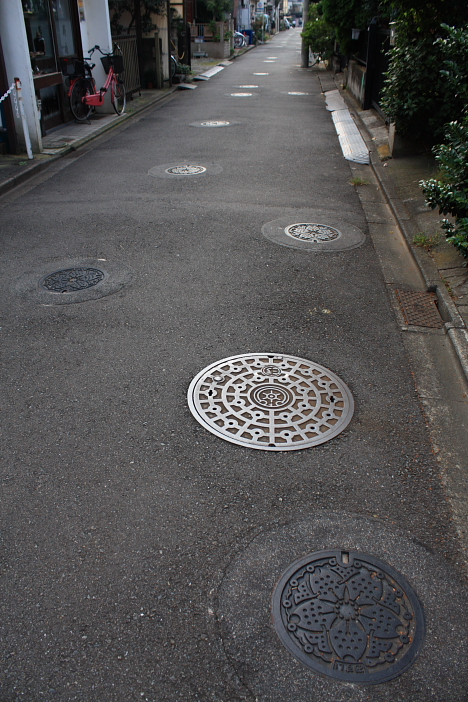
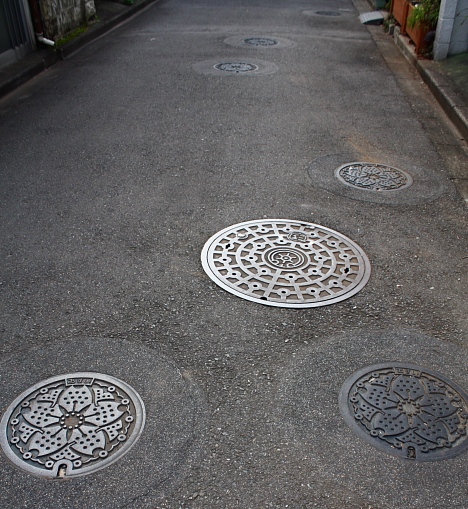
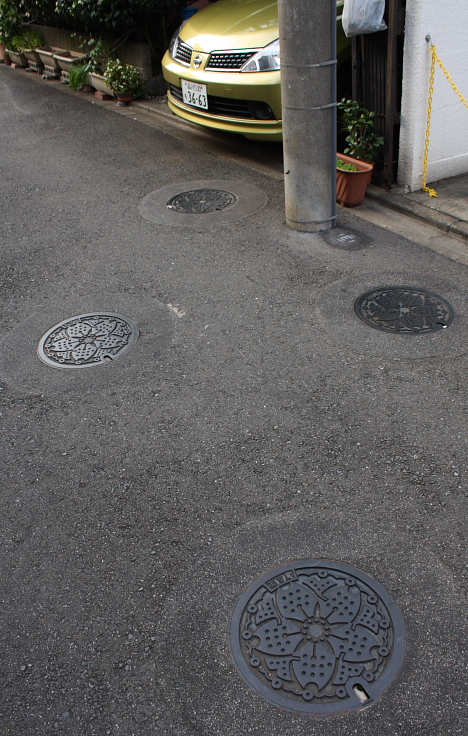
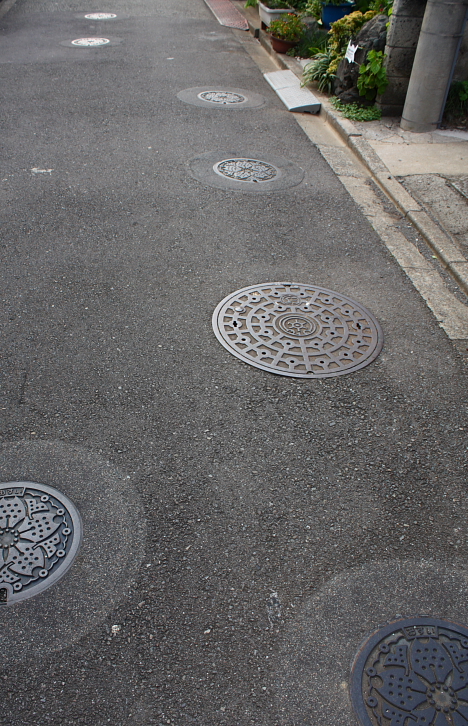
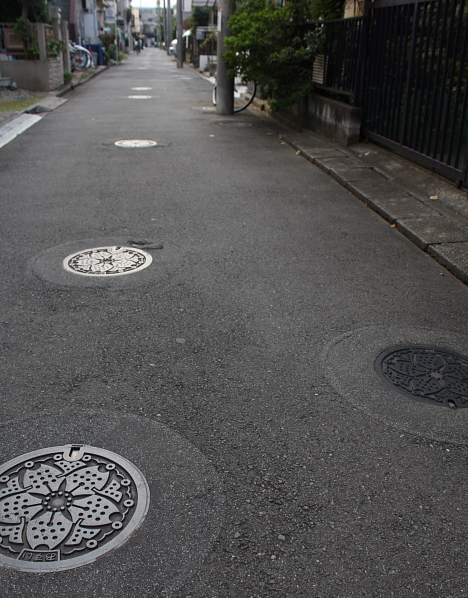
[Link: Google Maps]
Related: Japanese manhole covers
One day after a wild Japanese macaque caused a commotion at Tokyo's Shibuya station and escaped back into the streets, police have received multiple reports of monkey sightings in the area.
According to this TBS video news report, which refers to the search effort as "Operation Capture Monkey," the Japanese macaque was observed at various locations in the Harajuku/Omotesando area near Shibuya early this morning. Police armed with nets roamed the streets of Omotesando after at least one person reported seeing the monkey climbing a pink building. Others reportedly witnessed it scurrying across power lines. In addition to the sightings, a local resident found tomatoes and eggplants missing from his garden. He believes the monkey was responsible.

***UPDATE: The monkey has been spotted in the Omotesando area.***
Police in Tokyo are on the lookout for a wild monkey on the loose in the Shibuya area. The monkey -- identified as a Japanese macaque -- was spotted inside Shibuya station this morning (August 20), much to the surprise of morning commuters. (Watch an NNN news report.)
According to the Tokyu Corporation, which operates the Tokyu Toyoko line at Shibuya station, a security officer spotted the monkey climbing around inside the station at 9:45 AM. When the monkey perched itself on a sign, police and station employees tried unsuccessfully to trap it with nets.

After an hours-long standoff, the monkey made a run for it through the crowded station. Police and curious onlookers took chase, but the monkey eluded them by crossing a busy street and climbing up along the Yamanote line tracks. Its whereabouts are now unknown.
City officials say there has been a rise in Tokyo-area monkey sightings in recent weeks. A monkey was spotted in Koganei on August 12, and sightings were reported at three locations in Setagaya ward on August 18.
[Source: Yahoo!]
ADDED: At least one eyewitness captured the chaotic scene on cellphone video...
...and here's some pretty amazing eyewitness video of the panic that ensues when the monkey makes a run for it...
...and AP has some clean, raw footage as well...

One of the world's rarest fungi, an exotic star-shaped mushroom known to exist at only three locations on Earth, has been discovered in the mountains of Nara prefecture.
The Devil's Cigar (a.k.a. "Texas Star") -- known to botanists as Chorioactis geaster -- had been observed only in central Texas and at two remote locations in Japan prior to the recent discovery in Nara. The peculiar fungus is described as a dark brown cigar-shaped capsule that transforms into a tan-colored star when it splits open to release its spores. It is also one of only a few known fungi that produce an audible hiss when releasing spores.
First reported in 1893 in Austin, Texas, the curious mushroom appears in a limited area of central Texas each year, and until now, the rare sightings in Japan have occurred in forests in Miyazaki and Kochi prefectures. The fungus is included on the red list of threatened species published by Japan's Environment Ministry.
The recent Nara discovery was made by Masakuni Kimura, curator of a natural history museum in the town of Kawakami (Nara prefecture). Kimura first encountered Devil's Cigars in October 2006 while surveying a forest near Kawakami, where he found 12 of them growing from a dead oak tree next to a mountain stream at an elevation of 470 meters (about 1,550 ft). Nearly a year later, in September 2007, he discovered four more of the mushrooms when he returned to the site with Shuichi Kurogi, curator of the Miyazaki Prefectural Museum of Nature and History. Their findings were presented at a recent meeting of the Mycological Society of Japan.
The site of the Nara discovery, like the previous Miyazaki and Kochi sites, is located in a humid forest. At all three sites, the Devil's Cigars were observed growing on dead oak trees near a stream.

Texas Star, the state fungus of Texas?!
In central Texas (which is located at approximately the same latitude as southern Japan), the rare fungus appears during fall and winter, growing from the stumps and dead roots of cedar elm trees.
Tsuyoshi Hosoya, head botanist at Japan's National Science Museum, says, "The DNA of the Devil's Cigar from Miyazaki is consistent with the one from Texas. They are regarded as the same species."
While it is unknown how this exceedingly rare mushroom came to appear only in Japan and central Texas, one intriguing theory suggests that spores from Japan were swept up in an Asian dust cloud and carried across the globe.
[Sources: Sankei, SAS via Watashi to Tokyo]