
+ Video
By fading back and forth between scenes of pre- and post-quake Tokyo, this time-lapse video by YouTube user darwinfish105 shows how the metropolitan nightscape has been affected by Japan's ongoing power shortages and conservation efforts.
+ Video
By fading back and forth between scenes of pre- and post-quake Tokyo, this time-lapse video by YouTube user darwinfish105 shows how the metropolitan nightscape has been affected by Japan's ongoing power shortages and conservation efforts.
In November 1855, the Great Ansei Earthquake struck the city of Edo (now Tokyo), claiming 7,000 lives and inflicting widespread damage. Within days, a new type of color woodblock print known as namazu-e (lit. "catfish pictures") became popular among the residents of the shaken city. These prints featured depictions of mythical giant catfish (namazu) who, according to popular legend, caused earthquakes by thrashing about in their underground lairs. In addition to providing humor and social commentary, many prints claimed to offer protection from future earthquakes.

1. Earthquake victims take revenge on the giant catfish responsible for the destruction [+]
The popularity of namazu-e exploded, and as many as 400 different types became available within weeks. However, the namazu-e phenomenon abruptly ended two months later when the Tokugawa government, which ordinarily maintained a strict system of censorship over the publishing industry, cracked down on production. Only a handful are known to survive today.
* * * * *

2. Namazu and the kaname-ishi rock [+]
Namazu are normally kept under control by the god Kashima using a large rock known as kaname-ishi. The Great Ansei Earthquake of 1855 is said to have occurred when Kashima went out of town and left Ebisu (god of fishing and commerce) in charge. In this print, the giant subterranean catfish unleashes destruction on the city while Ebisu sleeps on the job. Kashima rushes home on horseback while the city burns, and Raijin the thunder god defecates drums. Large gold coins fall from the sky, symbolizing the redistribution of wealth during the rebuilding phase.
* * * * *

3. Tug-of-war between namazu and the god Kashima [+]
This print shows a namazu engaged in a fierce game of "neck tug-of-war" with the god Kashima. A group of earthquake victims root for Kashima, while those who typically profit from earthquakes (construction workers, firemen, news publishers, etc.) root for the catfish.
* * * * *

4. Ancient catfish (Artists: Kyosai Kawanabe and Robun Kanagaki)
Produced two days after the earthquake, this work by Kyosai Kawanabe and Robun Kanagaki is considered the first namazu-e catfish print. The picture, which makes reference to a popular kabuki play of the era, inspired the creation of many namazu-e prints to follow.
* * * * *
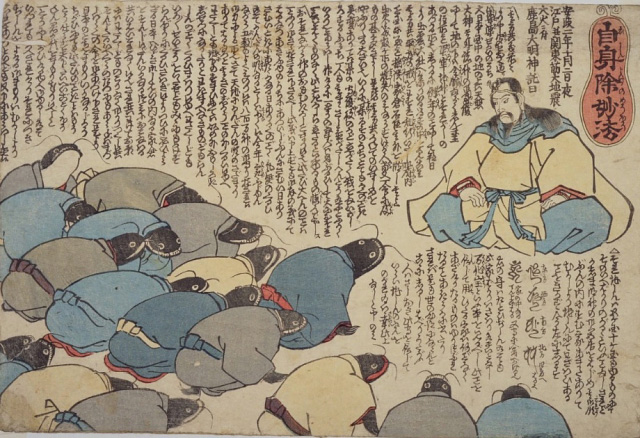
5. Magical method of earthquake protection [+]
This protective print, which claims to prevent earthquake damage to one's home if attached to the ceiling, shows a group of remorseful catfish apologizing to the god Kashima for causing earthquakes while he was away.
* * * * *

6. Catfish family
This print shows a mob of earthquake victims coming to take revenge on a namazu and its children.
* * * * *

7. For peace and tranquility [+]
In this print, which claims to offer protection from earthquakes, the god Kashima and prostitutes from the Yoshiwara red-light district express their anger toward the catfish responsible for earthquakes.
* * * * *

8. Namazu saviors
Some prints show the benevolent side of namazu. Here, they are seen rescuing people from the rubble.
* * * * *

9. Daikoku, the popular god of wealth, restrains a namazu and showers people with money [+]
* * * * *

10. Kashima restrains a namazu using the kaname-ishi rock
* * * * *

11. Kashima, kaname-ishi, and namazu [+]
In this print, the god Kashima is pictured in the top right corner. The kaname-ishi rock, portrayed as a person, stands on the head of the catfish, while a crowd of people try to subdue the giant beast. The people on the left who are not helping subdue the catfish include construction workers and others who typically profit from earthquakes.
* * * * *

12. Earthquake hand game
This print is a reference to the old Japanese saying, "The most frightening things are earthquakes, thunder, fires, and fathers." Here, a namazu plays janken (paper-rock-scissors) with the gods of thunder and fire while an elderly man (father) looks on.
* * * * *

13. Earthquakes, thunder, fires and fathers [+]
This print also makes reference to the old Japanese saying, "The most frightening things are earthquakes, thunder, fires, and fathers." Here, a namazu and the gods of thunder and fire discuss their powers over a fish dinner while a middle-aged man (father) looks on.
* * * * *

14. Tipsiness following the great namazu [+]
In this print, the god Kashima stabs his sword into the throat of the namazu, which is laid out on a giant table. The crowd of onlookers is divided into two groups. The people in the top half of the picture are labeled as "smiling" (those who benefit from the earthquake) and the people at the bottom are labeled as "weeping" (those who are harmed by the earthquake). The top group includes a carpenter, a plasterer, a lumber salesman, a blacksmith and a roofer, as well as an elite courtesan, an ordinary prostitute, a physician, and sellers of ready-to-eat foods. The bottom group includes a teahouse proprietor, an eel seller, various entertainers such as musicians, comedians and storytellers, a seller of luxury goods, a diamond seller, and a seller of imported goods.
* * * * *

15. Prosperity of the Ansei era [+]
This print, which shows a namazu punishing a rich man and a famous actor, illustrates a popular theory that the gods deliberately allowed the earthquake to happen in order to rectify some of the imbalances in the world.
* * * * *

16. Namazu attacked by the citizens of Edo [+]
* * * * *

17. Catfish and construction workers partying in the Yoshiwara red-light district, pt. 1 [+]
This print depicts a crowd of namazu and newly prosperous construction workers living it up at a parlor house in the Yoshiwara pleasure district.
* * * * *

18. Catfish and construction workers partying in the Yoshiwara red-light district, pt. 2 [+]
This print also shows carpenters, plasterers and roofers drinking and making merry in the Yoshiwara pleasure district while a namazu is restrained with a gourd.
* * * * *

19. The earthquake and a "million prayers" [+]
This print depicts a namazu as a priest seated inside a giant rosary. The creature does not want to cause any more earthquakes, but the "worshipers" -- tradesmen such as lumber dealers and carpenters who profit from the disaster -- are praying for it to act up again. The ghosts of earthquake victims float overhead.
* * * * *

20. Earthquake catfish and world rectification [+]
In this print, a group of construction workers pay respect to the namazu for helping them strike it rich.
* * * * *

21. The shaking of greater Edo [+]
This print shows a massive steamship-like namazu approaching the city. The creature is spouting money, and people on shore beckon for it to come closer. The depiction of this namazu conjures up images of Commodore Perry's black ships, which arrived in Japan in 1853 and eventually forced the country to open its ports to Western commerce.
* * * * *

22. The perpetrators of three big quakes captured alive [+]
In this print, the god Kashima has captured the catfish responsible for the major earthquakes in Shinshu, Edo, and Odawara. A carpenter, fireman, plasterer and roofer try to persuade the god to release the catfish, saying the creatures have apologized enough. The unforgiving Kashima sentences the fish to be cooked in a nabe stew.
* * * * *

23. Namazu of Edo and Shinshu
* * * * *
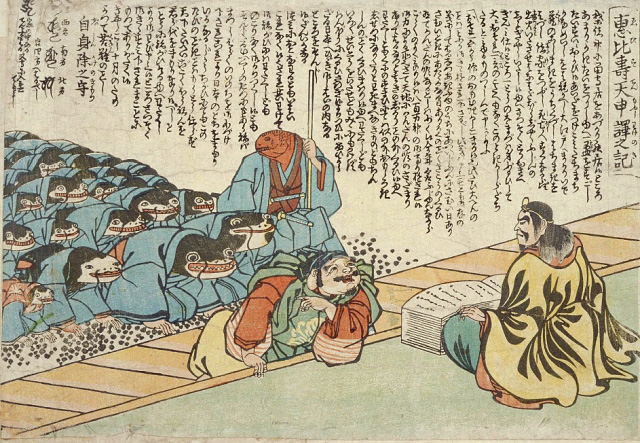
24. Ebisu apologizes [+]
In this print, Ebisu (god of fishing and commerce) apologizes to Kashima for falling asleep on the job after drinking. The catfish leader is also apologizing, saying it was the thoughtless ones that went wild.
* * * * *

25. Peace in the Ansei era
This print shows the god Kashima using the kaname-ishi to subdue the namazu responsible for the recent earthquakes.
* * * * *

26. Namazu is wrestled into submission and placed under the kaname-ishi rock [+]
* * * * *

27. Ridgepole raising
This print shows a group of namazu construction workers erecting the kanji character 平 (hira), which can symbolize "peace."
* * * * *

28. A man entertains a namazu [+]
* * * * *

29. People inspect a namazu picture
* * * * *

30. Monster namazu in the storehouse [+]
* * * * *

31. Gourd and catfish
In this print, a namazu tries to help a comrade escape from a trap by handing it a gourd. The image is a reference to the old Japanese expression "gourd and catfish" (meaning "slippery" or "elusive"), which originates from a famous 15th-century Zen painting of a man trying to catch a catfish with a gourd.
* * * * *

32. Mob takes revenge on a namazu [+]
* * * * *

33. Catching a catfish with a gourd (Artist: Kunisada Utagawa) [+]
* * * * *

34. People who profit from earthquakes make offerings to a namazu [+]
* * * * *

35. Fear of Kashima
This print shows people dancing around a namazu dressed as a representative of Kashima shrine in an annual ritual held before the start of the new agricultural season. The image of the rabbit represents the zodiac year of the rabbit (1855).
* * * * *

36. Reassurance of the quake-suppressing rock [+]
A crowd of elderly people, carpenters, young wives, china-shop owners, entertainers, Yoshiwara prostitutes, physicians, and others are offering prayers to the kaname-ishi rock, believed to have the power to keep earthquakes in check. When a person in the crowd voices his doubts about the rock's powers, the rock responds, "I assure you that if the earth moves even a little I will stand on my head." In the original Japanese, this answer features a pun on the words ishi-gaeshi ("overturning a rock") and ishu-gaeshi ("taking revenge").
* * * * *

37. Earthquake protection song
In this print, Daikoku, the popular god of wealth, showers people with money while the god Kashima restrains a namazu.
* * * * *

38. Frightened namazu [+]
This print shows a mother namazu chasing a mob of people who have kidnapped her two children. The message on the flag carried by a person in the crowd suggests they intend to grill and eat the young catfish.
* * * * *

39. Namazu with construction tools, portrayed as the legendary warrior Benkei
* * * * *

40. The god Ebisu restrains a giant catfish with a gourd [+]
World Order -- the celebrated music/dance performance group led by former martial artist Genki Sudo -- has released a fabulously choreographed video for the track "Machine Civilization," along with some words of hope following the recent devastation in Japan.
+ Video
Sudo's message in the YouTube video description:
The unprecedented disasters unfolding in Japan; earthquakes, tsunami, and nuclear explosions, will somehow change things to come. And to send my message about this, I have expressed it here with WORLD ORDER.
These disasters can be interpreted as a turning point for civilization. I think that we have arrived at a time of revolution, shared with all the people of the world, in today's society, economy, and political systems.
Incidents themselves are neutral. I believe that every single one of us, wandering through this deep darkness, can overcome anything, if only we let go of our fear, and face the it all in a positive light.
The world is not going to change. Each one of us will change. And if we do, then yes, the world will be changed. It is darkest right before the dawn. Let's all rise up to welcome the morning that will be so very bright for mankind.
In Tokyo and surrounding areas, signs of electricity conservation are visible everywhere. Rolling blackouts are in effect, train services have been scaled back, stores and businesses are using fewer lights, advertising signs and escalators have been switched off, and even some pachinko parlors have cut their hours of operation. On Twitter, a community of graphic designers has sprung up to create posters encouraging people to save power. Residents of eastern Japan are encouraged to print them out and post them where they live and work. [Link: Setsuden via GaijinPot]

Everyone save electricity

Please cooperate in conserving electricity

Save power and carry on

Let's conserve electricity! Switch OFF!

Turn OFF the power. Now anybody can be Santa.

Power saving!

The amount you turn off will light someone else up.
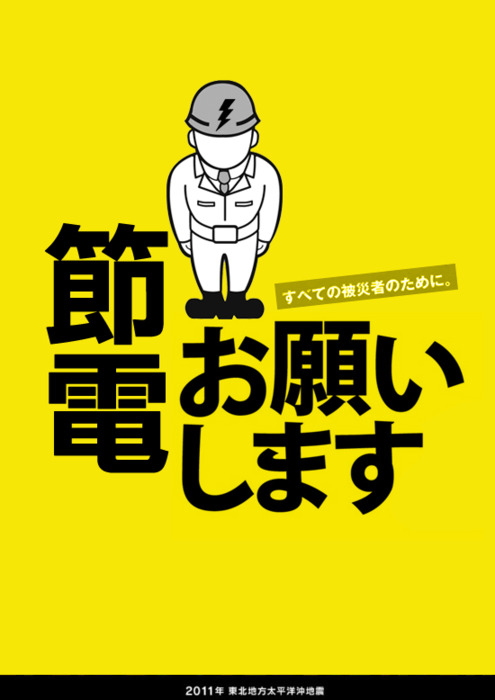
Please conserve electricity.

Save electricity. Save somebody.

Save electricity. Switch off.

The light you turn off will light up a smile.

Now conserving power

The quickest aid you can provide now is electricity.

Saving energy & open for business

Open for business in power saving mode!

Conserve electricity to prevent massive power failures!
Hello all. Many thanks to those of you who have offered kind words of support and encouragement over the past week. Recent events in Japan have gotten in the way of blogging lately, but we are safe and sound in Tokyo and life is slowly returning to normal. Look forward to more updates here soon.

Japan is in our hearts -- Artist: Josh Geiser
In the meantime, if you would like to support the ongoing disaster relief efforts, please consider making a much-needed donation to the Red Cross Japan Earthquake and Tsunami Fund. (Small contributions are appreciated, and credit card payments are accepted.)
You can also help by purchasing any of the Japan Earthquake Relief prints by underground artists at the Poster Cause Project. 75% of profits from these prints will be donated to the Doctors Without Borders' earthquake and relief efforts in Japan.

Artist: Saner

Artist: Brent Nolasco

Artist: Oliver Kroa Cramm

Artist: SCARECROWOVEN

Artist: Joe Iurato
[Link: Japan Earthquake Relief Prints]
Local gas companies occasionally add a touch of character to the giant spherical gas containers that dot the landscape of Japan. Here are a few examples.

Nicotan (mascot of Shibata Gas) -- Shibata, Niigata prefecture [via]

Watermelon -- Tomisato, Chiba prefecture [via]

Hikari-chan and Gatto-kun -- Niigata [via]

Zen monk-poet Ryōkan -- Tsubame, Niigata prefecture [via]

Soccer ball -- Kiryū, Gunma prefecture [via]

Tokkikki (Niigata prefectural mascots) -- Niigata [via]

Ōnyūdō -- Yokkaichi, Mie prefecture

Peach -- Akaiwa, Okayama prefecture [via]

Ouchi dolls -- Yamaguchi prefecture [via]

Welcome to Isesaki -- Gunma prefecture [via]

"Taisha" wheeled fish toy -- Niigata [via]

Morioka Gas character dancing the Sansa Odori -- Morioka, Iwate prefecture [via]


Bunbuku Chagama tanuki -- Gunma prefecture [via] // Origami cranes -- Mie prefecture [via]

Japanese irises -- Niigata [via]

Watermelon -- Takizawa, Iwate prefecture [via]

Godai-chan (tourism mascot for the city of Kashihara) -- Nara prefecture [via]

Kōfu, Yamanashi prefecture [via]

Kintarō -- Saitama [via]

Flowers and butterflies -- Niigata prefecture [via]

Artist's conception of Nintendo Kirby tanks [via]
50 Watts (formerly "A Journey Round My Skull") has posted a splendid assortment of 1970s and 1980s Japanese sci-fi art from old illustration books and catalogs. [More]

Pater Sato magazine cover

Hitoshi Ikematsu book jacket illustration, 1984

Noriyoshi Ohrai

Black Space -- Shuji Tanase, 1982

Atsushi Yoshioka
The Kaibutsu Ehon ("Illustrated Book of Monsters") is an 1881 book featuring woodblock prints of yōkai, or creatures from Japanese folklore. Illustrated by painter Nabeta Gyokuei, the book is modeled after the influential works of Toriyama Sekien, an 18th-century scholar and ukiyo-e artist known for his attempt to catalog the many species of yōkai in Japan. Here are 25 monsters from the book.

Mikoshi-nyūdō -- Monk-like creature that grows taller the more you look at it

Nue -- Chimera-like bringer of misfortune that can fly and morph into a dark cloud

Futsukeshibaba (a.k.a. Hikeshibaba) -- Mysterious old woman in white who extinguishes lanterns

Kasha -- Cat-like demon that descends from the sky to feed on corpses before cremation

Noderabō -- Strange creature standing near a temple bell

Waraime (a.k.a. Kerakera-onna) -- Giant cackling woman

Daibutsu-kaibutsu -- Mysterious pile of crumbling skulls
Argentina-based artist Juan Molinet has created a series of fictional Japanese ads featuring retro-style characters.

Osaka's Marshmellow Kid

Nagoya Sweet Salami Co.

Sumitomo Calamari Ice Cream

Cheesus by Hokama Good Cheese Co.

Kyoto Seafood Processing Co.

Satoyama Whistle Co.

Hokaido Industrial Sushi Food Co.
[Link]


