Japanese researchers have grown the first-ever fully functional bioengineered tooth inside the mouth of a mouse.
Grow new teeth - Mouse shows off bioengineered molar (glowing green)
The bioengineered tooth, which was grown in place of a lost molar, has the same properties of the old tooth and is strong enough to allow the mouse to chew food normally.
To create the new tooth, the researchers -- led by Tokyo University of Science professor Takashi Tsuji -- took epithelial cells and mesenchymal cells (about 50,000 each) from a mouse embryo and cultivated them together in a collagen-based medium to create a tiny tooth bud -- a mass of tissue that has the potential to develop into a tooth.
They then implanted the 0.5-mm tooth bud into the jawbone of an adult mouse in place of a lost tooth. After 37 days, a new tooth sprouted, and after 50 days, it had grown to the same height as the adjacent teeth. The bioengineered tooth has the same hardness as ordinary teeth and it contains blood vessels and nerves, making it sensitive to external stimuli and pain, according to the researchers.
This research is expected to advance the development of "tooth regenerative therapy," which may one day allow doctors to replace diseased or damaged teeth with bioengineered teeth grown from stem cells such as induced pluripotent stem (iPS) cells. This type of treatment could ultimately eliminate the need for dentures and false teeth.
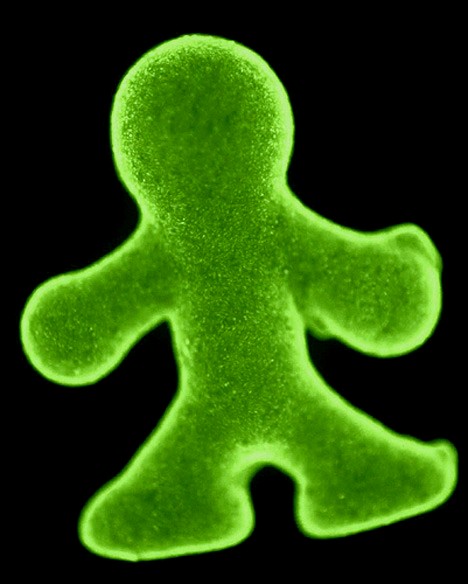
To demonstrate a new method for fabricating three-dimensional living biological structures, researchers at the University of Tokyo's Institute of Industrial Science (IIS) have created a 5-millimeter tall doll composed of living cells.
According to an announcement made on January 22, the researchers created the tiny figurine by cultivating 100,000 cell capsules -- 0.1-millimeter balls of collagen, each coated with dozens of skin cells -- together inside a doll-shaped mold for one day. After the cell capsules had coalesced to form the doll-shaped mass of tissue, it was placed in a culture solution, where it reportedly survived for more than a day.
The researchers, led by IIS professor Shoji Takeuchi, also successfully tested the biofabrication method with human liver cells. According to Takeuchi, the technique can be used to create bodily organs and tissues with complex cellular structures, which may prove useful in the fields of regenerative medicine and drug development.
"The overall shape can be controlled by changing the mold," said Takeuchi, who expressed a desire to combine multiple types of cells to create a complex system that functions as a living organism.
Japanese scientists have successfully cloned a prize beef cow more than 13 years after it died, it was announced on January 6. The legendary steer -- named "Yasufuku" in his first life (1980-1993) -- is regarded as the father of Hida beef, a high-quality meat from Gifu prefecture famous for its marbled texture and rich flavor.
During his 13-year life, the prize bull's sperm was used to sire 40,000 calves, helping to establish Hida as a high-class brand of beef. It is believed that more than 30% of the nation's Japanese black cattle can trace their roots back to Yasufuku.
To produce the clones, researchers from the Gifu Prefectural Livestock Research Institute and Kinki University (Osaka prefecture) employed a somatic cell nuclear transfer method using the nuclei of cells extracted from the bull's testicles, which had spent 13 years in deep-freeze. The first clone of Yasufuku was created in 2007. In all, four clones of Yasufuku have been born, although one died from complications after birth.
The results -- which were scheduled to be published in the US journal PLoS ONE on January 8 -- suggest it is possible to "resurrect" animals valued for their high-quality meat, long after they have died. Some suggest the cloning method can also be used resurrect prize pigs and horses.
Teruhiko Wakayama, the RIKEN genetic engineer who led the effort to clone the frozen mouse last year, reacted to the news of the cloned frozen cow. "I was surprised to learn that the researchers found usable cells in the frozen tissue," said Wakayama. "[Their findings suggest] it is now possible to clone cows from delicious beef found on the supermarket shelf."
News of this latest cloning success comes as the Japanese government grapples with whether or not to allow cloned animal products into the food chain. The Cabinet Office's Food Safety Commission is currently looking at scientific data from a variety of Japanese and foreign sources in an attempt to evaluate the safety of cloned animal products. The commission is scheduled to present its decision to the Ministry of Health, Labor and Welfare later this year. Lawmakers will then have the final say on whether or not to approve the sale of cloned meat to Japanese consumers.
In 2008 (between January and September), researchers in Japan are known to have created 557 somatic cell cow clones. In response to consumer distrust of cloned meat, the Ministry of Agriculture, Forestry and Fisheries (MAFF) currently requests research institutions to take voluntary measures to prevent cloned cows from ending up in the food supply.
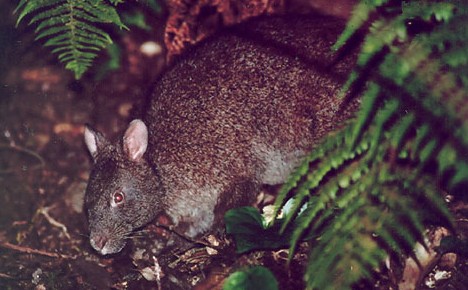
The Amami rabbit -- a threatened species found only in the Ryukyu Islands -- may become Japan's first endangered animal clone. Scientists at Osaka's Kinki University have cloned an embryo of the endangered rabbit and are awaiting its birth next month, it was announced earlier this week.
The Amami rabbit (Pentalagus furnessi) is a nocturnal, forest-dwelling "primitive" rabbit with dark fur, short legs, large curved claws and small ears. Found only on the islands of Amami-Oshima and Toku-no-Shima, it is sometimes called a "living fossil" for its resemblance to ancient rabbits that once inhabited the Asian mainland. The Amami rabbit's dwindling population -- now estimated at between 2,000 and 5,000 -- has earned it a spot on Japan's endangered species list.
To produce the clone, researchers took a cell from the ear of a dead Amami rabbit and injected it into the unfertilized egg of an ordinary lab rabbit. After the egg developed into the cloned embryo, researchers inserted it into the oviduct of a lab rabbit surrogate. The clone will be born in the coming weeks if the pregnancy comes to term. The chances of success are slim, though, as cloning pregnancies typically have a high failure rate. However, the scientists are prepared to repeat the process until a clone is born.
Although some people see cloning as a promising tool for restoring endangered populations when natural breeding is not possible, others argue it is more important to address the actual causes of the population decline. Deforestation and road accidents are major reason for the Amami rabbit's decline, as is the predatory mongoose, which humans released on the islands to control the snake population.
Pet dogs and cats also pose a danger to the species. In June, motion-sensitive cameras set up to monitor Amami rabbit activity on the island of Amami-Oshima captured the image of a feral domestic cat dragging a freshly killed carcass through the forest.
If the experiment succeeds, the Amami rabbit will join a growing list of endangered animals that have been cloned. Previous examples include the Asian gaur (a rare ox native to India and Burma), which died two days after it was born in the US in 2001, as well as the European mouflon (a Mediterranean wild sheep) and the Junqueira cow (Brazil).
Regardless of the outcome, the researchers suggest a degree of caution. Although cloning may potentially be used to preserve rare species, little is known about the long-term environmental impact, they said.
Is the second coming of the woolly mammoth near? Possibly, say researchers at Japan's Institute of Physical and Chemical Research (RIKEN), who have successfully cloned mice from carcasses that spent years in a deep freezer.
A RIKEN research team led by genetic scientist Teruhiko Wakayama successfully demonstrated a promising new cloning technique by replicating frozen laboratory mice whose cells were severely damaged after 16 years in permafrost-like conditions (-20 degrees Celsius). The technique might one day be used to resurrect mammoths and other extinct species, according to the researchers.
Scientists have long discussed the possibility of resurrecting extinct animal species by cloning carcasses preserved in ice, but existing techniques do not work with dead, freeze-damaged cell tissue. However, the RIKEN researchers were able to extract nuclei from the ruptured brain cells of the frozen mice after breaking down the tissue in a culture solution. Then, using the conventional nuclear transfer technique (which involves inserting cellular material from the frozen mice into the egg cells of healthy mice), the researchers created embryonic clones from the extracted brain cell nuclei. After that, the researchers established embryonic stem cell lines from the cloned embryos, which they used to produce four cloned mice.
When the clones reached maturity, they mated with other mice to produce healthy offspring.
Healthy offspring of cloned mice
The ability of clones to reproduce is a promising development for those interested in resurrecting extinct species.
Mammoths top the list of extinct animals that scientists will try to clone, primarily because many preserved specimens have been found buried in ice. In July 2007, a well-preserved frozen baby mammoth discovered in the Siberian Arctic was shipped to researchers in Japan.
"There are many technical challenges involved in resurrecting a mammoth," says Wakayama. "But we have shown that the nuclear transfer method can be used to create healthy clones, even when the animal's cells have been damaged by permafrost-like conditions."
Meanwhile, Kinki University biology professor Akira Iritani is pleased with the development. Iritani, a leading member of the Mammoth Creation Project -- a Japanese organization that aims to resurrect the woolly mammoth by cloning frozen specimens -- estimates as many as 10,000 frozen mammoth specimens lie buried in ice around the world, waiting to be cloned.
Iritani also coordinates the "Pleistocene Park" project, which aims to set up a Jurassic Park-like sanctuary in northern Siberia populated with resurrected mammoths and other creatures that roamed the Earth 20,000 years ago. The envisioned park would cover an area twice the size of Japan and include woolly rhinos, Siberian tigers, steppe lions, giant deer, ancient foxes, and ancestors of the Siberian horse.
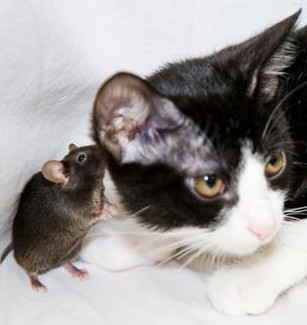
A team of University of Tokyo researchers led by professors Hitoshi Sakano and Ko Kobayakawa have announced they have genetically engineered a mouse that does not fear cats, simply by controlling its sense of smell. By tweaking genes to disable certain functions of the olfactory bulb -- the area of the brain that receives information about smells directly from olfactory receptors in the nose -- the researchers were able to create a "fearless" mouse that does not try to flee when it smells cats, foxes and other predators.
In studying the genetically modified mouse, the researchers have concluded that the evasive behavior exhibited by mammals when they smell predators may be genetically hardwired into the olfactory bulb from birth, and not learned through experience as commonly believed. The research suggests that the mechanism by which mammals determine whether or not to fear another animal they smell -- and whether or not to flee -- is not a higher-order cerebral function. Instead, that decision is made based on a lower-order function that is hardwired into the neural circuitry of the olfactory bulb. However, in other experiments, the researchers demonstrated that mice with impaired olfactory functions can also be taught to fear their predators.
According to Professor Sakano, the research indicates that behavior in the mammalian brain is determined both by instincts coded into the genes and by "associative circuitry" that allows responses to be learned through the environment.
The results of the research, which are to be published in the November 8 online edition of the British science journal Nature, are expected to help scientists better understand the structure of the brain's neural circuitry responsible for processing information about the outside world.
On October 3, a team of American and Japanese researchers from the Audubon Center for Research of Endangered Species (New Orleans) and the Kato Ladies Clinic (Tokyo) announced success in producing what they are calling the world's first kittens born from the frozen egg cells of a domestic cat, thanks to a special method of cryopreservation. Feline ova have long proved difficult to freeze properly because of their high fat content.
The breakthrough is expected to help protect endangered and threatened cat species, say the researchers, who obtained a total of 28 egg cells from ovaries removed from a female pet cat undergoing a desexing operation. After preserving the eggs through vitrification -- a rapid cooling technique that prevents the fluid inside the eggs from forming into ice -- and placing them in cold storage for 3 weeks, the researchers thawed 18 of the eggs, fertilized them through micro-insemination, and implanted the embryos into the womb of a surrogate mother cat. Two months later, at the end of August, three healthy "ice kittens" (two females and one male) were born at the Audubon Center, where they remain in good condition.
The researchers are now preparing to test their cryopreservation technique on the ova of canine species such as the Mexican wolf, as well as on lion ova. Noriko Kagawa, a researcher at Kato Ladies Clinic, says, "We hope to one day make it possible to preserve every type of animal."
Researchers from the Nara Institute of Science and Technology have developed a biotech-based process for creating ultrathin computer memory. The process, which uses a protein commonly found in mammals, allows memory to be built on thinner substrates because it eliminates the need for high-temperature processing, and it could lead to significantly smaller and thinner computers in the near future, suggest the researchers.
Computer memory typically consists of millions of circuit elements, known as memory cells, which are made of metal and arranged on a silicon substrate. Because the manufacturing process involves temperatures in excess of 1,000 degrees Celsius (1,832 degrees Fahrenheit), the substrate must have a high heat resistance, making thin materials with low heat resistance, such as glass and plastics, unsuitable. However, by using ferritin -- a globular protein complex that stores iron inside its hollow spherical structure, and which is commonly found in the bodies of mammals -- the research group developed a way to arrange metal memory cells on substrates without heat, allowing for the use of thinner substrate materials.
In this new method, ferritin containing metal molecules is applied to a substrate and allowed to self-assemble into a high-density, ordered arrangement. The ferritin is then irradiated with UV light, which completely destroys the protein and leaves behind tiny metal deposits on the substrate. In this way, the researchers bypassed the need for high-temperature processing, allowing for the creation of ultrathin memory chips that measure less than 1 micron in thickness.
The researchers, who happen to be fans of the popular Detective Conan (a.k.a. "Case Closed") series of manga and anime, say their success marks a major step forward in the development of ultrathin computers that, if coupled with ultrathin displays, could one day be used in devices like the high-tech eyeglasses that appear in Detective Conan. The Detective Conan series, which is authored by Gosho Aoyama, centers around Shin'ichi Kudo ("Jimmy Kudo" in the US version), a young detective that has been transformed into a prepubescent boy who goes by the alias of Edogawa Conan and who is armed with an array of high-tech gadgets like computerized eyeglasses, a voice-changing bow tie, and power-boost sneakers.
Research team leader and electronics engineering professor Yukiharu Uraoka says, "We are well on the way to developing computers built on thin films that can be integrated into eyeglass lenses or into clothing. Conan's eyeglasses are no longer a dream."
In response to the development, Gosho Aoyama, Conan's creator, says, "It is a great thrill to see an idea on the pages of a manga become a reality. Next, if possible, I'd like someone to develop power-boost sneakers."
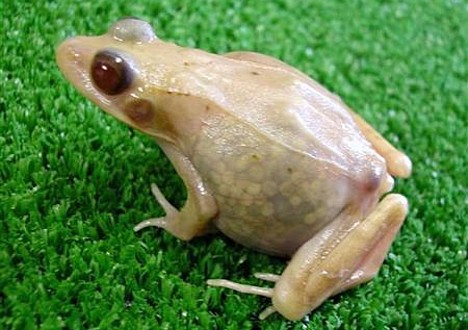
A research team led by professor Masayuki Sumida at Hiroshima University's Institute for Amphibian Biology has created a type of transparent frog whose internal organs are visible through its skin. The researchers say the see-through frogs can help in the study of diseases and in the development of medical treatments by allowing laboratory scientists to check the status of internal organs and blood vessels while the frogs are alive and without having to dissect them.
According to Sumida, the transparent frog is the result of breeding two specimens of Japanese brown frog (Rana japonica) that had a genetic mutation giving them pale skin. By selectively breeding their offspring, the researchers were able to create a frog that remains transparent for its entire life cycle. Most of the world's known transparent creatures live underwater, and transparent four-legged animals are extremely rare.
The researchers also say that by fusing the genes of fluorescent proteins to the frog's genes, they can create frogs that glow. Glowing frogs can help scientists study specific "problem" genes by providing a real-time visual indication (i.e. the frogs glow) when those genes become active.
Professor Sumida says, "Transparent frogs will prove useful as laboratory animals because they make it easier and cheaper to observe the development and progress of cancer, the growth and aging of internal organs, and the effects of chemicals on organs."
The results of the research will be announced at a meeting of the Zoological Society of Japan on September 22.





 A team of University of Tokyo researchers led by professors Hitoshi Sakano and Ko Kobayakawa have announced they have genetically engineered a mouse that does not fear cats, simply by controlling its sense of smell. By tweaking genes to disable certain functions of the
  On October 3, a team of American and Japanese researchers from the