Flexible, full-color OLED

Flexible organic EL display --

On May 24, Sony unveiled what it is calling the world’s first flexible, full-color organic electroluminescent display (OLED) built on organic thin-film transistor (TFT) technology. OLEDs typically use a glass substrate, but Sony researchers developed new technology for forming organic TFT on a plastic substrate, enabling them to create a thin, lightweight and flexible full-color display. The 2.5-inch prototype display supports 16.8 million colors at a 120 x 160 pixel resolution (80 ppi, .318-mm pixel pitch), is 0.3 mm thick and weighs 1.5 grams without the driver.

According to Sony, which plans to release a new line of miniature TVs this year and is bolstering efforts to develop next-generation flat-panel OLEDs, this new technology will lead to the development of thinner, lighter and softer electronics.

The company is scheduled to present the results of its research at the SID 2007 International Symposium now underway in the US.

Here’s the video.

[Source: IT Media, Sony press release]

New cement conducts electricity like metal

Electro-conductive cement ---

A team of researchers led by professor Hideo Hosono of the Tokyo Institute of Technology has developed a new type of alumina cement that conducts electricity like metal by altering the crystal structure at the nano level.

Ordinary alumina cement made from a lime-alumina compound (C12A7) has a crystal structure consisting of asymmetric cages, making it a poor conductor of electricity. But by sealing the alumina cement compound along with titanium inside a glass tube and heating it to 1,100 degrees Celsius, the researchers were able to create a homogenized, symmetrical cage structure that conducts electricity like metal.

Results indicate the cement’s electrical conductivity is on par with that of manganese at room temperature. Moreover, like other metals, the cement’s conductivity increases as its temperature decreases.

The researchers say that forming the cement into thin membranes would make it nearly transparent, making it an ideal substitute material for rare metals such as indium, which is used in plasma and liquid-crystal displays. In addition to being cheaper than rare metals, the cement would make an environmentally-friendly alternative because its ingredients are more readily available.

The Tokyo Institute of Technology worked with researchers from Osaka Prefecture University, the Institute of Physical and Chemical Research (RIKEN), and the Japan Synchrotron Radiation Research Institute (SPring-8) to develop the cement. The results are published in the April 11 edition of Nano Letters.

[Sources: Nikkei Net, Mainichi, SPring-8 press release]

Gemotion screen shows video in living 3D

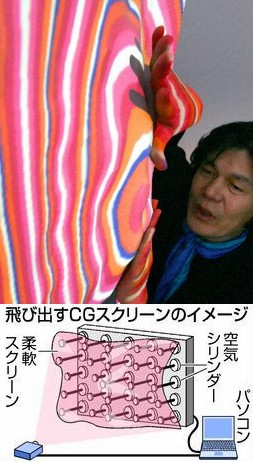
Gemotion -- Here’s a groovy display for people looking to add that extra dimension to their viewing material…

Gemotion is a soft, ‘living’ display that bulges and collapses in sync with the graphics on the screen, creating visuals that literally pop out at the viewer.

Yoichiro Kawaguchi, a well-known computer graphics artist and University of Tokyo professor, created Gemotion by arranging 72 air cylinders behind a flexible, 100 x 60 cm (39 x 24 inch) screen. As video is projected onto the screen, image data is relayed to the cylinders, which then push and pull on the screen accordingly.

“If used with games, TV or cinema, the screen could give images an element of power never seen before. It could lead to completely new forms of media,” says Kawaguchi.

The Gemotion screen will be on display from January 21 to February 4 as part of a media art exhibit (called Nihon no hyogen-ryoku) at National Art Center, Tokyo, which recently opened in Roppongi.

[Source: Asahi]

SHOJI: Symbiotic Hosting Online Jog Instrument

SHOJI: Symbiotic Hosting Online Jog Instrument -- On November 6, GS Yuasa and the University of Tokyo unveiled a system that ascertains the “mood” of a room by monitoring a variety of factors — including the feelings and behavior of the people in the room — and relays the mood data to remote terminals where it is expressed as colored LED light.

The system, called SHOJI (Symbiotic Hosting Online Jog Instrument), is similar in concept to KOTOHANA (developed by NEC and SGI), which are pairs of flower-shaped terminals that share data and change color according to emotion detected in voice patterns.

Like KOTOHANA, the SHOJI system consists of a pair of terminals placed at separate locations. Each terminal is equipped with a full-color LED array, a microphone and five sensors (developed at the University of Tokyo) that detect light, temperature, humidity, infrared radiation and ultrasonic waves. In addition to constantly measuring the room’s environmental conditions, SHOJI terminals can detect the presence and movement of people, body temperature, and the nature of the activity in the room.

Each SHOJI terminal constantly sends the room’s mood data over the Internet to the other terminal, where it is expressed as colored light on the LED array. By checking the color of light on the SHOJI terminal, users can easily understand the mood in the other room.

SHOJI’s display consists of 10 rows of LEDs that emit colors corresponding to different emotions — red for anger, blue for sadness, yellow for happiness, and green for peace. The display also provides a clear indication of mood shifts, with the top 5 rows representing the current mood of the room and the bottom 5 representing the recent past.

GS Yuasa will soon put SHOJI to a series of field tests at Tokyo-area companies, allowing head office managers to keep tabs on the mood at branch offices (and vice-versa). Tests are also planned at hospitals and in residential settings.

With the product release scheduled for April 2007, GS Yuasa plans to market SHOJI to companies at a price of between 300,000 to 400,000 yen ($2,500 to $3,300).

[Source: Fuji Sankei]

Giant video screen constructed at Tokyo-area horse track

World's largest display

Mitsubishi Electric has completed construction of the world’s largest high-definition video screen at a horse track in Tokyo. The screen employs Mitsubishi’s Aurora Vision LED technology and measures 11.2 meters (37 feet) x 66.4 meters (218 feet), giving it a surface area of 744 square meters (8,000+ square feet), or the equivalent of 3 tennis courts. Mitsubishi manufactured the screen for the Japan Racing Association (JRA) at its Nagasaki factory in the town of Togitsu, Nagasaki prefecture. The screen was divided into 35 pieces for delivery to the Tokyo Racecourse in Fuchu, Tokyo.

The bright, high-definition display is 3 times larger than what was previously installed at the horse track, and the screen’s three sections allow the audience to take in the action at other tracks. Total cost is reported to be 3.2 billion yen (US$28 million).

[Source: Asahi Shimbun]

==========

UPDATE: Check out this Fuji TV news report on YouTube. The video shows an athletic reporter sprinting from one end of the 2,651-inch monster to the other (in 12.8 seconds). You’d have to stack 1,550 32-inch TVs to match the size of this screen. [Via: TV in Japan]

Device uses waves to “print” on water surface

AMOEBA draws letters on water surfaceResearchers at Akishima Laboratories (Mitsui Zosen), working in conjunction with professor Shigeru Naito of Osaka University, have developed a device that uses waves to draw text and pictures on the surface of water.

The device, called AMOEBA (Advanced Multiple Organized Experimental Basin), consists of 50 water wave generators encircling a cylindrical tank 1.6 meters in diameter and 30 cm deep (about the size of a backyard kiddie pool). The wave generators move up and down in controlled motions to simultaneously produce a number of cylindrical waves that act as pixels. The pixels, which measure 10 cm in diameter and 4 cm in height, are combined to form lines and shapes. AMOEBA is capable of spelling out the entire roman alphabet, as well as some simple kanji characters. Each letter or picture remains on the water surface only for a moment, but they can be produced in succession on the surface every 3 seconds.

Researchers at Akishima Laboratories have developed similar devices in the past that used waves to draw pictures on the surface of water, but those devices had trouble producing letters with straight lines (such as the letter K). Additionally, it took the previous devices up to 15 minutes of data input time to produce each letter.

The newly developed technology uses improved calculation methods for controlling the wave generators, relying on formulas known as Bessel functions. In addition to being able to draw letters consisting of straight lines, the input time has been drastically reduced to between 15 and 30 seconds for each letter.

Akishima Laboratories expects the technology to be incorporated into amusement devices that combine acoustics, lighting and fountain technology, which they hope to see installed at theme parks and hotels.

====================

UPDATE Dec 27, 2006: Check out this short video of AMOEBA in action, from the World Business Satellite (WBS) news program (props to Seihin World). AMOEBA forms the letters “WBS” on the water surface.

[Source: Fuji Sankei]

Aurora on demand

Aurora generatorResearchers have developed the next best thing for would-be aurora gazers unable to make the trip to a near-polar location — an aurora generator. The device was developed by Professor Shigeyuki Minami from the Graduate School of Engineering at Osaka City University, who worked with real estate developer Iida Sangyo Co., Ltd.

Beginning August 1, Iida Sangyo plans to fire up the device as the main attraction at its Enoshima Island Spa (”Enospa“), affording visitors the extra luxury of gazing at the aurora while lounging poolside on the second floor.

The aurora is generated within the belly of the machine, where a near-vacuum state is maintained. Electrons collide with oxygen and nitrogen to create colorful light in the same way that naturally occurring auroral light is generated in the earth’s upper atmosphere. One side of the device is made of transparent acrylic resin, allowing viewers to admire the beauty of the artificial aurora contained within. The aurora generator measures 2.2 (H) x 2.8 (W) x 1.4 (D) meters (7 x 9 x 5 feet), though the company claims to have engineered prototypes as large as 3 x 3 meters.

Aurora simulators in the past have relied on techniques such as laser beams that create aurora-like effects, while devices that have relied on electrical discharge in a vacuum have been very small. In addition to being larger and more “real” than previous devices, Iida Sangyo’s device does not simply light up — it emits a shimmering curtain of dynamic multi-hued light consisting of as many as 11 colors.

The company has not revealed exactly what technology is at work in the device.

[Source: Tech-On! via /. Japan]

Chatty shows face at local anime fair

ChattyChatty, a talking mannequin with a human face, is on display at the Tokyo International Anime Fair 2006 (at Tokyo Big Sight through March 26).

Developed by Ishikawa Optics & Art Corporation, Chatty has a face that is brought to life by means of a video projector inside its head. A video image of an actual human face (or the face of a computer-generated character, if you prefer) is projected onto the inner surface of the mannequin’s face, which serves as a three-dimensional video screen. Audio synced with Chatty’s video lip movements gives the face an astonishingly realistic look.

Chatty’s presence at the anime fair brings Ishikawa one step closer toward realizing its dream, which is to see the technology behind Chatty’s face be put to use in speech-capable historical figures for museum exhibits, theme park guides, or human-faced androids.

[Sources: IT Media, Chatty homepage (check out the video of Chatty reciting Humpty Dumpty in Japanese!)]

UPDATE: Bizarre video of Chatty emerges. The Humpty Dumpty mantra continues. Thanks, Stefan!

Toshiba to postpone SED TV release until next year?

On February 21, Toshiba announced the possibility of postponing the spring 2006 release date for its next-generation flat-screen SED (Surface-conduction Electron-emission Display) TV until next year. Toshiba has worked with Canon to develop SED TV technology.

SED TV

At a press conference on February 21, Satoshi Niikura, vice president of Toshiba’s digital media operations, said, “Because SED is still in the trial production stage, we are unable to secure a sufficient quantity of panels (key components).” The company will soon make a final decision regarding its strategy.

SED panels are currently being manufactured on a trial basis at a joint-venture factory in the city of Hiratsuka in Kanagawa prefecture at a rate of about 1000 units per month. Full-scale production is not expected until 2007.

[Source: Asahi Shimbun]

AIST develops 3D image projector

3D image projectorJapan’s National Institute of Advanced Industrial Science and Technology (AIST) has developed a device that uses lasers to project real three-dimensional images in mid-air. The institute unveiled the device on February 7 in a demonstration that showed off the device’s ability to project three-dimensional shapes of white light.

AIST developed the projector with the cooperation of Keio University and Burton Inc. (Kawasaki, Japan). Until now, projected three-dimensional imagery has been “artificial” — optical illusions that appear 3D due to the parallax difference between the eyes of the observer. Prolonged viewing of this conventional sort of 3D imagery can cause physical discomfort.

The newly developed device, however, creates “real” 3D images by using laser light, which is focused through a lens at points in space above the device, to create plasma emissions from the nitrogen and oxygen in the air at the point of focus. Because plasma emission continues for a short period of time, the device is able to create 3D images by moving the point of focus.

3D image projectorAt the demonstration, bursts of laser light were emitted 100 times per second to form shapes in the air up to 50 cm above the device. Heat from the laser caused the air to expand, producing a crackling sound that resembled a series of tiny explosions.

At the moment, the distance at which the device can project images is limited to between 2 and 3 meters. Improved laser technology will enable images to be projected at greater distances and with more color, so we may soon see 3D images floating above our city skylines.

The chief scientist at AIST’s Photonics Research Institute says, “We believe this technology may eventually be used in applications ranging from pyrotechnics to outdoor advertising.”

[Sources: Mainichi Shimbun, AIST press release, Burton Inc.]

UPDATE 1: The English translation of the press release is here.

UPDATE 2 (Aug 16, 2007): New and improved 3D projector