The January 8 issue of DIME magazine takes a peek at some of the events, products and developments expected to have an impact on Japan in 2008. Here is a small taste of the many items mentioned in their preview (in no particular order).
Apple, Disney tap into Japanese phone market
 Of the countless new electronic products to be unveiled in Japan this year, few are likely to generate the amount of buzz that will accompany the Japanese launch of the yet-to-be-announced 3G iPhone. For the time being, would-be iPhone fans are holding their collective breath for all the gory details and specs, which may or may not come out at MacWorld 2008 (January 14-18).
Disney is also expected to make a splash with its entry into the mobile phone service market in spring. Working with Softbank, Disney will deliver mobile content to subscribers and help to develop new handsets -- which means we can probably look forward to an explosion of character-themed phones as the year progresses. (On a separate but related note, Tokyo Disneyland will be holding a year-long celebration to mark its 25th anniversary. Festivities will include the grand opening of the 705-room Victorian-style Tokyo Disneyland Hotel this summer.)
Electronic turf wars
With a little luck, the Blu-ray vs. HD DVD format war should finally come to a head this year in Japan. Tsutaya, Japan's largest movie rental company, is weighing the pros and cons of each format and preparing to decide which one to put on its store shelves. Some analysts argue that Tsutaya's choice will play a decisive role in determining which camp ultimately prevails.
In a different type of turf battle, competition between major electronics retailers is intensifying as Yamada Denki (LABI) continues to beef up its presence around the major train stations in central Tokyo. In recent months, Yamada has opened large-scale outlets in Ikebukuro, Akihabara, Shimbashi and Oimachi, and rumors suggest more are to come this year in Shibuya and Shinjuku. Good news for shoppers.
Dubbing 10
While the Olympics are expected to fuel demand for home entertainment systems, there is another development that promises to inject a little excitement into the DVD recorder market. "Dubbing 10," a new digital content protection system set to launch this year, gives Japanese consumers more freedom to copy digital broadcasts (compared to existing restrictions). As the name suggests, the new system allows digital broadcasts to be copied up to nine times and transferred to another playback device once. Although the Dubbing 10 system does not allow copies to be duplicated, it is still good news for consumers who, under the current digital content protection system (CPRM), are only allowed one opportunity to copy or transfer broadcasts that have been flagged as "copy once." Dubbing 10-compatible recorders are set to hit shelves soon, and Toshiba and Panasonic have announced they will be offering Dubbing 10 software upgrades for existing "copy once" recorders.
The next "B-sport" sweetheart?

When it comes to nubile young female athlete idols, the letter "B" stands for beach volleyball and badminton. In 2007, beach volleyballer Miwa Asao raised eyebrows when she released a gravure DVD and posed for sexy Sabra magazine, while badminton doubles team Kumiko Ogura and Reiko Shiota (together known as "Ogushio") were the subject of a popular photobook. In 2008, "B" might also come to signify bowling, as 17-year-old bowling idol (or bowdol, as some like to say) Rina Asada rises to stardom. Last year, Asada began appearing regularly on Nihon TV's "P-League" late-night bowling program, which features amateurs and professionals competing in tournaments. She also won the women's national high school bowling championship in July and has been selected as a member of Japan's national team. Some say her popularity could help spark a bowling craze among the nation's youth.
Government vs. metabolic syndrome
In April 2008, the Ministry of Health, Labour and Welfare will begin implementing new guidelines to combat metabolic syndrome and reduce the burden of associated medical costs. In addition to calling for new metabolic syndrome-specific health checks for 40- to 74-year-olds enrolled in public insurance programs, the guidelines will include diet, exercise and lifestyle recommendations for reducing the risk of developing the syndrome.
On top of boosting health awareness, the guidelines are expected to spur growth in the emerging market for metabolic syndrome-related goods and services, which is estimated at about 500 billion yen ($4.5 billion) in 2008. Fat-fighting food and drinks, such as Kao's popular Healthia teas and Suntory's oolong tea (kuro oolong cha), are expected to remain big-sellers, while new health-related devices, such as Omron Healthcare's pedometer that counts "aerobic steps" in addition to daily steps, are expected to appear.
 This year will also see the rise of a new type of business in which medical institutions team up with fitness gyms to help customers fight metabolic syndrome. One such example is the Medical Fitness OreoS facility that opened in Okutama (Tokyo) in September 2007. Established through a partnership between the Seijo drug store chain and a medical corporation, the fitness center provides individual customers with health advice and exercise programs based on the results of thorough medical examinations. The company is looking to open new facilities in 2008.
Another such facility is suUhaa Atami, an upscale medical resort scheduled to open in the city of Atami (Shizuoka prefecture) in the fall of 2008. With a hotel, health clinic, gym and spa, suUhaa Atami aims to provide a unique short-term resort experience to Tokyo residents interested in fighting metabolic syndrome. The large-scale facility is also expected to stimulate the local economy.
Trouble in smokers paradise
Cigarette smokers in Japan will feel the pinch in 2008 as the country continues its crawl toward a smoke-free public environment. New rules that ban smoking in the vast majority of Tokyo taxis will take full effect on January 7. According to the two major industry groups that oversee 52,000 taxis in Tokyo (95% of the total), drivers are being instructed to accommodate the demands of chain-smoking passengers by pulling over and letting them out for nicotine breaks as needed. Drivers are also being provided with portable ashtrays to give to passengers while they smoke outside.
 Smokers under the legal age of 20 will also feel the pinch as electronic age verification systems come to Japan's vast network of cigarette vending machines. In February, the Tobacco Institute of Japan will begin issuing age verification smart cards, called "taspo," which will need to be scanned at vending machines each time a purchase is made. Age-checking machines will start appearing in March, and the system is scheduled to be fully deployed nationwide by July. The taspo cards will also be equipped with an electronic money function, called "pidel," which will enable customers to make purchases with a simple swipe of the card (the machines will also allow users to add pidel funds to their taspo cards). It should not be long before taspo-capable cellphones begin to appear.
Japan-Brazil exchange year

In April 1908, the Kasato-Maru set sail from the port of Kobe carrying a group of Japanese emigrants headed to Brazil. Most of the passengers ended up working in harsh conditions on coffee farms, but the voyage marked the first of many to follow as Japanese emigrants felt drawn to the opposite end of the earth in search of a better life. Now, a century later, Brazil is home to 1.5 million ethnic Japanese -- the largest population outside Japan. To commemorate the 100th anniversary of the first Kasato-Maru voyage and highlight the Japanese cultural legacy in Brazil, the nations have designated 2008 a Japan-Brazil exchange year. More than 100 special events ranging from music festivals to friendly soccer tournaments are scheduled in Japan this year.
[Source: DIME, Jan. 8, 2008 (print)]


 In a technological advance that opens up new possibilities in the fields of robotics and wearable computing, researchers at the University of Tokyo have developed a stretchable, rubbery material that conducts electricity and can be incorporated into electronic devices.
 Lingerie maker
 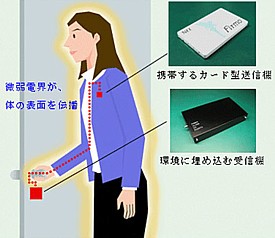 NTT has begun selling a device that transmits data across the surface of the human body and lets users communicate with electronic devices simply by touching them, the company announced on April 23.


