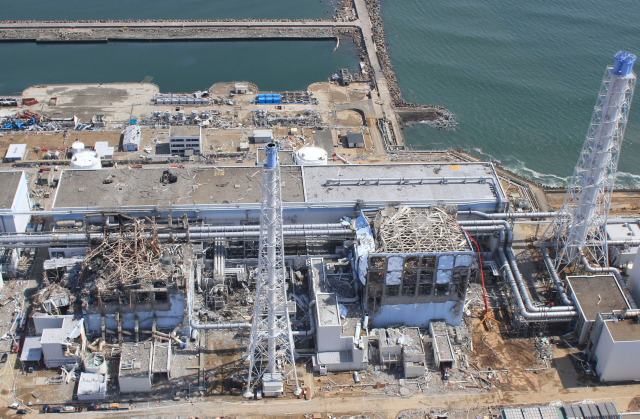
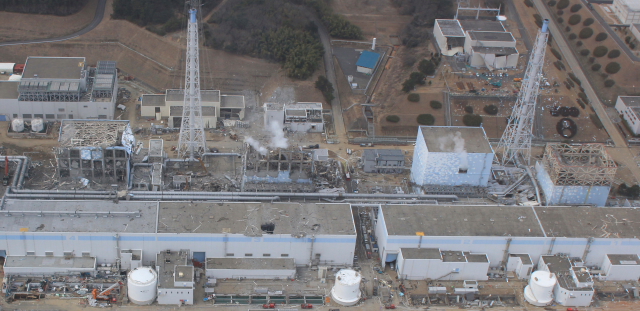
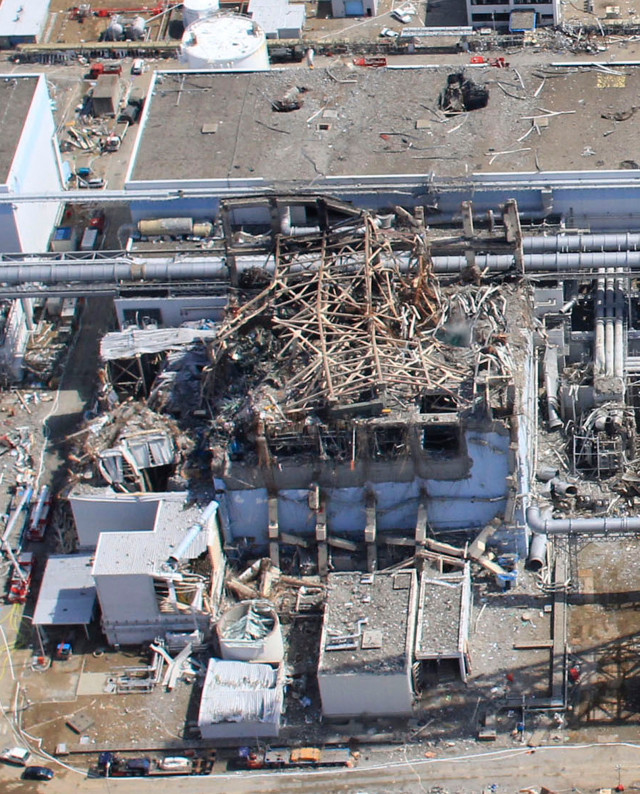
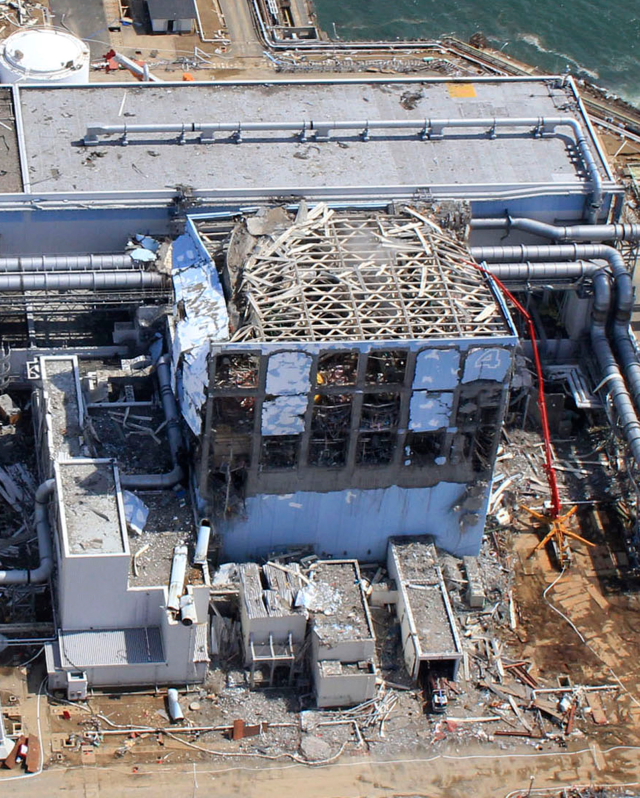
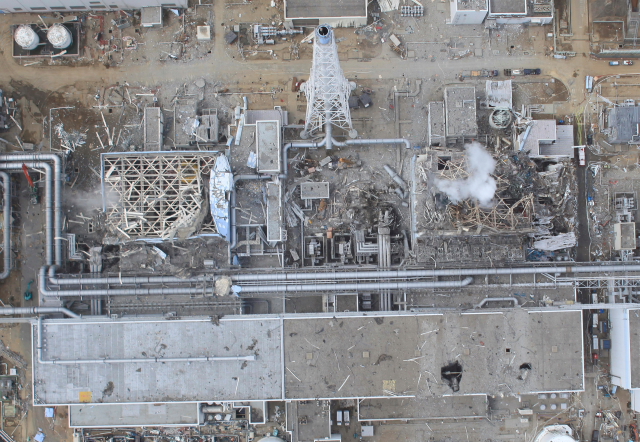
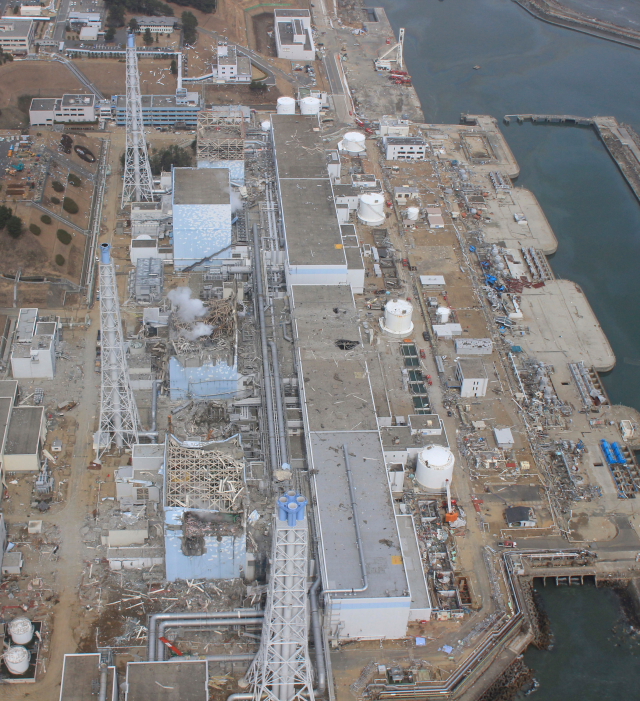
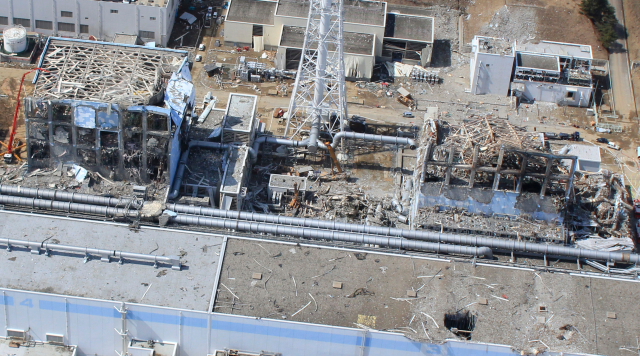
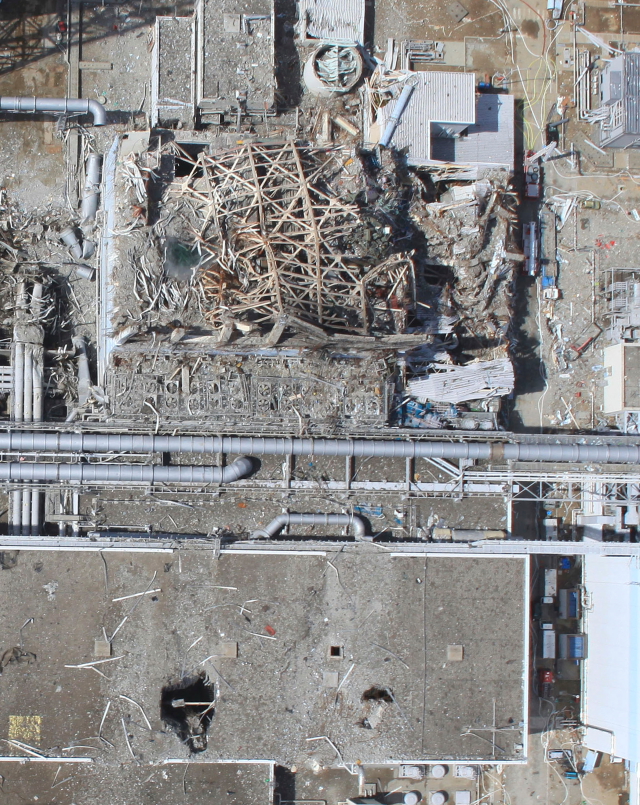
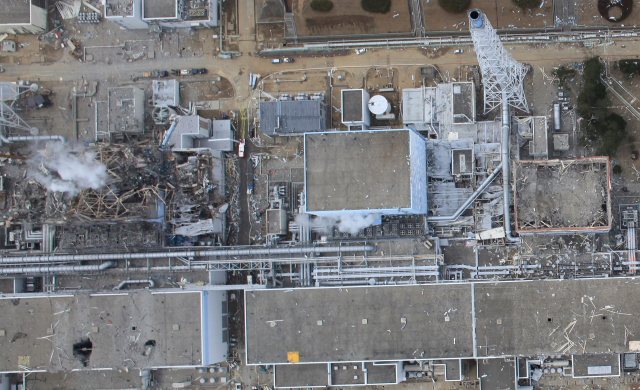
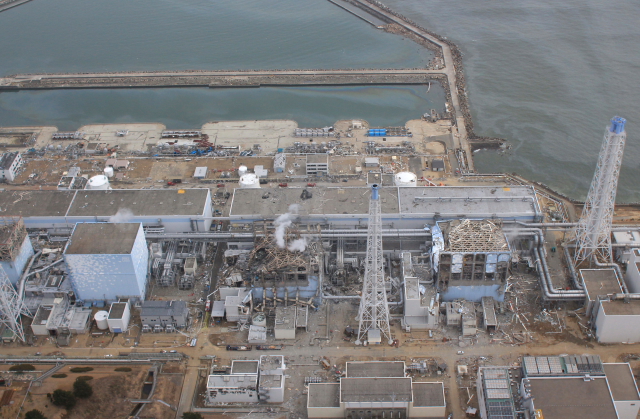
These high-resolution aerial photographs of the damaged Fukushima Daiichi nuclear power plant were taken on March 20 and 24, 2011 by a small unmanned drone operated by Air Photo Service, a company based in Niigata prefecture. Click [Enlarge] under each image for the full version.
[Enlarge] Unit 3 (left) and Unit 4 (right) - March 24
[Enlarge] Left to right: Unit 4, Unit 3, Unit 2 and Unit 1 - March 20
In the early 1990s, Japan's Power Reactor and Nuclear Fuel Development Corporation (PNC) -- a nuclear energy research organization which is now part of the Japan Atomic Energy Agency (JAEA) -- created a pro-nuclear PR cartoon entitled "Pluto-kun, Our Reliable Friend." The aim of the animated film, which features the company mascot Pluto-kun, is to dispel some of the fears surrounding plutonium. Scroll down for a rough summary.
[~1:30] The video begins with Pluto-kun disguised as a ghost. He explains that much of the fear surrounding plutonium is due to misconceptions. He says that it is very unfortunate that plutonium is used in nuclear weapons [like the one dropped on Nagasaki]. But he hates war! He loves to work for peace. He aspires to be like dynamite, whose power has been used for the benefit of mankind.
[1:30] Pluto-kun provides some basic information about plutonium. He explains that plutonium is created from uranium in nuclear reactors. He also says it was discovered by the US scientist Glenn T. Seaborg in 1940, and that it was named after the dwarf planet Pluto. (See Wikipedia for more.)
[2:30] Misconception #1 -- Pluto-kun addresses the fear that criminals could obtain plutonium and build a nuclear weapon. He explains two reasons why this would be virtually impossible. First, weapons require plutonium with a purity of at least 93%, but plutonium from reactors is only about 70% pure. A high level of technology would be required to produce weapons from this plutonium. Second, a high level of security is maintained around plutonium in Japan, making it all but impossible to steal.
[4:00] Misconception #2 -- Pluto-kun addresses the fear that plutonium is deadly and causes cancer. Plutonium's danger to the human body stems from the alpha radiation it emits. Because alpha radiation is relatively weak, it does not penetrate the skin, and plutonium is not absorbed into the body if it comes into contact with skin. He explains that you would not die instantly if you were to drink plutonium. If swallowed, the vast majority simply passes through the digestive tract without being absorbed. If it enters the blood stream (through a cut, for example) it cannot be removed easily from the body. It accumulates in the lymph nodes before ending up in the bones or liver, where it continues emitting alpha radiation. Plutonium can also get into the liver or bones if it is inhaled into the lungs. It is important not to breathe it in or allow it to enter the blood stream.
[6:00] No human is ever known to have died because of inhaling or ingesting plutonium.
[7:00] Pluto-kun explains what would happen if criminals dumped plutonium into a reservoir that provides our drinking water. Plutonium is heavy and it does not dissolve easily in water, so most of it would sink to the bottom. Even if you were to drink plutonium-laced water everyday, the vast majority of it would simply pass through the digestive system without being absorbed by the body.
[7:30] Pluto-kun suggests that the dangers of plutonium are often overemphasized, making it seem scarier than it actually is. He explains that most people associate plutonium with deadly radiation and nuclear weapons, but he likens this to a fear of non-existent ghosts.
[9:40] Pluto-kun explains that he is not a monster, and he asks you to understand who he truly is. As long as people use him peacefully and with care, there will never be any danger or anything to fear. He will provide an endless source of energy for a long time to come. He will be a reliable friend.
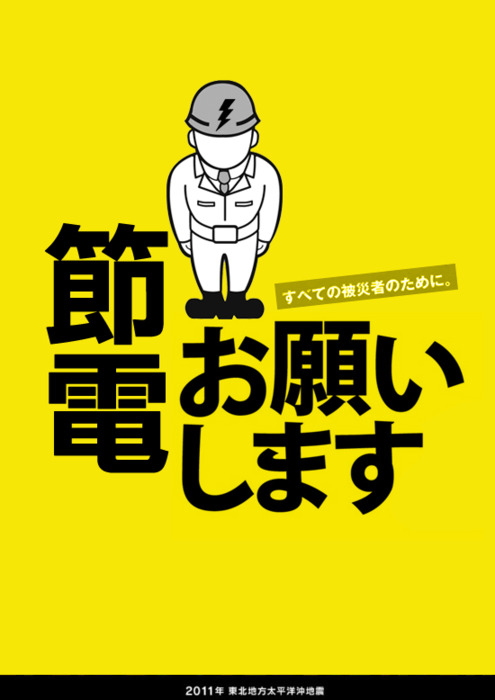
In Tokyo and surrounding areas, signs of electricity conservation are visible everywhere. Rolling blackouts are in effect, train services have been scaled back, stores and businesses are using fewer lights, advertising signs and escalators have been switched off, and even some pachinko parlors have cut their hours of operation. On Twitter, a community of graphic designers has sprung up to create posters encouraging people to save power. Residents of eastern Japan are encouraged to print them out and post them where they live and work. [Link: Setsuden via GaijinPot]
Everyone save electricity
Please cooperate in conserving electricity
Save power and carry on
Let's conserve electricity! Switch OFF!
Turn OFF the power. Now anybody can be Santa.
Power saving!
The amount you turn off will light someone else up.
Please conserve electricity.
Save electricity. Save somebody.
Save electricity. Switch off.
The light you turn off will light up a smile.
Now conserving power
The quickest aid you can provide now is electricity.
Saving energy & open for business
Open for business in power saving mode!
Conserve electricity to prevent massive power failures!
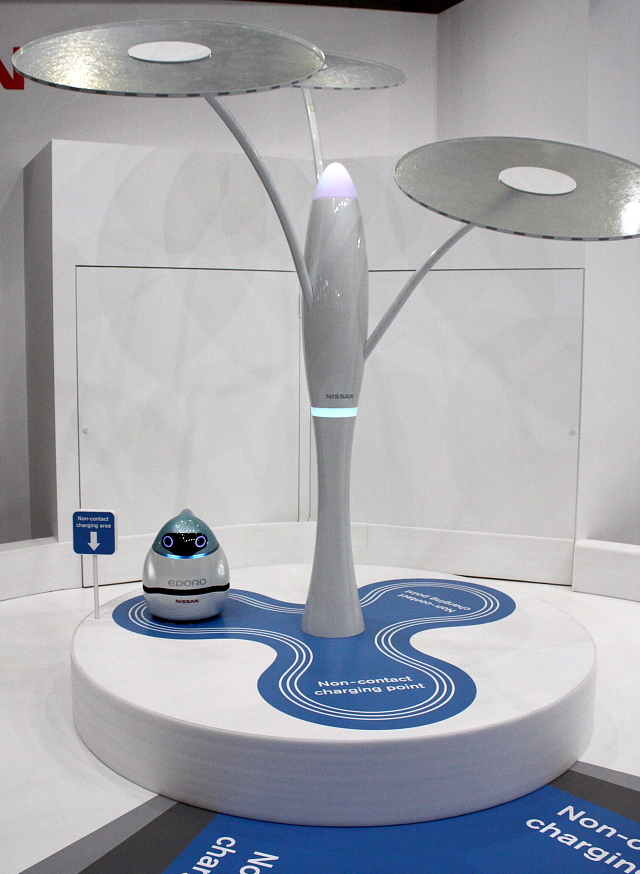
At the CEATEC Japan 2010 trade show now being held in Chiba (Oct 5-9), Nissan is exhibiting a futuristic model of a solar-powered wireless charging station for electric vehicles.
Solar Tree: Coming in 2030 to a city near you
The envisioned tree-shaped charging station -- called the "Solar Tree" -- stands 12 meters (39 ft) tall and has three translucent round solar panels that follow the sun across the sky. With an expected conversion efficiency of 30%, the three solar panels together can generate 20 kilowatts of power. At the base of each tree is a clover leaf-shaped wireless charging pad that can recharge batteries from a short distance, without the use of cables or plugs.
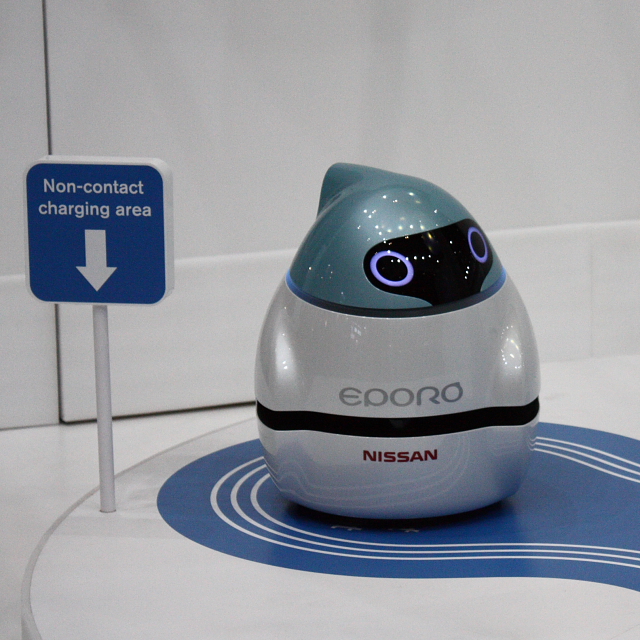
As part of the exhibition, Nissan showed off the latest version of its EPORO robot car, which has been outfitted with a wireless power system. In addition to recharging itself under a Solar Tree, the robot can also repower itself on the go by receiving electrical energy via charging lanes on the road.
EPORO robot recharging under a Solar Tree
Solar Trees can be used individually as small-scale charging stations in urban areas, or they can be grouped into forests to produce energy on the scale of power plants. According to Nissan's design, a forest of 1,000 Solar Trees will be able to provide electricity for 7,000 households.
In addition to providing power, Solar Trees can provide some relief from the heat in summer. The translucent solar panels offer protection from UV light, while fine mist emitted from the edges of the panels works to reduce the temperature in the immediate vicinity.
Japanese construction firm Shimizu Corporation has developed a series of bold architectural plans for the world of tomorrow. Here is a preview of seven mega-projects that have the potential to reshape life on (and off) Earth in the coming decades.
* * * * *
- Luna Ring
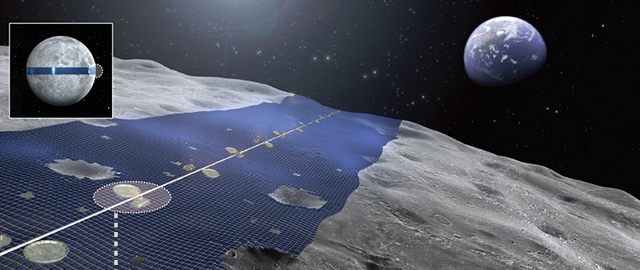
In response to the ever-growing demand for energy, Shimizu has developed plans for the Luna Ring, a project that seeks to transform the Moon into a massive solar power plant.
Luna Ring's 11,000-kilometer (6,800-mile) "solar belt" spans the Moon's equator
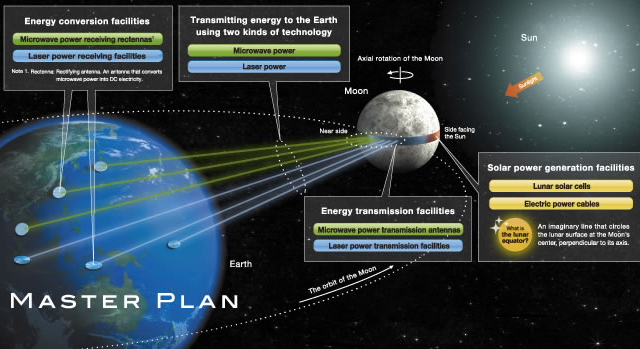
Electricity collected by the Luna Ring's enormous "solar belt" is relayed to power conversion facilities located on the near side of the Moon. There, the electricity is converted into powerful microwaves and lasers, which are beamed at Earth. Terrestrial power stations receive the energy beams and convert them back to electricity.
Luna Ring feeds power to energy-hungry Earth
The solar power plant is built mainly using lunar resources. Moon rocks and dust are used to manufacture building materials such as cement, bricks and glass fibers. Water is produced through a chemical process involving lunar soil and hydrogen.
Large machinery and equipment from Earth is assembled in space and landed on the lunar surface for installation. Much of the construction is performed by robots controlled by people on Earth, and a team of human astronauts is stationed on the Moon to supervise the robot operations. [More]
* * * * *
- Green Float
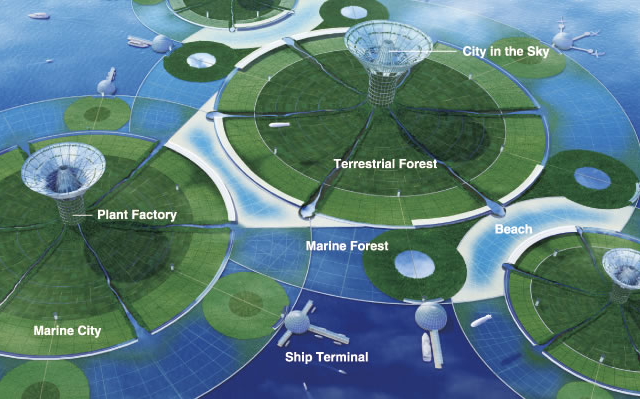
Shimizu's Green Float project seeks to build "botanical" cities that float like giant lily pads in the equatorial Pacific, where sunlight is plentiful and the impact of typhoons is minimal.
Lily pad-like cities at sea
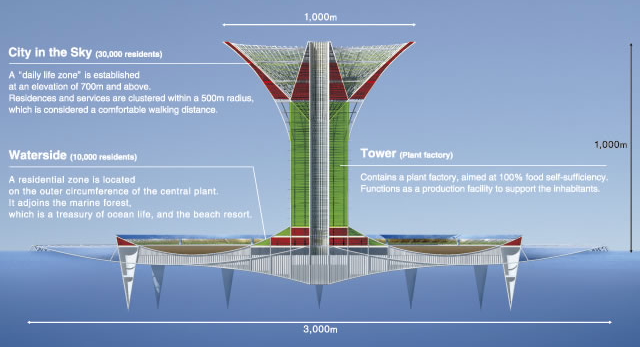
Each floating island features a 1,000-meter (3,300-ft) central tower. The lower section of the tower serves as an industrial area with offices and factories employing 10,000 workers, while the upper section functions as a residential area for 30,000 people. Another 10,000 residents live at ground level, in low-rise townhouses near the beach.
Green Float islands are 3 kilometers (1.9 mi) in diameter and support a population of 40,000
The typical Green Float island landscape consists of forests, grasslands, waterways and reservoirs. A portion of the land is set aside for agriculture and some of the shallow beaches are used for cultivating seafood, making the islands 100% food self-sufficient.
The eco-friendly Green Float cities rely on a variety of natural energy sources, including wave, wind and solar power, as well as ocean thermal energy conversion.
Green Float islands join to form a floating metropolis
Green Float islands are built upon a floating base of connected hexagonal tubes that each weigh 7,000 tons and measure 20 meters (65 ft) across and 50 meters (165 ft) deep. The primary structural material for the honeycomb-like base, as well as for the island's buildings, is magnesium alloy. Seawater -- which is composed of 0.13% magnesium by weight -- is an abundant source of magnesium. One ton of the material can be extracted from 770 tons of seawater. [More]
* * * * *
- Mega-City Pyramid
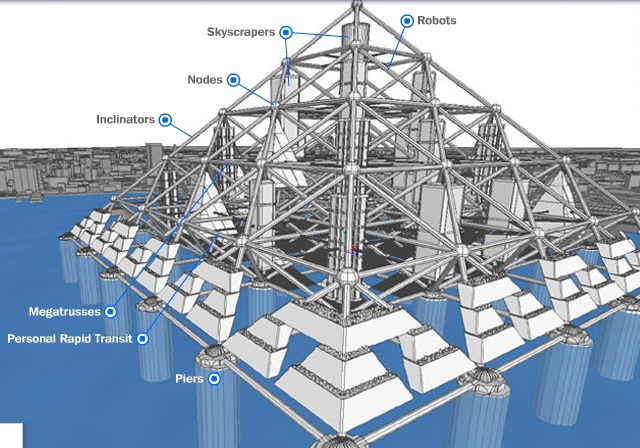
Shimizu's proposed Mega-City Pyramid is a self-contained city for one million people.
The Mega-City Pyramid stands 2,000 meters (1.25 miles) high
The pyramid-shaped hyperstructure is an assembly of skyscrapers suspended within a skeleton of 350-meter (1,150-ft) long shafts made from lightweight materials (such as carbon and glass fibers).
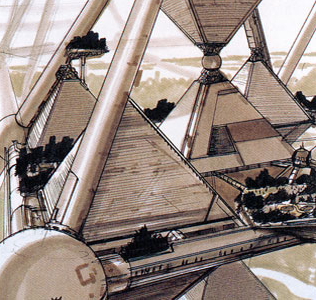
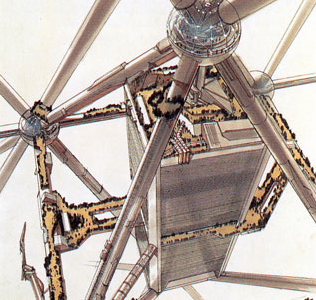
Residential buildings (left) and office complexes (right) inside Mega-City Pyramid
The skyscrapers within the Mega-City Pyramid are home to residences, offices, research institutions, shopping and entertainment centers, and other facilities. The connecting shafts, which measure from 10 to 16 meters (30 to 50 ft) in diameter, contain the city's plumbing, electrical and communication systems, as well as a network of trains, escalators and moving walkways.
The proposed hyperstructure has a footprint of approximately 8 square kilometers (3 sq mi), and it features an open-air construction that allows sunlight to reach the interior. A network of optical fibers transports sunlight into poorly-lit areas.
Construction of the massive Mega-City Pyramid is facilitated by robots and automated assembly systems, as well as by the use of standardized parts and materials. [More]
* * * * *
- Space Hotel
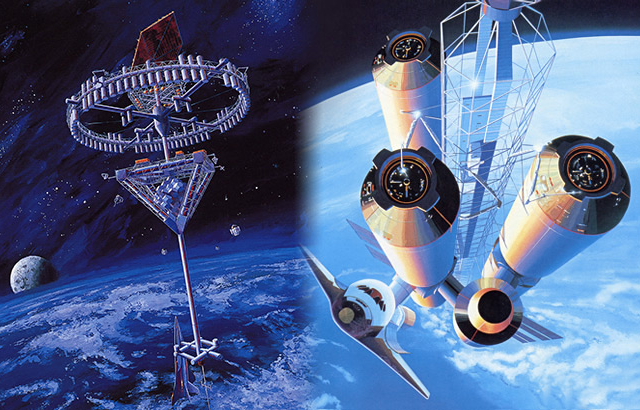
To capitalize on the coming boom in space tourism, Shimizu has developed plans for a space hotel in low-Earth orbit.
Shimizu Space Hotel, located 450 kilometers (280 mi) above Earth
The hotel -- which is powered entirely by solar energy -- features a microgravity recreational area where guests can enjoy sports, dining, and gazing at the Earth and stars. The 64 guest rooms and 40 staff rooms are situated in a ring measuring 140 meters (460 ft) in diameter. The ring rotates at a speed of 3 rpm to produce an artificial gravity of 0.7 g in the rooms. A 240-meter (790-ft) elevator shaft connects the hotel facilities with the docking port. [More]
* * * * *
- Lunar Bases
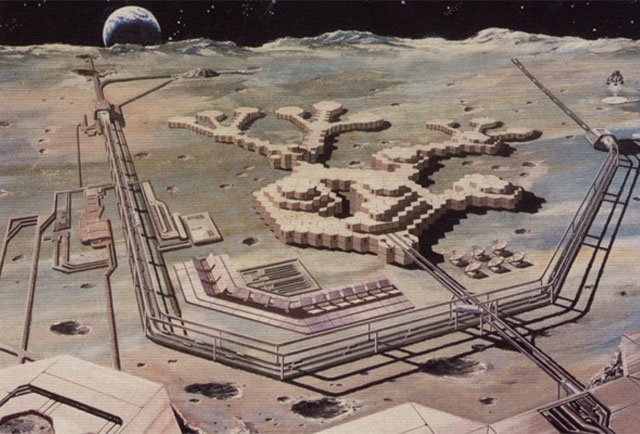
For the more adventurous offworld traveler, Shimizu has developed plans for lunar bases.
Lunar bases are the key to establishing a long-term human presence on the Moon
Shimizu's proposed bases feature a modular design of interlocking hexagonal units that can be arranged both horizontally and vertically. The modules are built using concrete made from lunar soil and rock. Tele-operated robots and automated assembly systems are used to construct the bases. [More]
* * * * *
- Urban Geo-Grid Plan
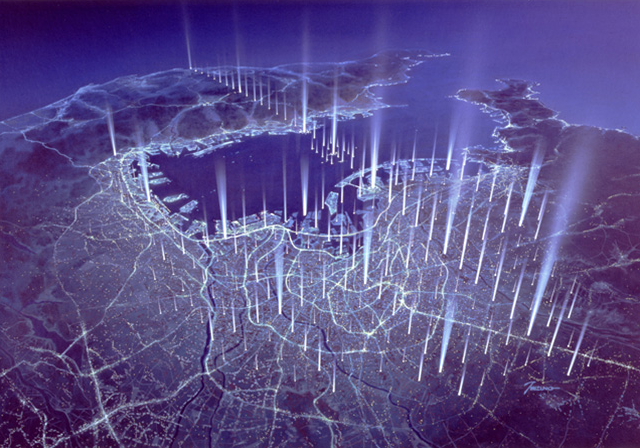
Back on Earth, Shimizu's Urban Geo-Grid Plan seeks to reduce urban congestion and improve the overall efficiency of Tokyo by placing a variety of city functions underground.
Urban Geo-Grid Plan puts much of Tokyo underground
The plan -- which covers an area extending from central Tokyo to the Boso Peninsula on the opposite side of Tokyo Bay -- consists of a vast underground network of so-called "grid points" and "grid stations." Grid points incorporate community facilities such as grocery stores, exhibition halls and public bathhouses, while the larger-scale grid stations incorporate office buildings, hotels, shopping centers, and train stations. An extensive underground transportation network connects the grid points and stations. Moving all these facilities underground frees up an enormous amount of street-level space that can be set aside for parks. [More]
* * * * *
- Desert Aqua-Net Plan
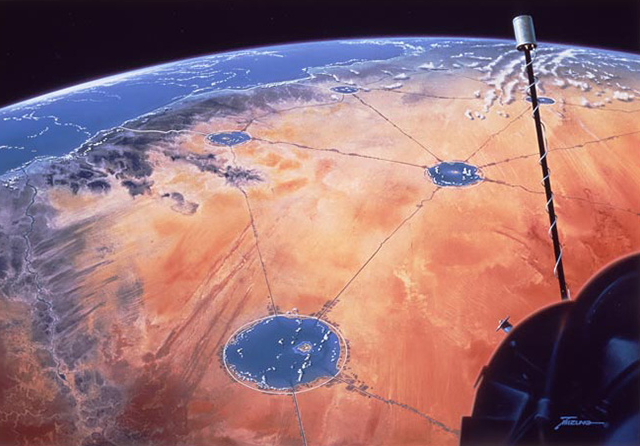
The Desert Aqua-Net Plan seeks to make the desert habitable by constructing a network of lakes and waterways.
Desert Aqua-Net Plan brings water to the desert
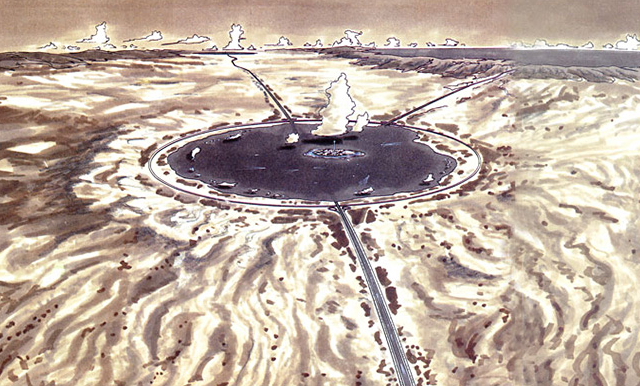
The plan involves creating artificial lakes in low-lying desert areas. Islands are constructed in the middle of the lakes, which are filled with seawater channeled inland through canals. The canals connect the lakes to form an extensive water network.
Located 150 kilometers (95 mi) apart, the artificial lakes measure 30 kilometers (20 mi) in diameter and 20 to 30 meters (65-100 ft) deep. The canals running between the lakes measure 50 meters (165 ft) wide and 10 meters (35 ft) deep
The lakes reduce temperatures and increase humidity in the surrounding areas, creating a comfortable and mild environment. Seafood and biomass resources (such as algae and seaweed) can be cultivated in the saltwater lakes, and the canals can be used to transport people and goods between the cities built on the artificial islands. [More]
Towering over Wakasu Kaihin Park in Tokyo's Koto ward is one of the largest wind turbines in Japan, a 100 meter (330 ft) tall power generator built by Ishikawajima-Harima Heavy Industries (IHI) in 2004, which outputs 1,950 kilowatts of electricity and is adorned with images of Astro Boy, Phoenix, Black Jack, Sharaku (the Three-eyed One), Unico and other Osamu Tezuka manga characters.
A new online service developed by electronics giant NEC offers carbon-conscious households a fun and friendly way to keep tabs on their energy consumption, as well as that of their neighbors.
Developed in conjunction with major Internet provider BIGLOBE, the service -- called "Carbon Diet" -- includes an easy-to-install wifi-enabled device that attaches to the home circuit breaker and measures power consumption via electric current sensors. The collected data is then periodically transferred to the home computer using a ZigBee wireless link and sent to an online server for processing.
Users can log on to the Carbon Diet website to check their daily and hourly energy consumption and see how they rank in comparison with other participating households. Users can also see how their monthly carbon footprint compares with the same month of the previous year. Based on the degree to which users actually reduce their carbon emissions, they are awarded "eco-points" that can be exchanged for virtual soil, water, flowers and grass in a nature restoration simulation game.
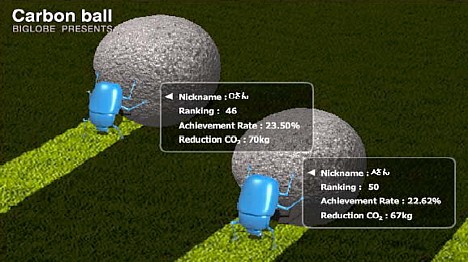
Participants can also view their progress in the form of a game called "Carbon Ball," which features dung beetle avatars in a "carbon ball" rolling contest. The distance each household's dung beetle travels is based on how successful they are in reducing power consumption. The game is designed to instill a sense of competition to keep users motivated and focused on reducing energy consumption.
For now, the three-month trial service is being conducted in the homes of 100 NEC employees. After the trial, NEC and BIGLOBE will work with Ex Corporation (an urban and environmental planning and consulting firm) to analyze the data and develop business models for local governments and the private sector. The company is aiming for sales of 2 billion yen ($20 million) over the next 3 years.
A research team led by professor Tomiki Ikeda at the Tokyo Institute of Technology has developed what is being called the world's first plastic motor powered solely and directly by light.
Unlike solar-powered motors that use photovoltaic cells to convert light to electric power (and which require wires and batteries to deliver and store the power), this first-of-a-kind motor converts light directly into mechanical energy, thanks to a belt made from a special elastomer whose molecular structure expands or contracts when illuminated, depending on the wavelength of light.
Ikeda began working on the light-activated motor in 2003, after discovering that a plastic compound containing azobenzene would contract when exposed to ultraviolet light and resume its original shape when exposed to visible light. Since then, in addition to working on improving the material's shape-shifting properties, Ikeda's team has been looking at ways to use the material in a motor that converts light directly into motion.
To test whether the material could be used as a mechanical power source, the researchers coated a polyethylene film with the shape-shifting plastic to create a 0.08-millimeter thick belt, which they looped around a pair of wheels measuring 10 millimeters and 3 millimeters in diameter. Then, by shining ultraviolet light on the belt near the smaller wheel and visible light near the larger wheel, the belt snapped into action and began turning the wheels. The larger wheel recorded a top speed of 1 rpm.
According to the researchers, the film demonstrated about 4 times more elastic strength than human muscle, and its strength remained unchanged even after contracting and expanding every 7 seconds for 30 hours.
"The material is still not very efficient at converting light to energy, but it can be improved," says Ikeda, who suggests the shape-shifting plastic can be used in larger-scale applications. He hopes to one day see the material used to power plastic automobiles and other fantastic plastic machines.
The results of the research were published in the July 19 edition of the German chemistry journal Angewandte Chemie.
On July 2, 108 days after departing from Hawaii on the world's longest voyage in a wave-powered boat, 69-year-old Japanese sailor Ken'ichi Horie was spotted in his boat off the coast of Japan. The solo sailor of the wave-powered Suntory Mermaid II was seen about 50 kilometers (31 mi) offshore south of the Cape of Muroto (Kochi prefecture), heading northeast toward his final destination, the Cape of Hinomisaki in the Kii Channel (Wakayama prefecture), where he is expected to arrive on the evening of July 3.
The 6,400-kilometer (nearly 4,000 mi) journey, which appears to have taken 5 to 6 weeks longer than originally planned, can ordinarily be completed by a diesel-powered boat in about 10 days. However, the Suntory Mermaid II, a 9.5 meter (31 ft) long x 3.5 meter (11 ft) wide, 3-ton vessel made of recycled aluminum, does not use an engine for propulsion. Instead, it relies on a pair of fins under the bow that move up and down as the waves come in, propelling the boat forward.
Horie, who was reached on his cellphone by an Asahi reporter, said he was in good physical shape and that the boat was in perfect working order, but that the increased boat traffic around Japan was forcing him to pay extra attention to safety.









 A research team led by professor Tomiki Ikeda at the Tokyo Institute of Technology has developed what is being called the world's first plastic motor powered solely and directly by light.


