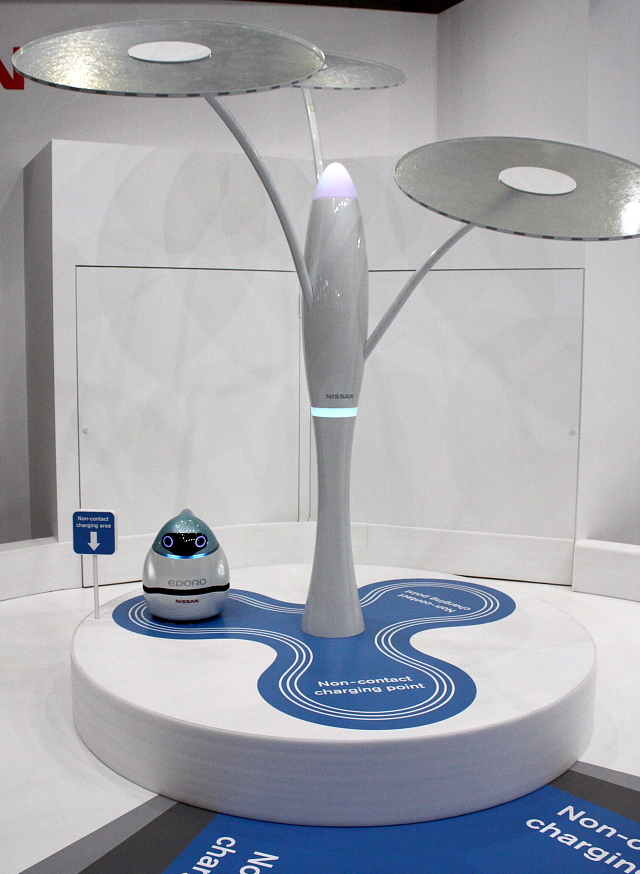
At the CEATEC Japan 2010 trade show now being held in Chiba (Oct 5-9), Nissan is exhibiting a futuristic model of a solar-powered wireless charging station for electric vehicles.
Solar Tree: Coming in 2030 to a city near you
The envisioned tree-shaped charging station -- called the "Solar Tree" -- stands 12 meters (39 ft) tall and has three translucent round solar panels that follow the sun across the sky. With an expected conversion efficiency of 30%, the three solar panels together can generate 20 kilowatts of power. At the base of each tree is a clover leaf-shaped wireless charging pad that can recharge batteries from a short distance, without the use of cables or plugs.
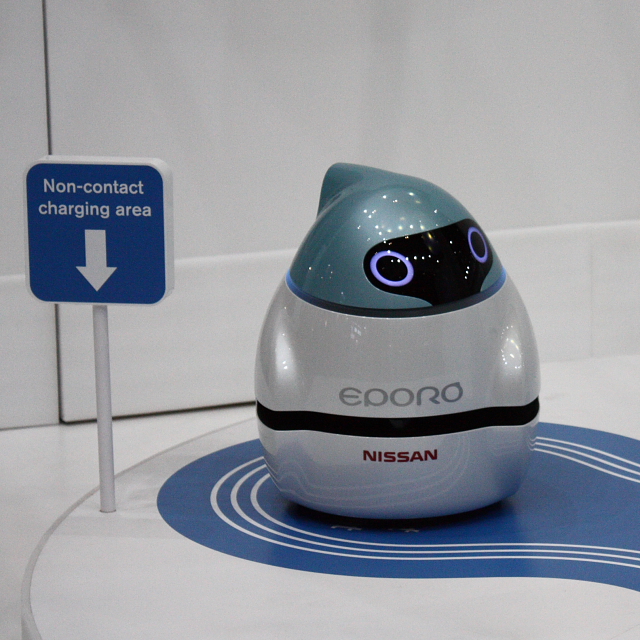
As part of the exhibition, Nissan showed off the latest version of its EPORO robot car, which has been outfitted with a wireless power system. In addition to recharging itself under a Solar Tree, the robot can also repower itself on the go by receiving electrical energy via charging lanes on the road.
EPORO robot recharging under a Solar Tree
Solar Trees can be used individually as small-scale charging stations in urban areas, or they can be grouped into forests to produce energy on the scale of power plants. According to Nissan's design, a forest of 1,000 Solar Trees will be able to provide electricity for 7,000 households.
In addition to providing power, Solar Trees can provide some relief from the heat in summer. The translucent solar panels offer protection from UV light, while fine mist emitted from the edges of the panels works to reduce the temperature in the immediate vicinity.
Japanese construction firm Shimizu Corporation has developed a series of bold architectural plans for the world of tomorrow. Here is a preview of seven mega-projects that have the potential to reshape life on (and off) Earth in the coming decades.
* * * * *
- Luna Ring
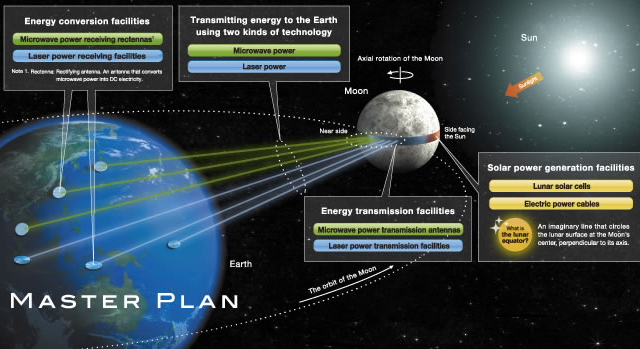
In response to the ever-growing demand for energy, Shimizu has developed plans for the Luna Ring, a project that seeks to transform the Moon into a massive solar power plant.
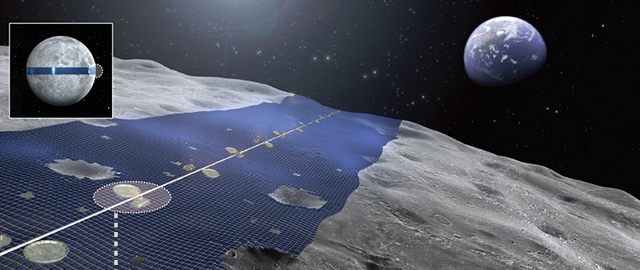
Luna Ring's 11,000-kilometer (6,800-mile) "solar belt" spans the Moon's equator
Electricity collected by the Luna Ring's enormous "solar belt" is relayed to power conversion facilities located on the near side of the Moon. There, the electricity is converted into powerful microwaves and lasers, which are beamed at Earth. Terrestrial power stations receive the energy beams and convert them back to electricity.
Luna Ring feeds power to energy-hungry Earth
The solar power plant is built mainly using lunar resources. Moon rocks and dust are used to manufacture building materials such as cement, bricks and glass fibers. Water is produced through a chemical process involving lunar soil and hydrogen.
Large machinery and equipment from Earth is assembled in space and landed on the lunar surface for installation. Much of the construction is performed by robots controlled by people on Earth, and a team of human astronauts is stationed on the Moon to supervise the robot operations. [More]
* * * * *
- Green Float
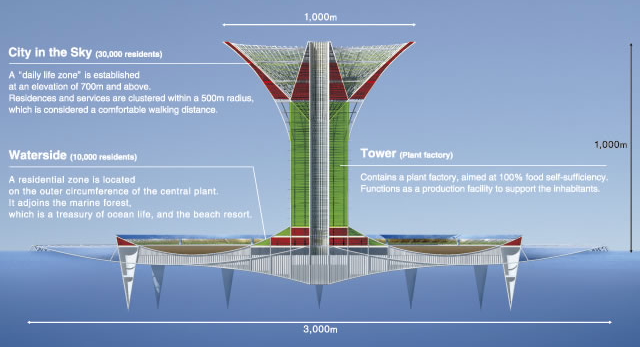
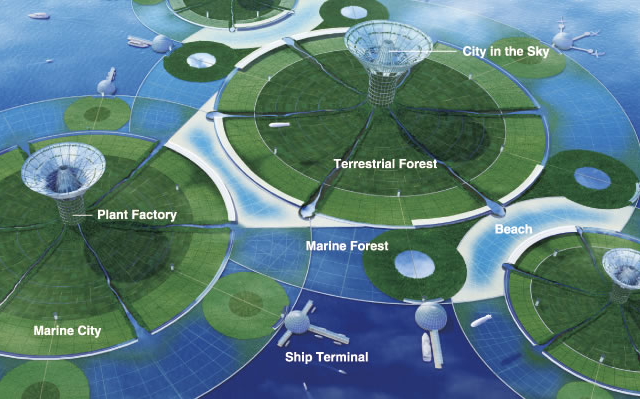
Shimizu's Green Float project seeks to build "botanical" cities that float like giant lily pads in the equatorial Pacific, where sunlight is plentiful and the impact of typhoons is minimal.
Lily pad-like cities at sea
Each floating island features a 1,000-meter (3,300-ft) central tower. The lower section of the tower serves as an industrial area with offices and factories employing 10,000 workers, while the upper section functions as a residential area for 30,000 people. Another 10,000 residents live at ground level, in low-rise townhouses near the beach.
Green Float islands are 3 kilometers (1.9 mi) in diameter and support a population of 40,000
The typical Green Float island landscape consists of forests, grasslands, waterways and reservoirs. A portion of the land is set aside for agriculture and some of the shallow beaches are used for cultivating seafood, making the islands 100% food self-sufficient.
The eco-friendly Green Float cities rely on a variety of natural energy sources, including wave, wind and solar power, as well as ocean thermal energy conversion.
Green Float islands join to form a floating metropolis
Green Float islands are built upon a floating base of connected hexagonal tubes that each weigh 7,000 tons and measure 20 meters (65 ft) across and 50 meters (165 ft) deep. The primary structural material for the honeycomb-like base, as well as for the island's buildings, is magnesium alloy. Seawater -- which is composed of 0.13% magnesium by weight -- is an abundant source of magnesium. One ton of the material can be extracted from 770 tons of seawater. [More]
* * * * *
- Mega-City Pyramid
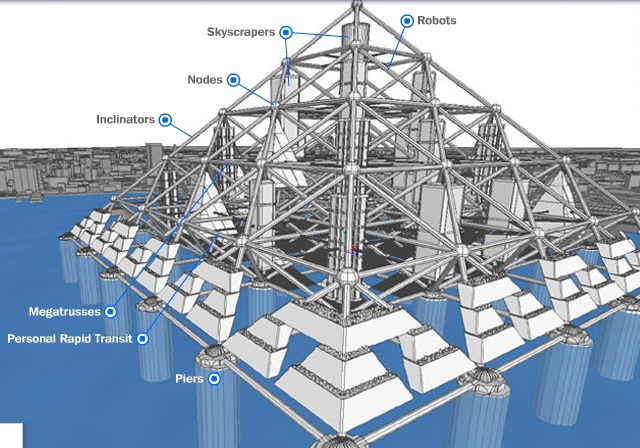
Shimizu's proposed Mega-City Pyramid is a self-contained city for one million people.
The Mega-City Pyramid stands 2,000 meters (1.25 miles) high
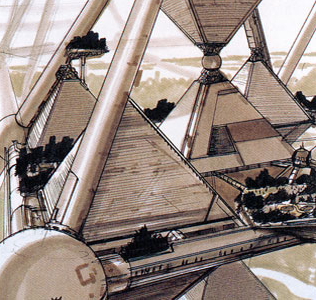
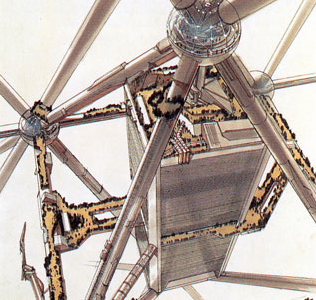
The pyramid-shaped hyperstructure is an assembly of skyscrapers suspended within a skeleton of 350-meter (1,150-ft) long shafts made from lightweight materials (such as carbon and glass fibers).
Residential buildings (left) and office complexes (right) inside Mega-City Pyramid
The skyscrapers within the Mega-City Pyramid are home to residences, offices, research institutions, shopping and entertainment centers, and other facilities. The connecting shafts, which measure from 10 to 16 meters (30 to 50 ft) in diameter, contain the city's plumbing, electrical and communication systems, as well as a network of trains, escalators and moving walkways.
The proposed hyperstructure has a footprint of approximately 8 square kilometers (3 sq mi), and it features an open-air construction that allows sunlight to reach the interior. A network of optical fibers transports sunlight into poorly-lit areas.
Construction of the massive Mega-City Pyramid is facilitated by robots and automated assembly systems, as well as by the use of standardized parts and materials. [More]
* * * * *
- Space Hotel
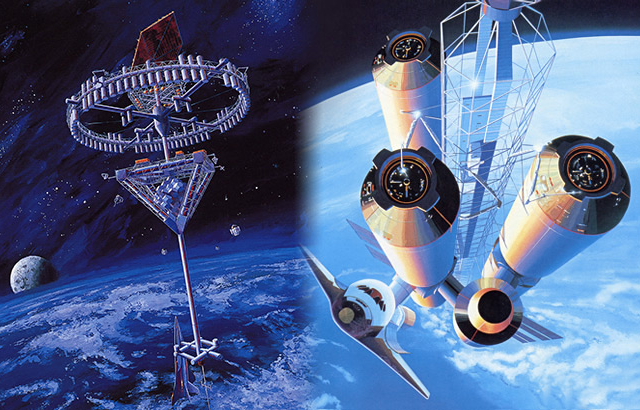
To capitalize on the coming boom in space tourism, Shimizu has developed plans for a space hotel in low-Earth orbit.
Shimizu Space Hotel, located 450 kilometers (280 mi) above Earth
The hotel -- which is powered entirely by solar energy -- features a microgravity recreational area where guests can enjoy sports, dining, and gazing at the Earth and stars. The 64 guest rooms and 40 staff rooms are situated in a ring measuring 140 meters (460 ft) in diameter. The ring rotates at a speed of 3 rpm to produce an artificial gravity of 0.7 g in the rooms. A 240-meter (790-ft) elevator shaft connects the hotel facilities with the docking port. [More]
* * * * *
- Lunar Bases
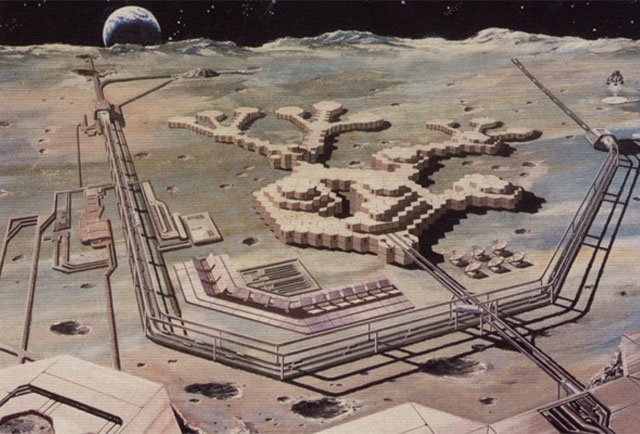
For the more adventurous offworld traveler, Shimizu has developed plans for lunar bases.
Lunar bases are the key to establishing a long-term human presence on the Moon
Shimizu's proposed bases feature a modular design of interlocking hexagonal units that can be arranged both horizontally and vertically. The modules are built using concrete made from lunar soil and rock. Tele-operated robots and automated assembly systems are used to construct the bases. [More]
* * * * *
- Urban Geo-Grid Plan
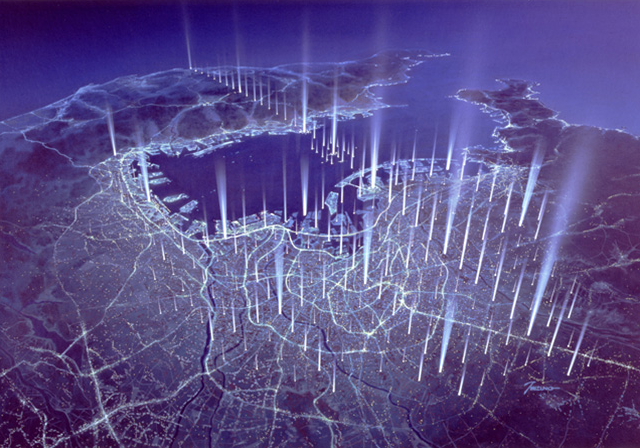
Back on Earth, Shimizu's Urban Geo-Grid Plan seeks to reduce urban congestion and improve the overall efficiency of Tokyo by placing a variety of city functions underground.
Urban Geo-Grid Plan puts much of Tokyo underground
The plan -- which covers an area extending from central Tokyo to the Boso Peninsula on the opposite side of Tokyo Bay -- consists of a vast underground network of so-called "grid points" and "grid stations." Grid points incorporate community facilities such as grocery stores, exhibition halls and public bathhouses, while the larger-scale grid stations incorporate office buildings, hotels, shopping centers, and train stations. An extensive underground transportation network connects the grid points and stations. Moving all these facilities underground frees up an enormous amount of street-level space that can be set aside for parks. [More]
* * * * *
- Desert Aqua-Net Plan
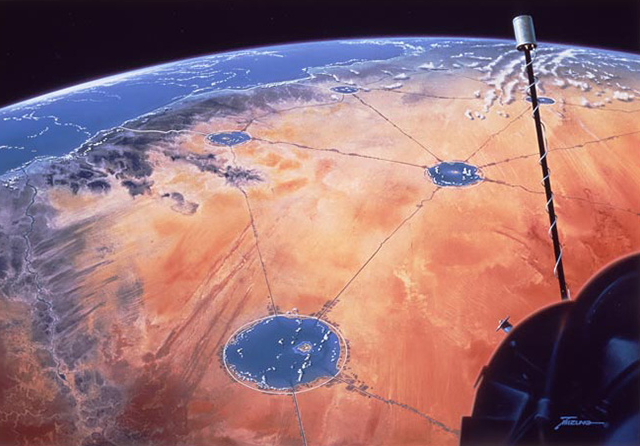
The Desert Aqua-Net Plan seeks to make the desert habitable by constructing a network of lakes and waterways.
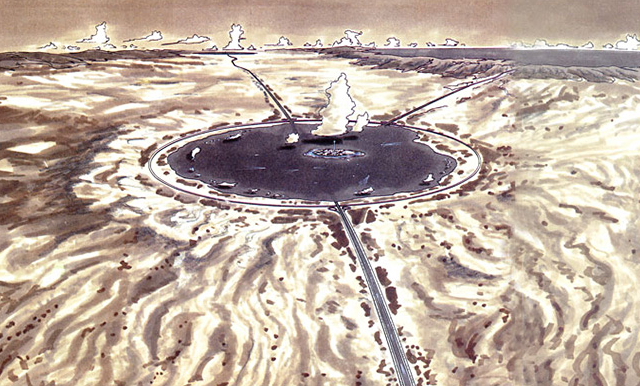
Desert Aqua-Net Plan brings water to the desert
The plan involves creating artificial lakes in low-lying desert areas. Islands are constructed in the middle of the lakes, which are filled with seawater channeled inland through canals. The canals connect the lakes to form an extensive water network.
Located 150 kilometers (95 mi) apart, the artificial lakes measure 30 kilometers (20 mi) in diameter and 20 to 30 meters (65-100 ft) deep. The canals running between the lakes measure 50 meters (165 ft) wide and 10 meters (35 ft) deep
The lakes reduce temperatures and increase humidity in the surrounding areas, creating a comfortable and mild environment. Seafood and biomass resources (such as algae and seaweed) can be cultivated in the saltwater lakes, and the canals can be used to transport people and goods between the cities built on the artificial islands. [More]
Masakatsu Sashie's fantastic "orb" paintings depict large, city-like spheres that float gently above the remains of a failed civilization. The giant orbs, which seem to be self-contained worlds unto themselves, are pieced together from the scraps of old Showa-period buildings and bits of consumer culture, such as vending machines, pachinko parlors, fast food signs, and video game components. Part retro and part sci-fi, the orbs appear to hover gracefully between the worlds of a nostalgic past and a dystopian future.
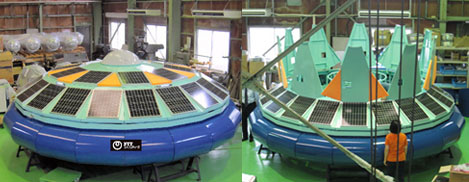
As part of the upcoming Aqua Metropolis festival in Osaka, engineering firm NTT Facilities has developed a pair of solar-powered, UFO-shaped floating water purifiers that will be deployed in the city's canals and in the moat at Osaka Castle.
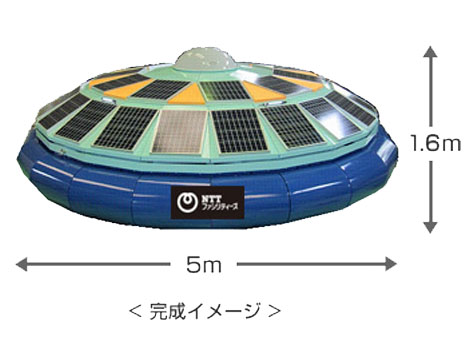
The disc-shaped machines -- called "Solar UFOs" -- weigh about 3.4 tons each and measure 1.6 meters (5 ft) tall and 5 meters (16 ft) across. During the day, an array of solar panels power the machine's filtration system, which pumps fresh oxygen into the water while removing impurities. At night, a 1.3-kilowatt solar battery provides juice to the LED lamps lining the edges of the floating craft.
The machines, which can purify about 9,000 liters (2,400 gallons) of water per day, spray the clean water out through a nozzle on top, like a fountain. In addition to keeping the surface clean of bird droppings and grime, the water spray keeps the solar panels cool, helping to maintain a high output efficiency.
The Solar UFOs are built using technology developed by NTT Facilities, a Tokyo-based company (part of the NTT Group) whose business includes architecture, construction planning, power supply system design, and the management of large-scale solar power plants. The water cleaners are currently not for sale.
Plans are to keep one Solar UFO operating in the Dotonbori canal (in central Osaka) until mid-October. The one in Osaka Castle moat is scheduled to remain in operation until the end of March 2010. NTT Facilities also announced plans to deploy Solar UFOs in Tokyo-area waters in the near future.
What will automobiles look like 50 years down the road? If they turn out to be anything like these concepts from the design studios of four major automakers, we are in for quite a ride.
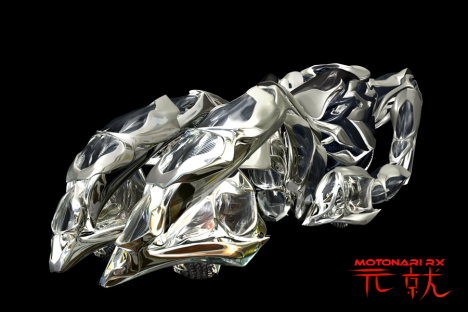
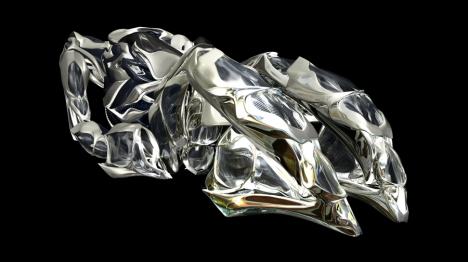
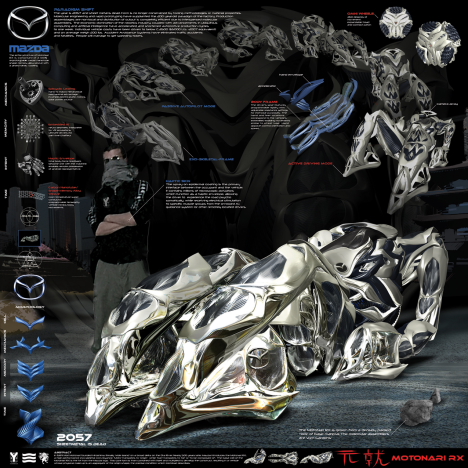
In Mazda's vision of the late 2050s, advances in molecular engineering have rendered metal-based manufacturing obsolete. The rise of ubiquitous computing and artificial intelligence drastically accelerates the automotive production cycle. Cars are cheap, lightweight (around 200 lbs, or less than 100 kg), and equipped with intelligent crash avoidance systems that eliminate traffic accidents. However, people still manage to get speeding tickets.
The Mazda Motonari RX -- which takes its name from the legendary Japanese warrior Mori Motonari -- interfaces seamlessly with the driver to function as an extension of the body.
The vehicle drives sort of like a street luge. Acceleration and direction is determined by two armrest mounted control points, and the vehicle's exoskeletal frame shape-shifts in accordance with the position of the driver's arms and legs when enveloped in the seat.
Omni wheels
Four omnidirectional wheels allow 360 degrees of movement, and the tread expands or contracts to suit the driving conditions.
A "haptic skin" suit consisting of millions of microscopic actuators enables the driver to experience the road psycho-somatically while receiving electrical muscle stimulation from the onboard AI guidance system (or other remotely located drivers).
The vehicle's entire structure is comprised of a 100% reprototypable, carbon nanotube/shape memory alloy weave with a photovoltaic coating, which allows the vehicle to mimic the driver's body movements while powering the in-wheel electrostatic motors. [More]
* * * * *
- Toyota Biomobile Mecha
In Toyota's vision of the late 2050s, cities have developed vertically due to limited area on the ground, leading the transportation industry to develop new vehicles capable of navigating vertical space.
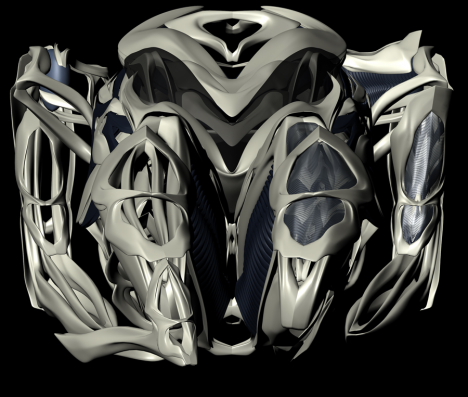
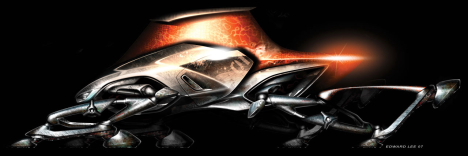
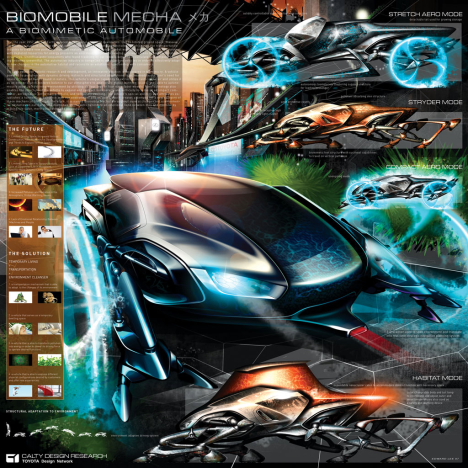
Toyota's Biomobile Mecha, a shape-shifting vehicle with nano-laser wheels, can read and adapt to changes in the environment and travel vertical pathways by means of biomimetic feet with powerful suction.
In addition, the Biomobile Mecha is powered by pollution. A special skin derives energy from harmful substances in the air, so the vehicle never runs out of fuel (as long as the future skies remain polluted) and restores balance to the environment while it goes.
The real-time strategic navigation planning system, which reads the environment via a 3D scanner, gives the vehicle "instincts" that enable it to autonomously adapt to the driving environment.
Advanced nanotechnology enables the vehicle to expand and contract its structure horizontally and vertically as needed, allowing it to serve as a compact commuter, an aerodynamic performance vehicle, or even as a temporary dwelling. [More]
* * * * *
- Nissan OneOne
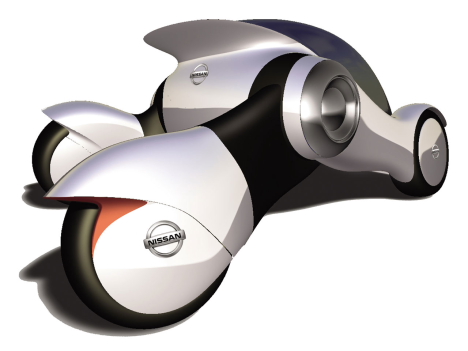
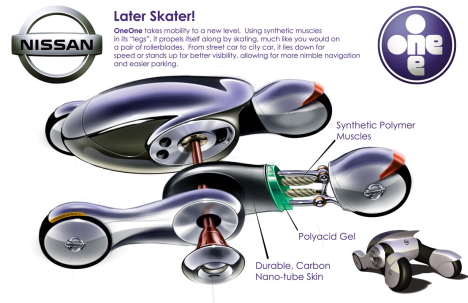
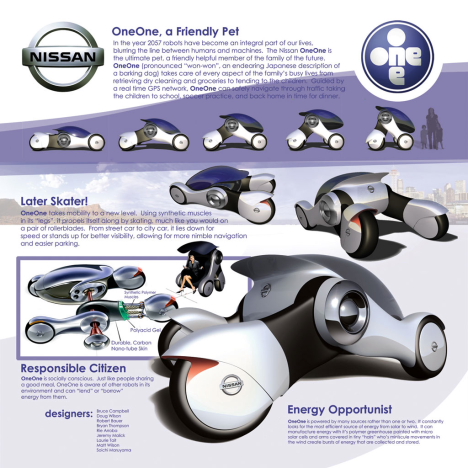
In Nissan's vision of the 2050s, robots have become an integral part of our lives, blurring the line between humans and machines. The Nissan OneOne combines personal mobility with the family robot concept.
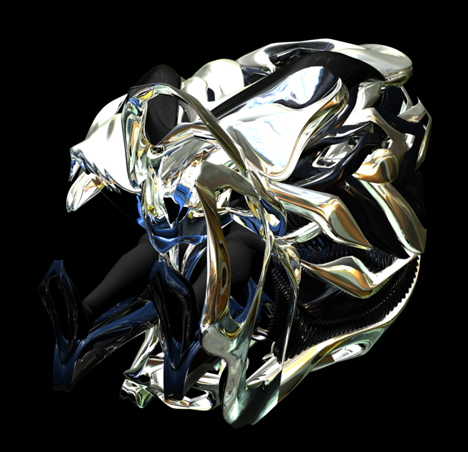
Billed as the ultimate pet, the Nissan OneOne (pronounced "wan-wan," the Japanese sound for a barking dog) is a friendly, helpful member of the family of the future. Able to operate autonomously without a driver, the GPS-guided vehicle can help out by picking up the dry cleaning, fetching the groceries, and taking the kids to school.
The vehicle can also assume various positions depending on the driving environment. It reclines to achieve greater speed, and it stands up to increase visibility and squeeze into tight spaces. [More]
* * * * *
- Honda 124 (One to the Power of Four)
In Honda's vision of the 2050s, people have flocked back to the suburbs, fueling consumer demand for a truly flexible commuter vehicle.
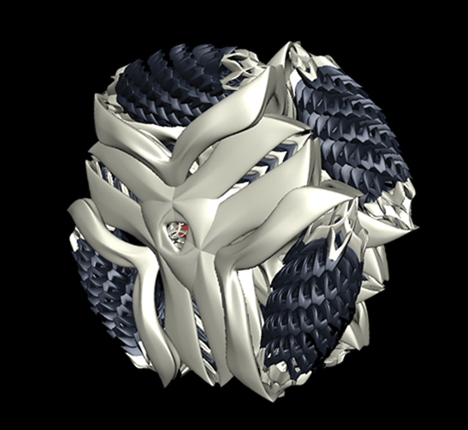
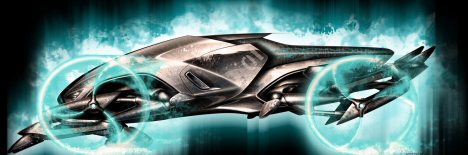
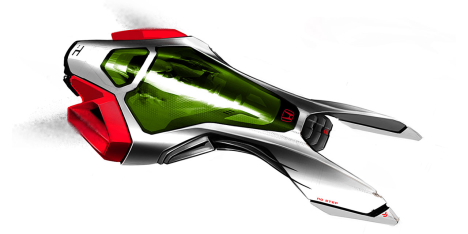
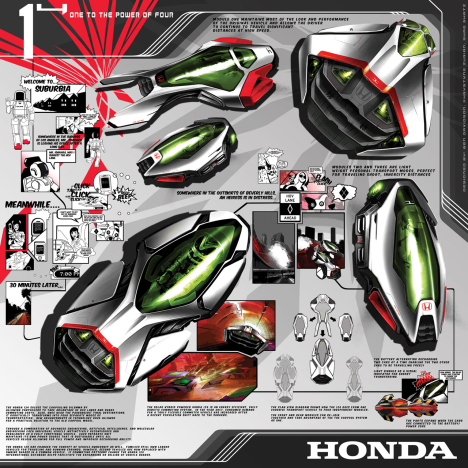
The solar-hybrid powered Honda 124 (One to the Power of Four) is an energy-efficient, modular vehicle that can separate into four different fully functional units, each uniquely suited for specific driving conditions.
A combination of robotics, artificial intelligence and molecular engineering (which enables the body panels to be reshaped according to use) allow each module to instinctively reconfigure itself and operate as a fully functional unit. Two of the modules are suitable for short-distance inner-city driving, while the other two are ideal for longer distances at higher speeds.
Because the Honda 124 consists of multiple units that can be joined together, carpoolers can take advantage of HOV lanes and share commuting costs. [More]
A new online service developed by electronics giant NEC offers carbon-conscious households a fun and friendly way to keep tabs on their energy consumption, as well as that of their neighbors.
Developed in conjunction with major Internet provider BIGLOBE, the service -- called "Carbon Diet" -- includes an easy-to-install wifi-enabled device that attaches to the home circuit breaker and measures power consumption via electric current sensors. The collected data is then periodically transferred to the home computer using a ZigBee wireless link and sent to an online server for processing.
Users can log on to the Carbon Diet website to check their daily and hourly energy consumption and see how they rank in comparison with other participating households. Users can also see how their monthly carbon footprint compares with the same month of the previous year. Based on the degree to which users actually reduce their carbon emissions, they are awarded "eco-points" that can be exchanged for virtual soil, water, flowers and grass in a nature restoration simulation game.
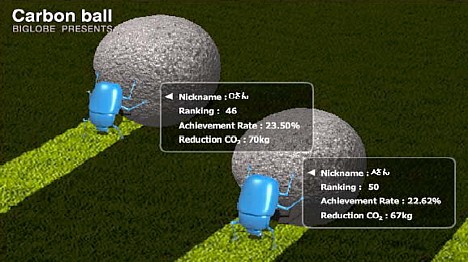
Participants can also view their progress in the form of a game called "Carbon Ball," which features dung beetle avatars in a "carbon ball" rolling contest. The distance each household's dung beetle travels is based on how successful they are in reducing power consumption. The game is designed to instill a sense of competition to keep users motivated and focused on reducing energy consumption.
For now, the three-month trial service is being conducted in the homes of 100 NEC employees. After the trial, NEC and BIGLOBE will work with Ex Corporation (an urban and environmental planning and consulting firm) to analyze the data and develop business models for local governments and the private sector. The company is aiming for sales of 2 billion yen ($20 million) over the next 3 years.
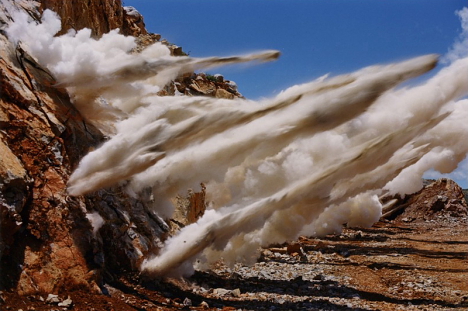
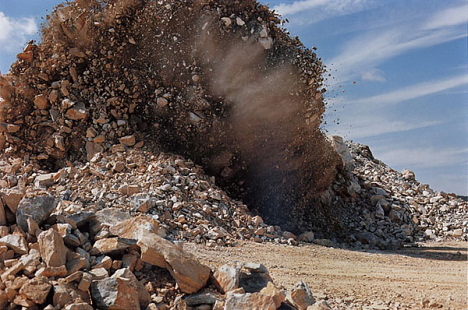
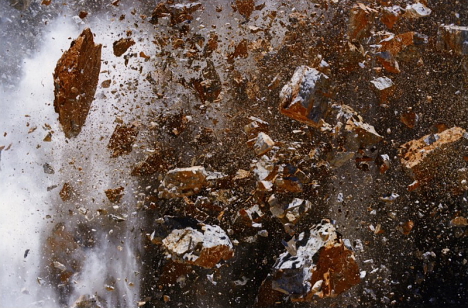
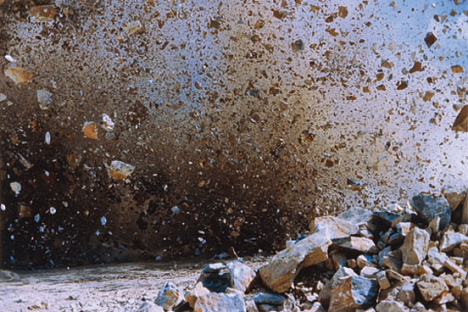
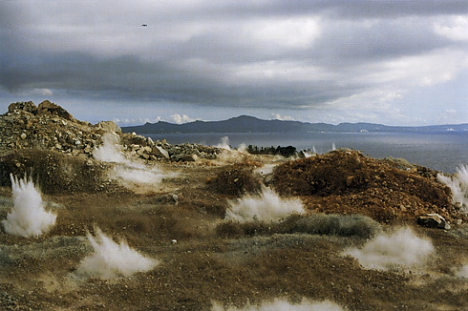
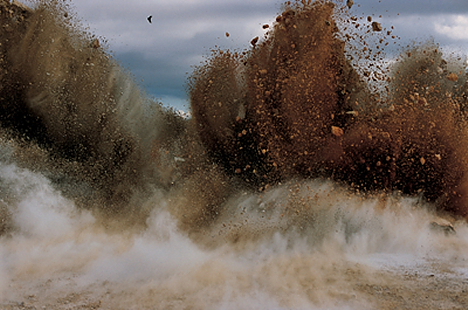
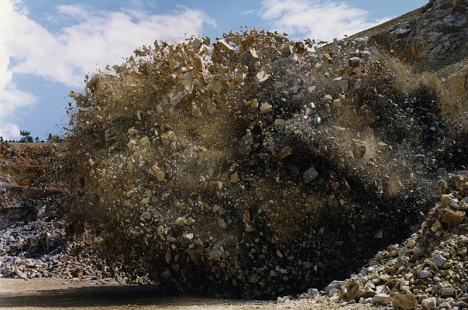
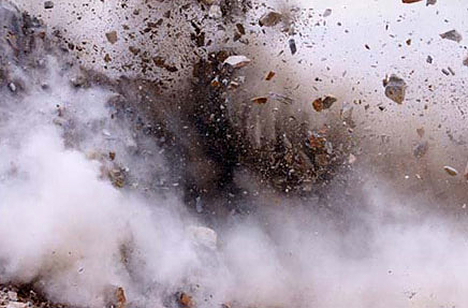
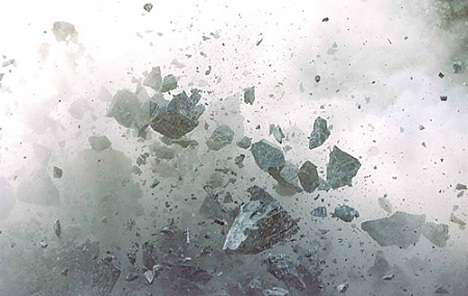
In his "Blast" series of photographs, Naoya Hatakeyama uses remote-control cameras to capture the drama and destruction of Japan's limestone blasting operations from point-blank range.
The dangerous, close-up views of exploding debris inspire the viewer to consider the human capacity for destruction, while providing a unique perspective on the instant obliteration of these ancient rock formations.
Hatakeyama began photographing Japan's limestone mining operations in the early 1980s. In 1994, he published Lime Works, a photo book focused on limestone processing facilities.
In 1995, he turned his camera toward the detonation side of the mining process, which he has been photographing ever since.
Limestone, a sedimentary rock consisting mainly of calcium carbonate (CaCO3), is one of the few natural resources in which Japan is totally self-sufficient.
It can be argued that Japan's (and the world's) entire way of life is dependent on limestone, a key ingredient in the production of concrete, steel, glass, plastic, and even medicine.
Japan extracts about 200 million tons of limestone from quarries each year, scarring countless mountainsides in the process.
The nation is believed to have an additional 10 billion tons of limestone deposits at its disposal -- enough to last another 50 years at the current rate of consumption.
A sewage plant in Japan's Nagano prefecture has started mining gold from sludge, earning a cool 5 million yen ($56,000) in its first month of operation.
On January 28, sewage plant operator Nagano Prefecture Suwa Construction Office announced that approximately 1.9 kilograms (4.2 lbs) of gold can be mined from each ton of molten fly ash generated when incinerating sludge at its facility in the town of Suwa.
Located in central Nagano prefecture, the Suwa Basin is home to numerous precision machining companies, metal plating facilities and hot springs, which may explain the high concentration of gold in the wastewater sludge.
Joint research conducted in 2007 by Nagano prefecture and the Japan Sewage Works Agency found that the concentration of gold in the ash was comparable to that of a high-grade ore. But because the cost of extracting the gold outweighed the potential profit, the operator continued treating the ash as an industrial waste material.
However, with the recent rise in the price of gold, Suwa decided to start mining the molten fly ash. Last October, they sold 1.4 tons of the ash to a smelting company. At the end of January, Suwa is scheduled to receive its first payment of 5 million yen ($56,000) for the recovered gold.
By the end of March 2009, Suwa plans to mine a total of 5 tons of ash for a profit of 15 million yen ($167,000). The sewage operator says it will use the revenue to help pay for plant maintenance and operating costs.
The facility treats about 100,000 tons of wastewater each day, generating about 3 tons of ash in the process.
The Amami rabbit -- a threatened species found only in the Ryukyu Islands -- may become Japan's first endangered animal clone. Scientists at Osaka's Kinki University have cloned an embryo of the endangered rabbit and are awaiting its birth next month, it was announced earlier this week.
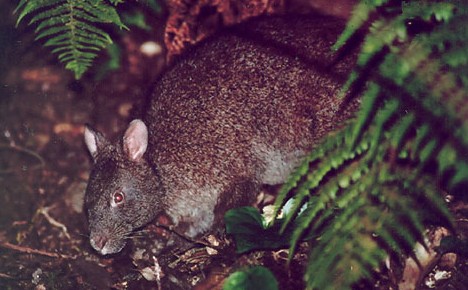
The Amami rabbit (Pentalagus furnessi) is a nocturnal, forest-dwelling "primitive" rabbit with dark fur, short legs, large curved claws and small ears. Found only on the islands of Amami-Oshima and Toku-no-Shima, it is sometimes called a "living fossil" for its resemblance to ancient rabbits that once inhabited the Asian mainland. The Amami rabbit's dwindling population -- now estimated at between 2,000 and 5,000 -- has earned it a spot on Japan's endangered species list.
To produce the clone, researchers took a cell from the ear of a dead Amami rabbit and injected it into the unfertilized egg of an ordinary lab rabbit. After the egg developed into the cloned embryo, researchers inserted it into the oviduct of a lab rabbit surrogate. The clone will be born in the coming weeks if the pregnancy comes to term. The chances of success are slim, though, as cloning pregnancies typically have a high failure rate. However, the scientists are prepared to repeat the process until a clone is born.
Although some people see cloning as a promising tool for restoring endangered populations when natural breeding is not possible, others argue it is more important to address the actual causes of the population decline. Deforestation and road accidents are major reason for the Amami rabbit's decline, as is the predatory mongoose, which humans released on the islands to control the snake population.
Pet dogs and cats also pose a danger to the species. In June, motion-sensitive cameras set up to monitor Amami rabbit activity on the island of Amami-Oshima captured the image of a feral domestic cat dragging a freshly killed carcass through the forest.
If the experiment succeeds, the Amami rabbit will join a growing list of endangered animals that have been cloned. Previous examples include the Asian gaur (a rare ox native to India and Burma), which died two days after it was born in the US in 2001, as well as the European mouflon (a Mediterranean wild sheep) and the Junqueira cow (Brazil).
Regardless of the outcome, the researchers suggest a degree of caution. Although cloning may potentially be used to preserve rare species, little is known about the long-term environmental impact, they said.