Walkman-style brain scanner

Portable brain scanner ---

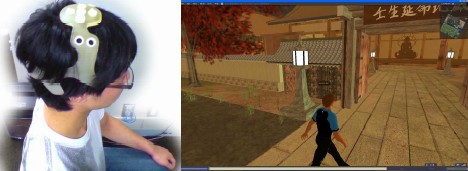
Hitachi has successfully trial manufactured a lightweight, portable brain scanner that enables users to keep tabs on their mental activity during the course of their daily lives. The system, which consists of a 400 gram (14 oz) headset and a 630 gram (1 lb 6 oz) controller worn on the waist, is the result of Hitachi’s efforts to transform the brain scanner into a familiar everyday item that anyone can use.

The rechargeable battery-operated mind reader relies on Hitachi’s so-called “optical topography” technology, which interprets mental activity based on subtle changes in the brain’s blood flow. Because blood flow increases to areas of the brain where neurons are firing (to supply glucose and oxygen to the tissue), changes in hemoglobin concentrations are an important index by which to measure brain activity. To measure these hemoglobin concentrations in real time, eight small surface-emitting lasers embedded in the headset fire harmless near-infrared rays into the brain and the headset’s photodiode sensors convert the reflected light into electrical signals, which are relayed to the controller.

The real-time brain data can either be stored in Flash memory or sent via wifi to a computer for instant analysis and display. A single computer can support up to 24 mind readers at a time, allowing multiple users to monitor brain activity while communicating or engaging in group activities.

In addition to health and medical applications, Hitachi foresees uses for the personal mind reader in fields such as psychology, education and marketing. Although it is unclear what neuromarketing applications the company has in mind, it is pretty clear that access to real-time customer brain data would provide marketers with a better understanding of how and why shoppers make their purchasing decisions. One can also imagine interactive campaigns that, for example, ask customers to think positive thoughts about a certain product in exchange for discount coupons or the chance to win a prize.

The technology could also be used in new forms of entertainment such as “mind gaming,” where the player’s physical brain activity becomes a part of game play. It is also feasible to integrate the brain scanner with a remote control brain-machine interface that would allow users to operate electronic devices with their minds.

Hitachi has yet to determine when the personal mind reader will be made commercially available.

[Source: Tech-On!]

Gemotion screen shows video in living 3D

Gemotion -- Here’s a groovy display for people looking to add that extra dimension to their viewing material…

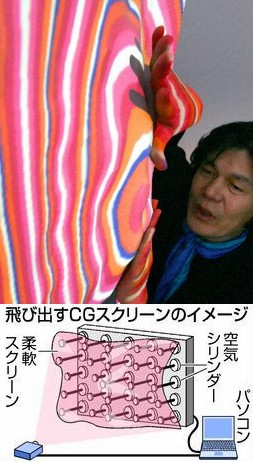
Gemotion is a soft, ‘living’ display that bulges and collapses in sync with the graphics on the screen, creating visuals that literally pop out at the viewer.

Yoichiro Kawaguchi, a well-known computer graphics artist and University of Tokyo professor, created Gemotion by arranging 72 air cylinders behind a flexible, 100 x 60 cm (39 x 24 inch) screen. As video is projected onto the screen, image data is relayed to the cylinders, which then push and pull on the screen accordingly.

“If used with games, TV or cinema, the screen could give images an element of power never seen before. It could lead to completely new forms of media,” says Kawaguchi.

The Gemotion screen will be on display from January 21 to February 4 as part of a media art exhibit (called Nihon no hyogen-ryoku) at National Art Center, Tokyo, which recently opened in Roppongi.

[Source: Asahi]

Video: Asteroid impact avoidance system

This video shows a very simple, yet ingenious way to save the planet from destruction by a giant meteor.

Nintendo Wii commercial — Deliverance version

Check out this parody of a Nintendo Wii commercial based on that unforgettable scene from “Deliverance,” the classic 1972 film starring Burt Reynolds, Ned Beatty and Jon Voight. Wiiiiiiiiiiiiiiiii…

(Link to YouTube video)

[Via: Crazy Japan!]