

Researchers at the University of Tokyo have developed a computerized, sensor-based "magic mirror" that analyzes muscular activity and shows real-time computer-generated images of how hard the user's muscles are being worked while exercising.
The magic mirror, developed under the leadership of professor Yoshihiko Nakamura of the Information and Robot Technology Research Initiative (IRT), was unveiled at the University of Tokyo last Friday. In a demonstration for the media, the system's display monitor showed a real-time computer-generated image of a male model's musculo-skeletal system while he performed a series of physical exercises.
The system, which is currently capable of monitoring the activity of 30% of the body's roughly 300 skeletal muscle pairs, consists of 16 electromyographs (instruments that record the electrical waves associated with muscle activity) attached to the user's body, 10 motion-capture cameras, and a pair of floor sensors to measure the force exerted on the legs.
On the monitor, each muscle is shown in a different color depending on how much it is being used at a particular moment. Active muscles are shown in red, while inactive muscles are shown in yellow.

(Muscle images can also be overlaid on the video image of the user's body.)
The magic mirror system uses newly developed software that is reportedly 10 times faster than previous technology, allowing the system to operate in real-time, even when the user is moving rapidly.
The researchers, who are already working on a more compact version that incorporates the cameras directly into the display, envision the system being used in homes, gyms and hospitals. In addition to helping people get into shape, the system might also help doctors more effectively treat conditions that affect the muscles.
[Sources: Robot Watch, Yomiuri, Nikkei]
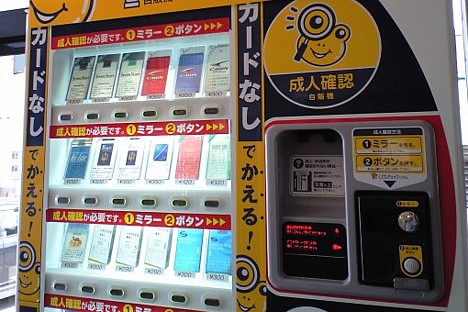
 As part of the age-verification system, most of Japan's 570,000 cigarette vending machines are being outfitted with RFID readers that check the purchaser's Taspo age-verification card. Smokers without a Taspo card can now either buy their cigarettes in person over the counter or use one of 4,000 special machines equipped with face-recognition systems (these machines do not require Taspo cards). More face-recognition machines are on the way, according to vending machine manufacturer Fujitaka, who developed the face-recognition hardware.


 The Japan Aerospace Exploration Agency (JAXA) and public broadcaster NHK have succeeded in capturing their first high-definition video of Earth from the Kaguya lunar explorer, a.k.a. SELENE (SELenological and ENgineering Explorer), an orbiter launched in mid-September on a mission to study the moon. (
 On September 5, the Omron Corporation unveiled smile recognition software that promises to improve the ability of machines to read human emotions.


