Frozen baby mammoth headed to Japan

Baby mammoth --- Researchers at Japan’s Jikei University will soon be checking the mailbox for a cool package from Siberia — the recently discovered frozen body of an ancient baby mammoth. The nearly complete body of the female calf, said to be one of the best-preserved specimens of frozen mammoth ever discovered, is estimated to have been less than one year old before it was preserved in ice about 10,000 years ago.

According to the Russian Tass news agency, a reindeer herder stumbled upon the 130 cm (4 ft 3 in) tall, 50 kg (110 lbs) frozen mammoth in May in an area of permafrost in northwestern Siberia, near the Yuribey River on the Yamal Peninsula, which extends into the Kara Sea. The mammoth, whose trunk and eyes remain intact and which still has some fur on its body, was shown to an international panel of experts that convened on July 5 in the town of Salekhard, near the discovery site.

Preparations are now being made to ship the baby mammoth to Jikei University School of Medicine, where researchers will use advanced computed tomography (CT) scanners to obtain three-dimensional images of its internal organs. “This is the first opportunity for anyone to perform an analysis on a complete mammoth body,” says Jikei University professor Naoki Suzuki, “and it should provide a more complete picture of its anatomy and how it lived.”

[Source: Yomiuri]

Nandemo Microscope provides USB-powered ear, teeth and skin checks

Nandemo Microscope by Thanko --

Want to know how you really look? USB gadget maker Thanko is planning to release a USB-powered microscope called the “Nandemo Microscope,” which ships with four separate attachments, each specifically designed to provide close-up views of different parts of the anatomy. In addition to the standard attachment, the three other attachments allow users to perform oral exams, check inside ears and get close-ups of skin and hair.

With a 1.3 megapixel CMOS sensor, 640 x 480 (VGA) resolution, adustable LED lighting and software for viewing and saving video and still images, you’re only a USB connection away from hooking your computer screen up with a very intimate picture of yourself. Whether or not you would actually want to look at it is another question.

The Nandemo Microscope, which is compatible with Windows 2000 Professional/XP/Vista, goes on sale in mid-July at a price of 12,800 yen (slightly more than $100).

[Source: Nandemo Microscope page via IT Media]

QR code on shrimp crackers

QR Ebi-sen -- Internet content creator Hertz has launched a new marketing service called “QR Ebi-sen,” which allows companies and individuals to print QR code on shrimp crackers. QR code, a type of two-dimensional code that enjoys widespread use in Japan, connects users to mobile web content when they scan it with a QR code reader-equipped cellphone.

Using natural dye extracted from tamarind seeds, the QR code is printed on the smooth surface of white crackers provided by ebi senbei manufacturer Shimahide, whose factory is located in the city of Kanonji in Kagawa prefecture — a place known for delicious ebi senbei. The resulting cracker has a high-contrast, high-quality image readable by a cellphone QR code scanner.

The price for the service starts at 10,000 yen ($85), with an additional fee based on the number of crackers printed. Visitors to the NET Marketing Forum held at Tokyo Midtown from June 6 to 7 will get the first taste of QR Ebi-sen courtesy of the Web Technology Corporation, who will be handing them out from their company booth.

[Source: Impress Watch]

Movie QR code and kung fu high school girls

Movie QR Code -- Hakuhodo DY Group i-Business Center and IT DeSign have developed “movie QR code,” a type of QR code that incorporates moving video into the design.

QR code is a type of two-dimensional barcode that has grown popular in Japan in recent years, because it provides a simple, automated way for users to enter data into their mobile phones. By using mobile phones to scan QR code that appears in an outdoor advertisement, for example, users may be directed to a website containing more detailed product information.

To personalize the appearance of printed QR code, which looks like a chaotic arrangement of tiny black and white squares, IT DeSign recently developed “Design QR,” which incorporates static images of logos, characters or photos into the code. Movie QR code takes this concept a step further by incorporating moving images into the design, thus optimizing it for use on video screens, where it promises to be more effective in attracting the attention of potential scanners. Seriously, how will anyone be able to resist scanning a bit of on-screen QR code if, for example, it contains a cute, bug-eyed critter that literally begs you to scan it?

Movie QR code works just like standard QR code — any user armed with a reader-equipped cellphone can scan it.

On May 21, the companies plan to launch a new type of advertising service built around the use of movie QR code. Details of the service will be announced soon.

Interestingly, a commercial video containing QR movie code has been circulating the web for a while. The video, called “Kung Fu High School Girls” (Kanfuu Joshi-kousei), begins with two high school girls talking about Black Jack (the famous manga character), who they both think is cool. Things quickly turn ugly when the girls disagree about whether Black Jack is a foreigner or Japanese, and a full-on kung fu battle ensues. After a while, a boy wearing a giant QR code headpiece arrives on his bicycle and urges the girls to stop. By scanning his face, he explains, they can find the answer to their question and settle their dispute. (This is a cue for the viewer to scan the computer screen with a cellphone QR code reader.)

Scanning the movie QR code takes you to http://aniful.jp/pr/ (which appears to be accessible only by keitai), where there is a link to another video that contains the answer. For some reason, the Pink Tentacle keitai is having problems downloading that video, so we may never know the truth. Is Black Jack Japanese? Or a foreigner?

[Sources: IT Media, “Kung Fu High School Girl” video (non-YouTube version)]

NTT’s eye-tracking system monitors pupil size, blinking

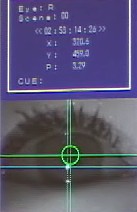
Eye-tracking system recognizes viewer interest --- The NTT Group has unveiled technology that analyzes the interest level of TV viewers and web surfers by monitoring their eye movement, pupil size and blinking.
Improving on conventional eye-tracking systems that provide an understanding of where viewers cast their gaze, this new computer-operated system features cameras that monitor and analyze unconscious physiological reactions to interesting viewing material — namely, enlarged pupils and changes in the rate of blinking.

The technology, which became commercially available on March 14, was developed by NTT Learning Systems (NTTLS) and the Visual Interactive Sensitivity Research Institute (VIS), both of which are involved in visual content creation. NTTLS says the technology can be used in conjunction with driver safety training videos, and negotiations with a major automaker are now underway.

NTTLS claims the system appeals to a wide range of potential users, including those involved in TV commercial advertising and web content creation. Television audience ratings alone do not provide producers a clear picture of the level of interest in commercials, and web traffic stats do not show which parts of a web page visitors find interesting. With this system, however, producers can get a more accurate understanding of what the audience is looking at and how interesting they find it.

Judging from the large size (and presumably high cost) of the device that sits between the viewer and the monitor, though, the system is clearly designed for use in the laboratory. But it’s just a matter of time before this is standard computer monitor/TV screen equipment and producers keep one eye on the real-time audience pupil data while they develop and deliver content.

[Source: Asahi]

Tiny robot reduces need for surgery

Surgical microbot ---

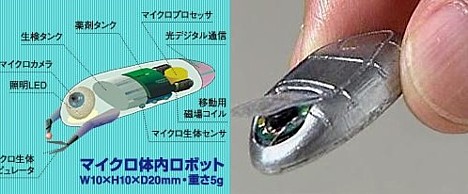
On February 26, researchers from Ritsumeikan University and the Shiga University of Medical Science completed work on a miniature robot prototype that, once inserted into the body through an incision, can be freely controlled to perform medical treatment and capture images of affected areas. The plastic-encased minibot, which measures 2 cm (0.8 inch) in length and 1 cm (0.4 inch) in diameter, can be maneuvered through the body by controlling an external magnetic field applied near the patient.

While other types of miniature swallowable robots have been developed in the past, their role has mostly been limited to capturing images inside the body. According to Ritsumeikan University professor Masaaki Makikawa, this new prototype robot has the ability to perform treatment inside the body, eliminating the need for surgery in some cases.

The researchers developed five different kinds of prototypes with features such as image capture functions, medicine delivery systems, and tiny forceps for taking tissue samples. MRI images of the patient taken in advance serve as a map for navigating the minibot, which is said to have performed swimmingly in tests on animals. Sensor and image data is relayed back to a computer via an attached 2-mm diameter cable, which looks like it can also serve as a safety line in case the minibot gets lost or stranded.

[Source: Chugoku Shimbun]

Nanotext: Holographic print gets 30 times finer

Nanotext --- On February 1, Toppan Printing unveiled new nanotext printing technology for inserting microscopic text into holographic images. The company says they plan to use nanotext to provide an extra layer of security to their “Crystagram” holographic anti-counterfeit technology. Test production is set to begin later this month.

Toppan’s holographic nanotext printing uses electron beams (EB) to print characters 30 times smaller than possible with existing “microtext” technology. With a resolution of about 100 nanometers, it is now possible to print more than 20 holographic characters in a space the width of a human hair (about 80 microns).

Holograms have long been used as an effective method for preventing the counterfeit of items ranging from gift certificates to credit cards to luxury brand products, but organizations find themselves locked into a race with counterfeiters that are quick to adopt new technologies. Nanotext, Toppan argues, provides the next hurdle for counterfeiters to overcome.

Toppan is now working on the technology necessary for mass production, and full market release is scheduled for autumn 2007. The company is aiming for first-year sales of 300 million yen ($2.5 million).

[Source: Toppan press release]

Sayaka: Next-generation capsule endoscope

Sayaka: Next-generation endoscopic capsule --

Endoscopic capsules, ingestible pill-shaped devices designed to capture images from inside the digestive tract, have been around for quite a while. But Sayaka, an endoscopic capsule developed by RF System Lab in December 2005, has dramatically increased the overall image quality by changing the camera position and enabling the camera to rotate.

While conventional capsules — including RF System Lab’s own Norika — typically have cameras at one end of the capsule, Sayaka’s camera has been moved to the side, where it has a better view of the intestinal walls. In addition, a tiny stepper motor rotates the camera as the capsule passes through the digestive tract, allowing Sayaka to capture images from every angle.

Like Norika, Sayaka’s power is supplied wirelessly from an external source, primarily so that no harmful battery substances get into the body.

On a typical 8-hour, 8-meter (26 feet) journey through the gastrointestinal tract, Sayaka snaps approximately 870,000 photos, which are sent to a receiver located near the body. Image mosaicking technology is then used to stitch the images together into a flat, high-resolution rectangular map of the intestines, which can be magnified up to 75 times. In addition to scouring the maps for problem areas, gastroenterologists can compare maps from previous sessions to track changes in a patient’s condition.

And as if all that were not enough, RF System Lab has released a trippy Sayaka promo video featuring a smooth disco/house soundtrack and starring a naked humanoid that floats over the Nazca Lines, shooting beams from its eyes as it scans the landscape below. Cool.

[Link: Sayaka homepage]

Model train controlled via brain-machine interface

Hitachi brain-machine interface -- Hitachi has successfully tested a brain-machine interface that allows users to turn power switches on and off with their mind. Relying on optical topography, a neuroimaging technique that uses near-infrared light to map blood concentration in the brain, the system can recognize the changes in brain blood flow associated with mental activity and translate those changes into voltage signals for controlling external devices. In the experiments, test subjects were able to activate the power switch of a model train by performing mental arithmetic and reciting items from memory.

The prototype brain-machine interface allows only simple control of switches, but with a better understanding of the subtle variations in blood concentrations associated with various brain activities, the signals can be refined and used to control more complex mechanical operations.

In the long term, brain-machine interface technology may help paralyzed patients become independent by empowering them to carry out actions with their minds. In the short term, Hitachi sees potential applications for this brain-machine interface in the field of cognitive rehabilitation, where it can be used as an entertaining tool for demonstrating a patient’s progress.

The company hopes to make this technology commercially available in five years.

[Source: Yomiuri Shimbun via Seihin World]

Iris recognition technology for mobile phones

Iris recognition techology for cellphones -- On November 6, Oki Electric announced the development of iris recognition technology for camera-equipped mobile phones. Unlike Oki’s previous iris recognition technology that relies on infrared cameras for the iris scan, the new technology uses ordinary cellphone cameras.

With plans to make the technology commercially available in March 2007, Oki hopes to boost the security of cellphone payment systems.

According to Oki, any camera-equipped cellphone or PDA can perform iris recognition once the special software is installed. Identification accuracy is said to be high, with only 1 in 100,000 scans resulting in error, and the system can tell the difference between flesh-and-blood eyes and photographs.

[Sources: Nikkei Net, Oki press release]