Enter the Jellyfish Fantasy Hall at Enoshima Aquarium south of Tokyo and you will find yourself surrounded by dazzling swarms of gently pulsating creatures. Here's a look at a few of the species on display there.
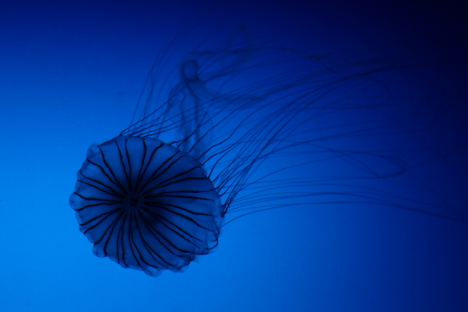
Japanese sea nettle [+]
Jellyfish, which have inhabited the world's oceans in one form or another for over one billion years, come in a dizzying array of shapes, sizes and colors. One species commonly found in Japanese coastal waters in spring and summer is the Japanese sea nettle (Chrysaora melanaster). When full grown, this jelly can reach up to 1 meter (3 ft) in length with an umbrella measuring 20 centimeters (8 in) in diameter.
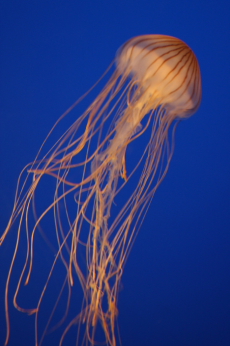
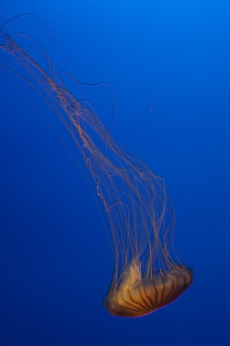
Japanese sea nettle [+] // [+]
The Japanese sea nettle has a relatively strong toxin. If dried and ground into powder, the toxin can irritate the eyes and nose when scattered on the wind. Ninja used to use this jellyfish powder as a weapon, and even today the jellyfish is known in Japan as hakushon-kurage ("sneeze jellyfish").
* * * * *
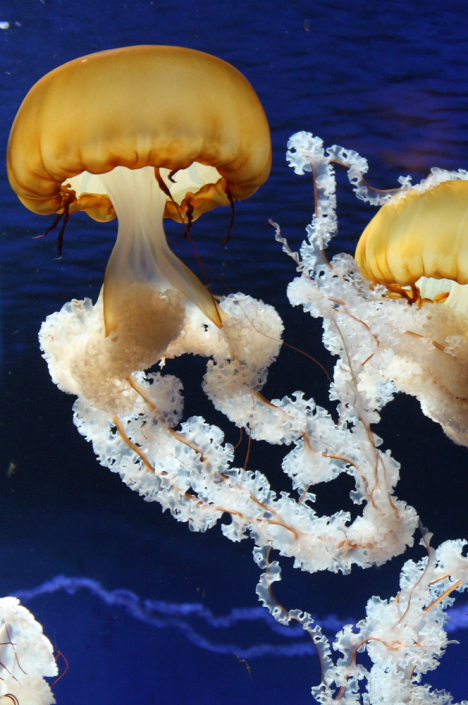
Pacific sea nettle [+]
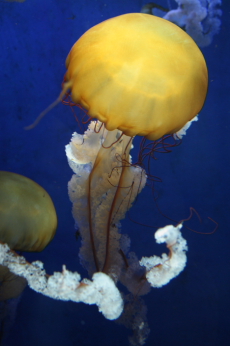
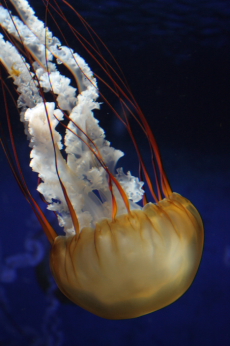
The Pacific sea nettle (Chrysaora fuscescens) is one of the world's largest jellyfish, with an umbrella that typically measures up to 50 centimeters wide and tentacles that stretch up to 2 meters (6.5 ft) in length. It has a moderate to severe sting that can cause welts to form.
Pacific sea nettle [+] // [+]
Found in the northwestern Pacific along the North American coast (and not in Japanese waters), this sea nettle has adapted to the cold California Current.
* * * * *
Atlantic sea nettle [+]
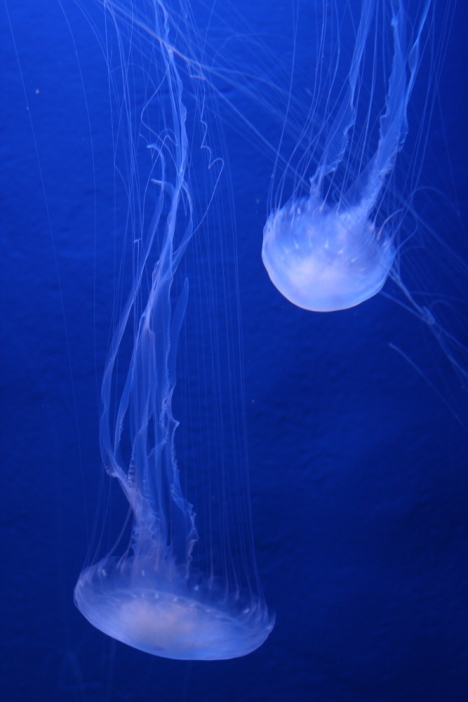
The Atlantic sea nettle (Chrysaora quinquecirrha) is found in the Atlantic along the North American coast, and like its Pacific cousin, this jelly can inflict a nasty sting. Its semi-transparent body makes it difficult to spot -- a problem both for beachgoers and for the sea nettle's prey.
* * * * *
Upside-down jellyfish [+]
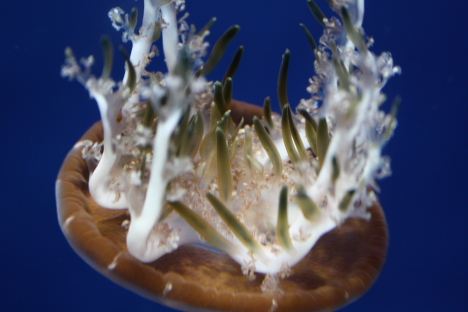
The upside-down jellyfish (Cassiopea sp.), which has an umbrella that typically grows to about 20 centimeters (8 in) in diameter, is found in shallow waters from the tropics to the subtropics.
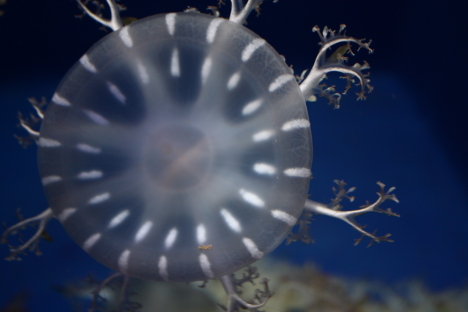
Upside-down jellyfish [+]
This jellyfish gets its name from the fact that it is usually seen upside-down on the sea floor, where it feeds on small plankton that drop down from above.
* * * * *
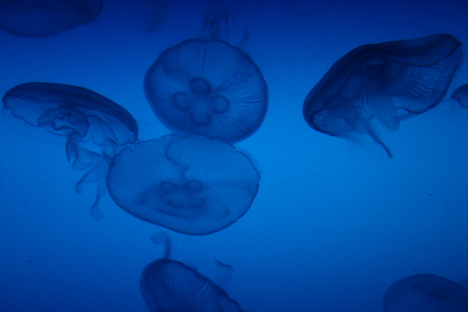
Moon jelly [+]
The moon jelly (Aurelia aurita) is probably the world's most widely distributed jellyfish. It is quite commonly found along the shores of Japan. Although it is composed of more than 95% water, it has an amazing ability to quickly heal itself, even after severe injuries. The moon jelly typically grows to a length of 15 centimeters (6 in) from the top of the umbrella to tip of the tentacles, with a diameter of 30 centimeters (1 ft).
* * * * *
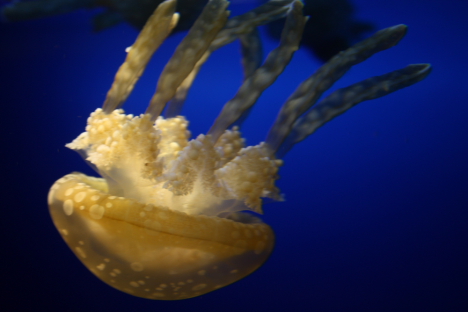
Spotted jellyfish [+]
The spotted jellyfish (Mastigias papua) has a brownish umbrella with white spots. With thick tentacles resembling the arms of an octopus, this creature is known in Japan as tako-kurage, or "octopus jellyfish." The spotted jellyfish gets its color from the algae that lives within its umbrella. This algae produces a type of sugar through photosynthesis that serves as a nutrient for this jellyfish.
Instead of one single mouth, the spotted jellyfish appears to have several smaller mouth openings in its oral arms.
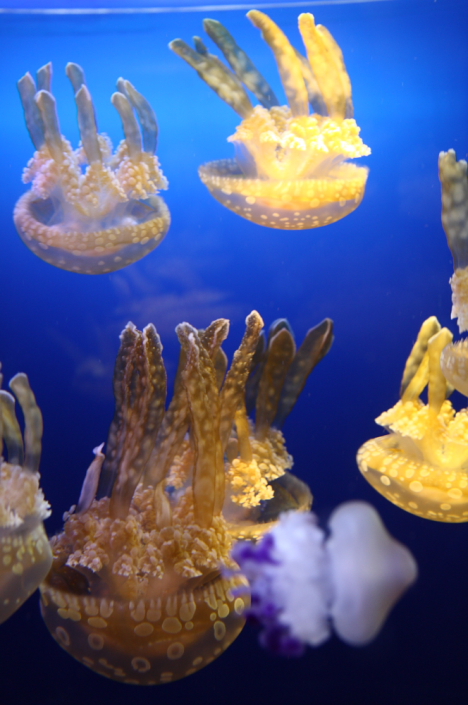
Spotted jellyfish [+]
Though mainly found in the southern Pacific Ocean, the spotted jellyfish is active in Japanese waters from summer to autumn. When full grown, this jellyfish measures about 50 centimeters (1 ft 8 in) from top to bottom and 15 centimeters (6 in) wide.
* * * * *
Other species found in the Jellyfish Fantasy Hall include the blue jellyfish (Catostylus mosaicus), brownbanded moon jelly (Aurelia limbata), and Amakusa jellyfish (Sanderia malayensis).

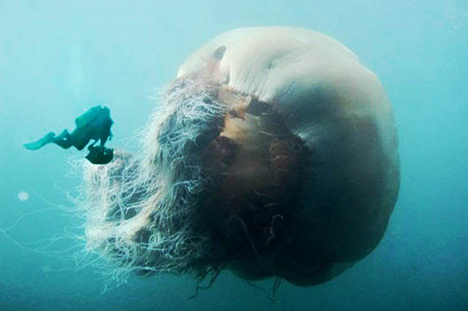
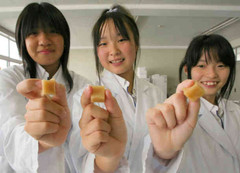 The students began cooking with Nomura's jellyfish three years ago, after a NASA-designed food safety management system was installed at the school. In 2006, after the school developed a method for processing giant jellyfish into an edible powder, a local company began using it as an ingredient in their jellyfish cookies.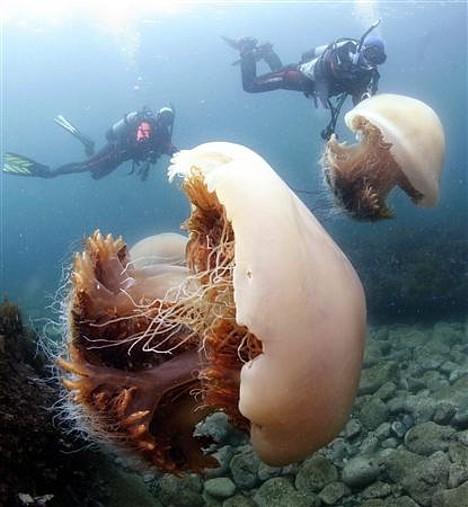
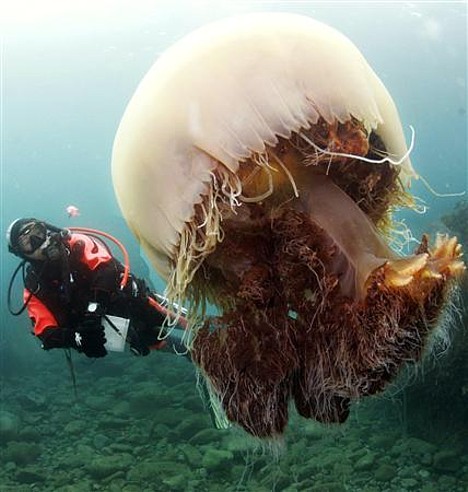


 In the latest development in Japan's war against giant
  As part of an
 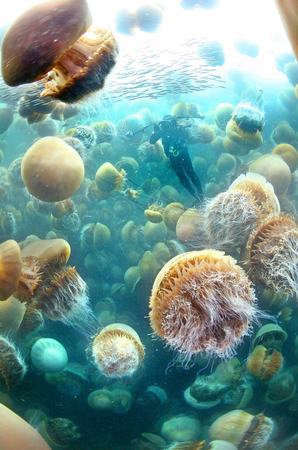 This crazy photo from the Yomiuri Shimbun shows a diver swimming amongst a swarm of giant jellyfish. These giant sea blobs, known as Echizen kurage (


