25 Apr 2008
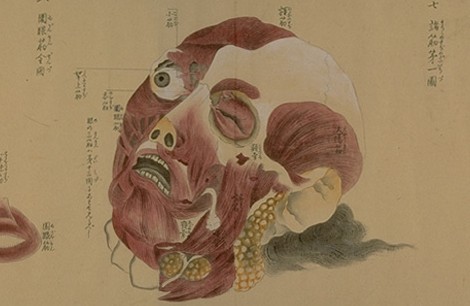
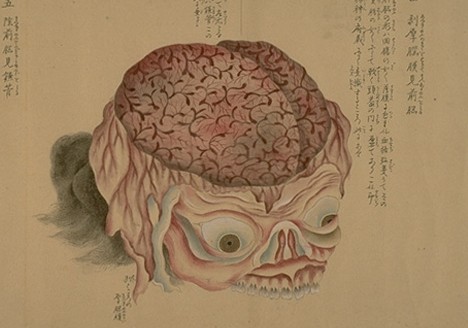
The Kaibo Zonshinzu anatomy scrolls, painted in 1819 by Kyoto-area physician Yasukazu Minagaki (1784-1825), consist of beautifully realistic, if not gruesome, depictions of scientific human dissection.

Unlike European anatomical drawings of the time, which tended to depict the corpse as a living thing devoid of pain (and often in some sort of Greek pose), these realistic illustrations show blood and other fluids leaking from subjects with ghastly facial expressions.

The fact that the bodies used in scientific autopsies in Edo-period Japan generally belonged to heinous criminals executed by decapitation adds to the grisly nature of the illustrations.

According to the Keio University Library (where these documents are currently stored), the two scrolls contain 83 illustrations based on Minagaki’s observations of over 40 bodies. They are regarded as the best collection of early 19th-century anatomical drawings by a Japanese hand.

The first scroll includes a handwritten compliment by Philip von Siebold, the German physician credited with being the first European to teach Western medicine in Japan, who was reportedly impressed by the quality of the drawings when he observed them in 1826.

Siebold’s note, in Dutch, reads: “This anatomical research has been carried out with great diligence and should therefore achieve great recognition.”

In 2003, Japan’s Ministry of Culture designated Kaibo Zonshinzu an important cultural property, saying that the scrolls, which were produced as a result of actual observation and based on Dutch scholarship, demonstrate the level of knowledge that medical science reached in the Edo period.

[Link: Kaibo Zonshinzu via Ectoplasmosis >> Morbid Anatomy >> Bibliodyssey]
21 Comments ::: Art, Crime, Health, Keio University, Relic
12 Oct 2007

While recent developments in brain-computer interface (BCI) technology have given humans the power to mentally control computers, nobody has used the technology in conjunction with the Second Life online virtual world — until now.
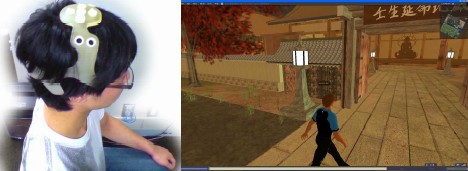
A research team led by professor Jun’ichi Ushiba of the Keio University Biomedical Engineering Laboratory has developed a BCI system that lets the user walk an avatar through the streets of Second Life while relying solely on the power of thought. To control the avatar on screen, the user simply thinks about moving various body parts — the avatar walks forward when the user thinks about moving his/her own feet, and it turns right and left when the user imagines moving his/her right and left arms.
The system consists of a headpiece equipped with electrodes that monitor activity in three areas of the motor cortex (the region of the brain involved in controlling the movement of the arms and legs). An EEG machine reads and graphs the data and relays it to the BCI, where a brain wave analysis algorithm interprets the user’s imagined movements. A keyboard emulator then converts this data into a signal and relays it to Second Life, causing the on-screen avatar to move. In this way, the user can exercise real-time control over the avatar in the 3D virtual world without moving a muscle.
Future plans are to improve the BCI so that users can make Second Life avatars perform more complex movements and gestures. The researchers hope the mind-controlled avatar, which was created through a joint medical engineering project involving Keio’s Department of Rehabilitation Medicine and the Tsukigase Rehabilitation Center, will one day help people with serious physical impairments communicate and do business in Second Life.
(For video of the Second Life BCI, check the links on the Ushida & Tomita Laboratory news page, right above the first photo.)
[Source: Nikkei Net]
55 Comments ::: Brain, Game, Health, Keio University, Simulacra, Smart Tech
19 Sep 2006

In a move that could provide a crucial boost to our robotic friends struggling up the near side of the Uncanny Valley, major cosmetics manufacturer Kao Corporation and a Keio University research team led by robotics professor Takashi Maeno have developed an artificial skin that feels just like human skin.
Skin, the largest organ of the human body, consists of a soft layer of tissue (dermis) covered by a tougher protective layer (epidermis). The artificial skin developed by Kao and Keio mimics the feel of human skin with a 1-cm thick “dermis” of elastic silicone covered by a 0.2-mm thick “epidermis” of firm urethane. Countless tiny hexagonal indentations etched into the urethane epidermis provide it with a very realistic texture.
In a series of unscientific tests, 10 out of 12 people who touched the skin thought it felt like human skin, while equipment designed to measure the mechanical properties of skin confirmed the artificial skin had characteristics resembling human skin.
The skin was unveiled earlier this month at the 24th Annual Conference of the Robotics Society of Japan (RSJ) at Okayama University. While Kao plans to use the artificial skin in the development of new cosmetics, Professor Maeno sees potential applications in the field of household robotics, where there are many opportunities for human-robot interaction.
[Source: Yomiuri Shimbun]
19 Comments ::: Household, Kao, Keio University, Material, Robot, Simulacra
01 Aug 2006
The East Japan Railway Company (JR-East), as part of research aimed at developing more environmentally friendly train stations, is testing an experimental system that produces electricity as people pass through ticket gates. JR claims that this sort of human-powered electricity generation system may provide a portion of the electricity consumed at train stations in the future.
The ticket gate electricity generation system relies on a series of piezo elements embedded in the floor under the ticket gates, which generate electricity from the pressure and vibration they receive as people step on them. When combined with high-efficiency storage systems, the ticket gate generators can serve as a clean source of supplementary power for the train stations. Busy train stations (and those with large numbers of passengers willing to bounce heavily through the gates) will be able to accumulate a relatively large amount of electricity.
JR-East, who worked with Keio University to develop the system, claims that in addition to being put to use as an independent power supply that does not require hardwiring, the system can also be used as a way of measuring the traffic flow through ticket gates.
The system is being tested at the JR-East head office in Shibuya, where it is installed at the entrance to the reception area on the 4th floor. As visitors pass through the gate, a lamp lights up, signifying that electricity has been produced. Testing of the system will continue until August 11.
[Source: Chunichi Shimbun via /.Japan]
12 Comments ::: Energy, JR, Keio University, Tokyo, Transportation