15 Nov 2007

To anyone planning a visit to Japan, please note: YOU WILL BE TREATED AS A POTENTIAL TERRORIST WHEN YOU ARRIVE. As many foreign residents in Japan are already painfully aware, a new law that takes effect November 20 will require non-Japanese people entering the country to be fingerprinted and photographed in the name of fighting terrorism.
Over the past few days, Ministry of Justice officials at airports across Japan have been staging promotional events and showing off the new hardware that will be used to collect the fingerprints and scan the faces of the estimated 5 to 6 million foreigners potential terrorists that enter the country each year. The devices, which proudly bear the NEC logo, consist of a monitor, two fingerprint readers (one for each hand) and a camera that captures mugshots. The devices are being installed at immigration counters nationwide so that you can be fingerprinted and photographed while immigration officials ask you the usual questions about the purpose of your visit and your intended length of stay. Your biometric data will then be stored for an extended period of time in a database, which law enforcement officials will somehow use to thwart terrorist attacks.
Under the law, called the Immigration Control and Refugee Recognition Act, all non-Japanese citizens — except for state guests, visitors using diplomatic or official passports, people under the age of 16, and special status permanent residents (such as Korean nationals who grew up in Japan) — are to be treated as potential terror threats and must be fingerprinted and photographed when they enter the country. The law makes Japan the world’s second country to fingerprint and photograph its foreign visitors. The United States was first.
Japanese lawmakers, who passed the law with little public debate, conveniently overlooked the fact that Japanese people — not foreigners — are the ones with a proven history of committing terrorism in Japan. In fact, Japanese citizens have been responsible for every terrorist incident in modern Japanese history (i.e. the Aum Shinrikyo gassing of the Tokyo subways in 1995), which raises the question of why there is any need to fingerprint and photograph foreigners to begin with.
Or, at the very least, if lawmakers truly believe that blanket fingerprinting and face-scanning is the way to prevent terrorism, then why not require all people in Japan — citizens and non-citizens alike — to keep their fingerprints and other biometric data on file? Without a doubt, NEC and other companies that develop biometric system hardware and software would be more than willing to supply the government with the extra equipment they need to do the job.
Regardless, for now at least, the xenophobic government seems content to invade the privacy of millions of law-abiding foreigners who live, do business, visit and study in Japan each year.
Thanks a lot, Japan.
[Photos via Sankei, Asahi]
26 Comments ::: Biometrics, Law, NEC, Security
25 Sep 2007
NEC Corporation has teamed up with Aida Engineering to develop a briefcase-sized DNA analysis system that allows police to perform comprehensive DNA testing at crime scenes in as little as 25 minutes. NEC is calling the device the world’s first portable all-in-one DNA analysis system able to handle all DNA testing processes from extraction to analysis. Designed specifically for law enforcement officials and planned for release in 2008, the system measures 50 x 40 x 20 cm (20 x 16 x 8 in.), making it small enough to be carried to crime scenes or other locations where quick DNA analysis is required.
Nowadays it typically takes about one day to complete a DNA analysis (one week if re-testing or confirmation is required), and a variety of different equipment is used to perform the separate processes. NEC’s new portable system, on the other hand, can perform all the processes within the same unit — and it can do it all more quickly. In particular, the compact unit can be used to: (1) take cell samples, (2) extract the DNA, (3) perform polymerase chain reaction (PCR) amplification to generate copies of the DNA, (4) perform electrophoresis to measure the spacing between DNA bands (to create the genetic fingerprint), and (5) perform short tandem repeat (STR) analysis to create a unique genetic profile for the individual. In addition, the compact unit dramatically speeds up the processes — particularly the repeated heating and cooling processes performed in PCR amplification — making it possible to complete the entire DNA analysis in 25 minutes.
The system will be exhibited at the 18th International Symposium on Human Identification scheduled for October 1 to 4 in Los Angeles, and at a meeting of the Japanese Association of Sociology of Law scheduled for November 8 in Tokyo.
[Source: NEC press release]
9 Comments ::: Biometrics, Crime, Electronics, NEC
20 Jul 2007
On July 19, electronics giant NEC announced it has developed the world’s first automated border control system that uses facial recognition technology capable of identifying people inside their automobiles. The system is already in operation at checkpoints on the Hong Kong - Shenzhen border.
Built around NEC’s NeoFace biometric face recognition system, as well as NEC’s electronic passport technology, the system is designed to boost the speed and efficiency of Hong Kong Immigration Department operations by allowing residents with microchipped national ID cards to remain in their vehicles while automated cameras verify their identities. Hong Kong residents aged 11 or over are required by law to carry a national ID card (HKID), and the recently issued “smart” IDs are embedded with chips that contain biometric and personal data.
The system works by first reading a vehicle’s license plate as it approaches a border gate. Because each vehicle in Hong Kong is registered to an individual driver, a simple automated database check determines who the driver should be. Next, the cameras scan the face of the driver and a database search is performed. If there is a match, the immigration process is completed and the gate opens, allowing the vehicle to pass through.
For now, NEC’s setup only works with truck drivers, but coming improvements promise the ability to identify up to 8 passengers per vehicle. The cameras have been installed at 8 of the 40 border gates on a new road connecting Hong Kong and Shenzhen, with all 40 gates expected to be upgraded by August.
NEC eventually hopes to develop a face recognition system so quick and accurate that it would eliminate the need for fingerprinting.
[Sources: Softbank Business + IT, NEC press release]
6 Comments ::: Asia, Biometrics, Imaging, NEC, Security, Smart Tech, Transportation
10 May 2006
On May 9, NEC announced the development of new technology that enables its PaPeRo household robot to connect with a variety of personal devices. The technology provides PaPeRo with a digital avatar that “follows” you to the device of your choice, where it appears on the screen and interacts with you.

Details of conversations with the robot and its avatar are exchanged between the devices so that PaPeRo can provide services and information tailored to your needs when you change devices. The avatar, a virtual representation of NEC’s PaPeRo, is designed to work on computers as well as other personal devices such as PDAs and car navigation systems.
When the robot is connected to devices via wireless LAN, saved data — including data about your interests and tastes — can be shared between the robot and its avatars. For example, after telling the real PaPeRo at home that you would like to eat Chinese food, PaPeRo’s avatar appears on your car navigation screen when you get in your car. There, the avatar searches for the route from your home to the restaurant of choice and provides directions. The search results can also be easily transferred to your PDA.
The user-friendly conversation-based control is designed to eliminate the cumbersome task of learning how to operate the avatar on multiple devices with different interfaces. Originally developed by NEC in January 1997, PaPeRo has received upgrades in speech and face recognition skills, gaining the ability to provide information to users through conversation and manage schedule information.
NEC has not announced when this new technology will be made commercially available, but has expressed the intent to continue with technological developments aimed at helping inexperienced children and the elderly to operate a variety of devices.
(Watch VIDEO of PaPeRo in action (QuickTime, 1.24 MB). Here, the demonstrator asks PaPeRo for shopping recommendations and instructs it to move to the car navigation system and the PDA.)
[Source: Nihon Keizai Shimbun]
No Comments ::: Electronics, NEC, Robot, Smart Tech
03 Mar 2006
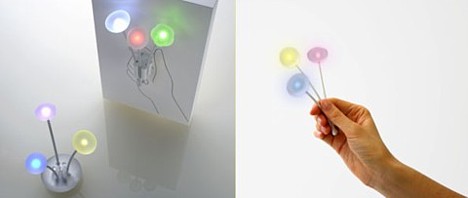
NEC, NEC Design and SGI Japan have teamed up to develop KOTOHANA, flower-shaped terminals that use LED light to remotely communicate human emotions.
Each KOTOHANA set consists of two flower-shaped terminals equipped with LEDs that change color according to the emotions of the person who owns the counterpart. Each flower contains a microphone that captures voice data for processing, the results of which are sent via wireless LAN to the other terminal, where it is expressed as LED light.

KOTOHANA’s Sensibility Technology (ST) emotion recognition engine, which was developed by SGI Japan with the cooperation of AGI, detects joy, sorrow, calmness and excitement in speech patterns. Happiness is expressed as yellow, sadness as blue, calmness as green, and excitement as red. Changing emotions are expressed through subtle color gradations and variations in light brightness.
The product is still in the prototype stage, with the ST engine running on a separate computer connected to KOTOHANA. NEC plans to showcase KOTOHANA at CeBIT, the international trade show for information and telecommunications technology to be held from March 9 to 15 in Hannover, Germany.
[Source: Yahoo! News Japan via japan.internet.com]
13 Comments ::: Illumination, NEC, SGI Japan, Smart Tech, Telepresence