SWITL -- an impressive "robot hand" tool developed by factory equipment manufacturer Furukawa Kikou -- seems to defy the laws of nature by picking up deposits of gels, sauces and other soft semi-liquids without smearing them or altering their shape. This demo video shows how well the tool handles mayonnaise and ketchup.
Details about the technology are not available on Furukawa Kikou's website (perhaps because the patent is pending), but the tool appears to incorporate a conveyor belt design. According to the company, the magic goop scoop was originally developed for use in bakery production lines, but its unique ability to cleanly handle semi-liquids makes it suitable for a wide range of applications.
Robotics researchers from Osaka University have teamed up with NTT Docomo and Qualcomm to develop a handheld humanoid phone that brings a new dimension to mobile communications. A prototype of the device -- called "Elfoid P1" -- was unveiled at a presentation in Tokyo on March 3.
The Elfoid phone is a miniature version of the Telenoid R1 robot developed last year by a research team led by Osaka University professor Hiroshi Ishiguro. The current prototype measures 20 centimeters (8 in) long, is covered in a soft fleshy urethane skin, and has the same genderless and ageless appearance as the Telenoid. The control buttons are embedded in the chest, which glows green when the Elfoid is in use.
Dr. Ishiguro with Telenoid and Elfoid [Photo by: eSeL.at]
Like the full-sized Telenoid robot, the Elfoid handset is designed to add an element of realism to long-distance communication by recreating the physical presence of a remote user.
Equipped with a camera and motion-capture system, the Elfoid phone will be able to watch the user's face and transmit motion data to another Elfoid phone, which can then reproduce the face and head movements in real-time.
The current prototype is unable to move, but future versions will incorporate tiny motors and parts made from shape-memory alloys, allowing the Elfoid to move its eyes, mouth, neck and arms. Other features will include a temperature sensor, accelerometer, and an easy-to-use voice and gesture based interface.
Tetsujin 28-gō, the famous Japanese robot manga series written and illustrated by Mitsuteru Yokoyama, ran as a monthly insert in Shōnen Magazine from July 1956 to May 1966. The manga follows the adventures of a 10-year-old boy named Shotarō and his giant crime-fighting robot named Tetsujin 28 (a.k.a "Gigantor" in the US), which was originally built by the boy's late father as a secret weapon for the Japanese military during World War II.
Visitors to the Digital Content Expo in Tokyo last weekend were treated to a choreographed dance routine featuring AIST's feminine HRP-4C robot and four humans.
The performance, called "Dance Robot LIVE! - HRP-4C Cybernetic Human," is the culmination of a year-long effort to teach the humanoid to dance. The routine was produced by renowned dancer/choreographer SAM-san (a member of the popular music group TRF who has worked with numerous well-known artists like SMAP and BoA), and the lip-synced song is a Vocaloid version of "Deatta Koro no Yō ni" by Kaori Mochida (Every Little Thing).
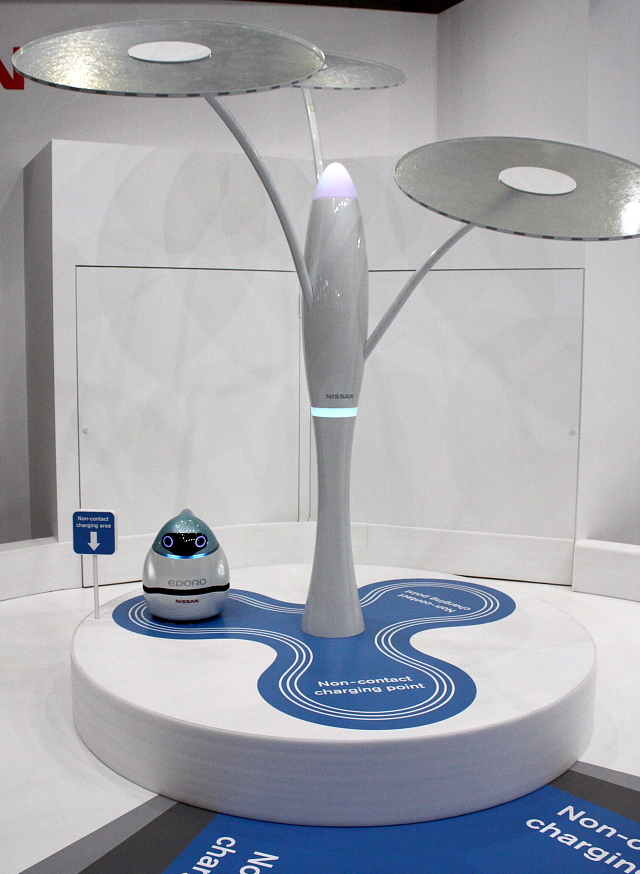
At the CEATEC Japan 2010 trade show now being held in Chiba (Oct 5-9), Nissan is exhibiting a futuristic model of a solar-powered wireless charging station for electric vehicles.
Solar Tree: Coming in 2030 to a city near you
The envisioned tree-shaped charging station -- called the "Solar Tree" -- stands 12 meters (39 ft) tall and has three translucent round solar panels that follow the sun across the sky. With an expected conversion efficiency of 30%, the three solar panels together can generate 20 kilowatts of power. At the base of each tree is a clover leaf-shaped wireless charging pad that can recharge batteries from a short distance, without the use of cables or plugs.
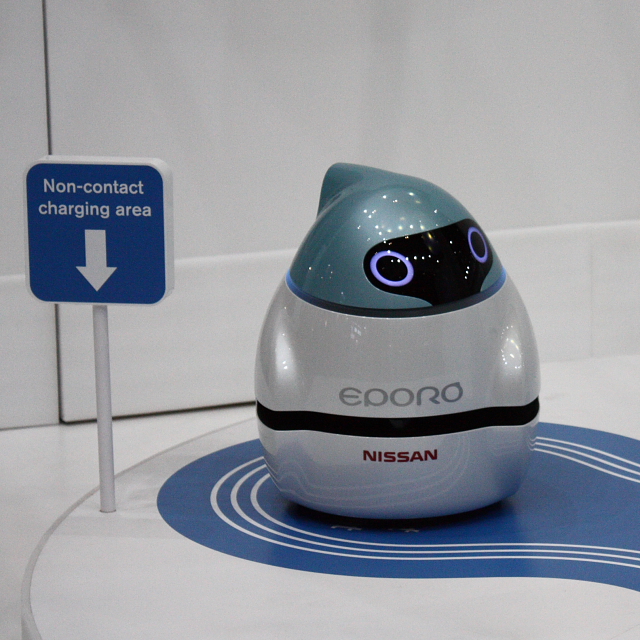
As part of the exhibition, Nissan showed off the latest version of its EPORO robot car, which has been outfitted with a wireless power system. In addition to recharging itself under a Solar Tree, the robot can also repower itself on the go by receiving electrical energy via charging lanes on the road.
EPORO robot recharging under a Solar Tree
Solar Trees can be used individually as small-scale charging stations in urban areas, or they can be grouped into forests to produce energy on the scale of power plants. According to Nissan's design, a forest of 1,000 Solar Trees will be able to provide electricity for 7,000 households.
In addition to providing power, Solar Trees can provide some relief from the heat in summer. The translucent solar panels offer protection from UV light, while fine mist emitted from the edges of the panels works to reduce the temperature in the immediate vicinity.
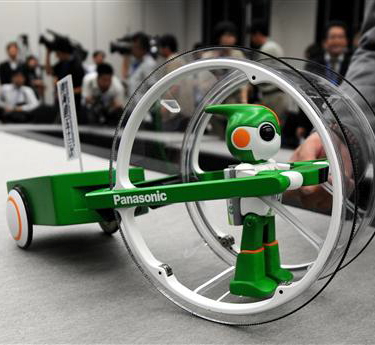
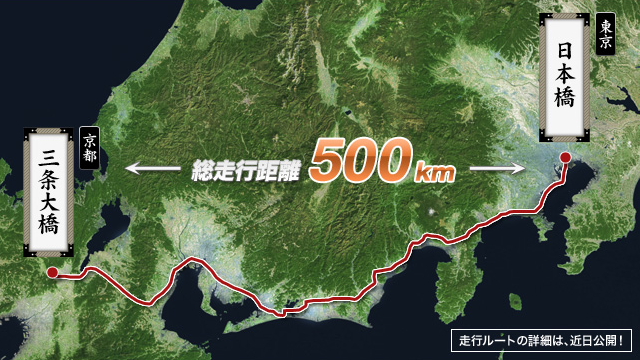
As a publicity stunt to demonstrate the durability of Evolta batteries, Panasonic's mascot robot is hiking the historic 500-kilometer (300-mi) Tōkaidō Road from Tokyo to Kyoto.
Evolta World Challenge III: Kyoto or bust! -- Photos via Sankei News
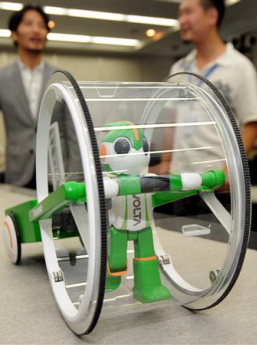
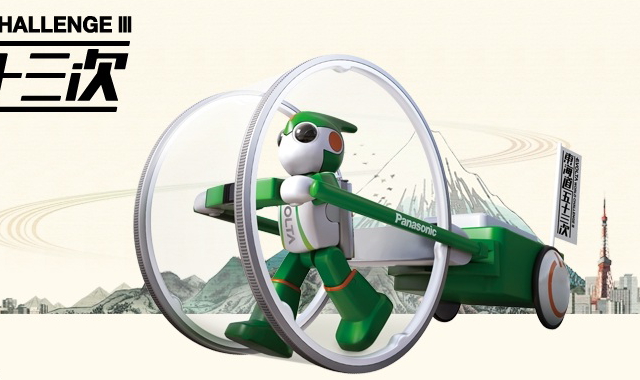
The Evolta humanoid, whose new design is meant to resemble an ancient highway traveler pulling a two-wheeled cart, measures 17 centimeters (7 in) tall and 40 centimeters (16 in) long. Constructed mostly of lightweight plastic, carbon fiber and titanium, the robot weighs about 1 kilogram (2.2 lbs). It is powered by 12 AA batteries and operated by remote control, and it can travel at a rate of 3 to 5 kilometers per hour (2-3 mph). If all goes according to schedule, the robot will complete the journey on December 10, after 49 days of walking.
On the 500-km Tōkaidō Road from September 23 to November 10, 2010
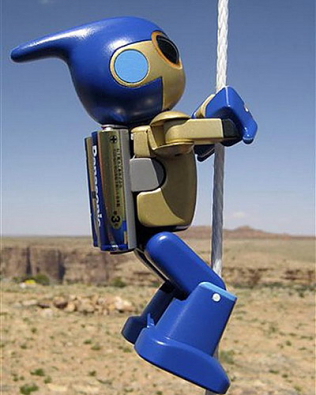
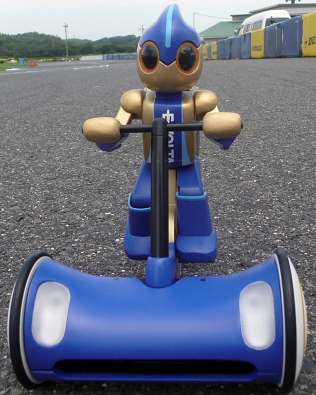
The Evolta robot is no stranger to endurance challenges. In May 2008 the battery-powered mascot climbed a 530-meter (1,740-ft) rope suspended from a Grand Canyon cliff, and in August 2009 it drove non-stop for 24 hours around the Le Mans race circuit, covering a distance of 23.7 kilometers (14.8 mi). Each feat earned the robot a Guinness World Record.
Evolta robot at Grand Canyon (2008) // Evolta robot at Le Mans (2009)
The current and previous versions of the humanoid were created by renowned roboticist Tomotaka Takahashi, founder of Kyoto University's Robo-Garage. The new robot features a hamster wheel-like design to facilitate movement over uneven surfaces, as well as a handcart that holds batteries. The batteries will be recharged once per day throughout the course of the journey.
Artist rendition of Evolta robot on Tōkaidō Road (2010)
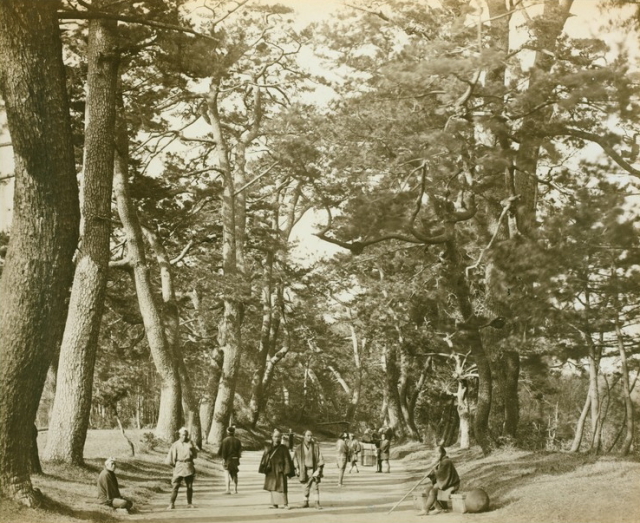
The 500-kilometer (300-mi) Tōkaidō Road, which runs between Nihonbashi bridge in Tokyo and Sanjō Ōhashi bridge in Kyoto, served as Japan's most important transport artery during the Edo period. During its heyday in the 17th to 19th centuries, the road was one of the busiest highways in the world. In those days, it typically took travelers about 10 to 12 days to walk the route, weather permitting.
Tōkaidō Road photographed by Felice Beato in 1865
In the 17th century, the Tokugawa shogunate set up 53 post stations along the route, where travelers could find food, shelter and other services. These stations are perhaps best known through "The Fifty-Three Stations of the Tōkaidō" series of woodblock prints by the great ukiyo-e artist Utagawa Hiroshige, who first traveled the route in 1832.
Shinagawa, the first station on the Tōkaidō Road (print by Hiroshige)
The landscape has changed a great deal since then, and many of the old post stations have developed into towns and cities. The Evolta robot plans to pass through at least one station per day during the trek.
All of the action is being broadcast live on Ustream (morning to afternoon, Japan time).
The robot will also be tweeting its progress (in Japanese) at @evoltatoukaidou.
AUJIK, a mysterious Shinto group that believes all things in nature -- including the products of human technology -- possess a soul, have created a series of videos showing organic/synthetic artifacts intended to bridge the gap between the natural and artificial worlds.
This video, narrated by a masked AUJIK member named Nashi, explores some of the group's thoughts on technological singularity and artificial selection. AUJIK suggests that the tension between "original" nature (trees, rocks, animals, etc.) and "refined" nature (human technology) is decreasing, and that the two are converging. The group believes it is possible to accelerate this convergence by creating organic/synthetic artifacts such as the ones that appear in the video.
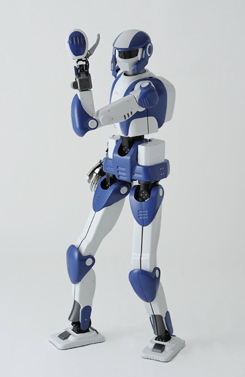
Kawada Industries and Japan's National Institute of Advanced Industrial Science and Technology (AIST) have updated their 10-year-old line of HRP humanoid robots with an athletic machine they hope to develop into a menial worker.
HRP-4: Menial worker of the future?
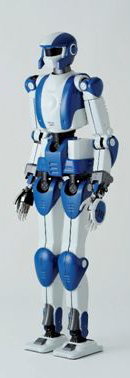
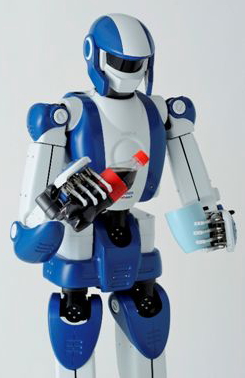
The blue and white humanoid -- named HRP-4 -- stands 1.51 meters (5 ft) tall and boasts the body of a track-and-field athlete. The robot's 34 joints are more flexible than those of previous models, and at 39 kilograms (86 lbs), it weighs 4 kilograms (8.8 lbs) less than last year's entertainment-oriented HRP-4C fembot.
At the unveiling on Wednesday, the agile robot demonstrated a range of skills that may come in handy in the workplace, such as the ability to stand on one foot, twist its waist, strike poses, follow spoken commands, recognize faces, and track objects by moving its head. Its five-fingered hands are also more dexterous than those of its predecessors.
Kawada and AIST plan to begin selling the robots to universities and research institutions in January 2011 at a starting price of 26 million yen ($305,000) each.