
+ Video
This time-lapse video of the 18-meter (59-ft) Gundam robot in the city of Shizuoka, Japan is the latest in a series of YouTube uploads from Gundam videographer darwinfish105.
+ Video
This time-lapse video of the 18-meter (59-ft) Gundam robot in the city of Shizuoka, Japan is the latest in a series of YouTube uploads from Gundam videographer darwinfish105.
Researchers from Osaka University have teamed up with the Advanced Telecommunications Research Institute (ATR) to develop a minimalist humanoid robot that recreates the physical presence of a remote user.
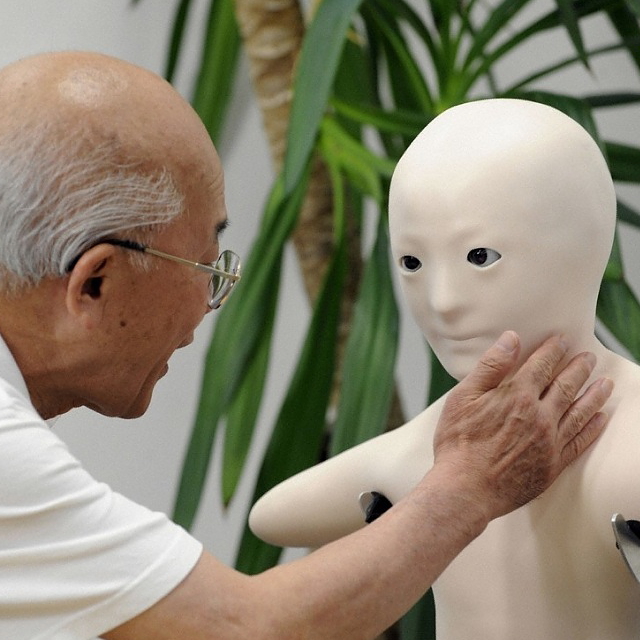
Named "Telenoid R1," the teleoperated communication robot measures 80 centimeters (31 in) tall and weighs 5 kilograms (11 lbs). The portable machine features a soft silicone body that is pleasant to the touch, and it uses 9 actuators to move its eyes, mouth, head and rudimentary limbs.
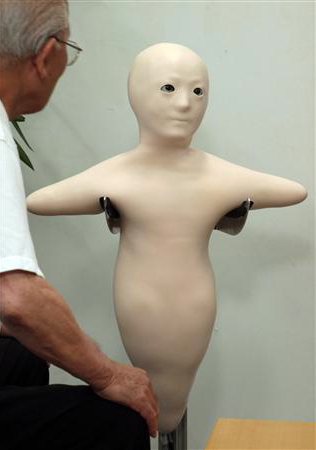
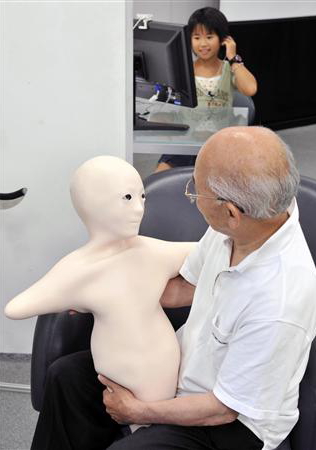
Data is transmitted between the user and robot via Internet connection
The Telenoid R1 robot is designed to add an element of realism to long-distance communication by recreating the physical presence of the remote user. The robot's actions mirror those of the remote user, whose movements are monitored by real-time face tracking software on the user's computer. Users can also transmit their voice through the robot's embedded speakers.
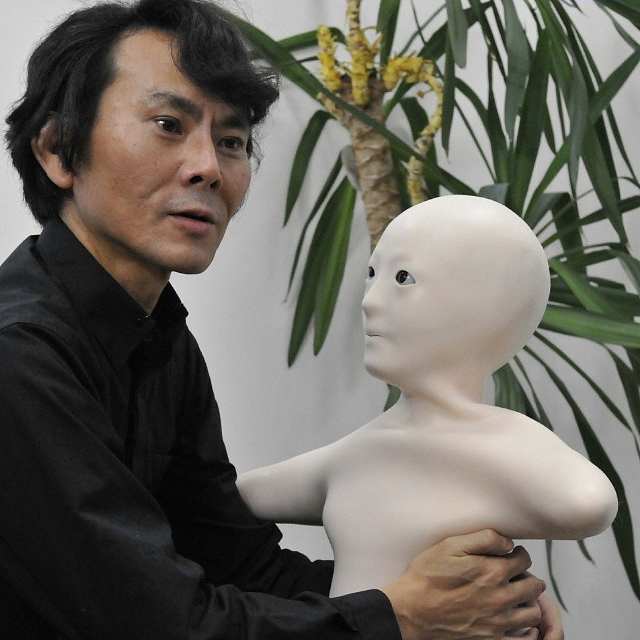
Telenoid R1 with Dr. Hiroshi Ishiguro (Osaka University)
The Telenoid R1 is endowed with only the most basic human features -- just enough to recreate the physical presence of the remote user, according to robot's creators. The robot's androgynous and ageless look makes it suitable for a wide range of users, whether they are male, female, young or old.
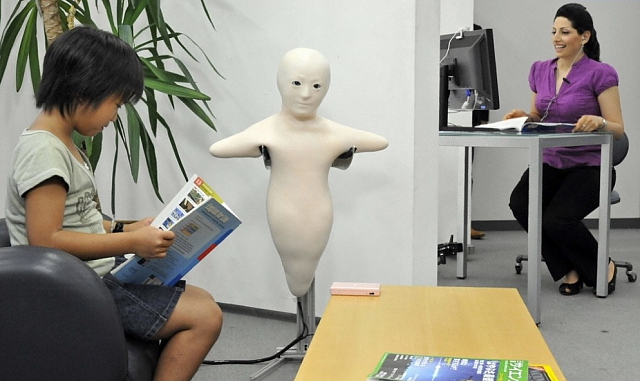
English lessons can be conducted via the Telenoid R1 robot
At the unveiling in Osaka on August 1, the developers announced plans to begin selling two versions of the minimalist humanoid in October. The high-end model will be priced at about 3 million yen ($35,000), and a cheaper model will be available for about 700,000 yen ($8,000).
Here's a short video demonstration.
Here is a collection of sci-fi illustrations by the prolific Shigeru Komatsuzaki (1915-2001), whose fantastic work appeared on plastic model kit boxes and in magazines and picture books in the 1960s to 1970s. Click the "+" under each image for a larger view.

The Missiler, 1970 [+]

Giant Shocker Machine, 1975 [+]

Space colony, 1980 [+]

Crawler, 1968 [+]

Mobile marine airport, 1980 [+]

Tokyo volcano, ca. 1965

Attack Boy, 1970 [+]

Undersea super tunnel, 1981 [+]

SHADO-mobile, ca. 1970 [+]

UFO, ca. 1970 [+]

Solar City, 1982 [+]

Thunderbird 1, 1964 [+]

Thunderbird 2, 1964 [+]

Thunderbird 3, 1964 [+]

Thunderbird ships, 1964 [+]

Rikishi Boy, 1970 [+]

Frog car boat, 1961 [+]

Baron car boat, 1961 [+]

Highway rescue boat, 1981 [+]

Space train, 1981

Moon bus [+]

Air car [+]

HariHari, 1970 [+]

Sea monster battle, 1954 [+]

The Mole (Jet-Mogura Tank), 1968 [+]

Thunderbird 6 - Sky-Ship 1, 1968 [+]

Thunderbird Mars Explorer - Zero X, 1967 [+]

Proteus Bluebird CN7, 1963 [+]

Long John - Spirit of America, 1963 [+]

Earthquake, 1979 [+]

Guardman Robot, 1970 [+]
* * * *
Edit: A few more images. (Thanks, Franz!)

Underground metropolis, ca. 1980 [+]

World Space Force, 1982 [+]

Horizon Car, ca. 1960 [+]

Ark of Space, 1968 [+]
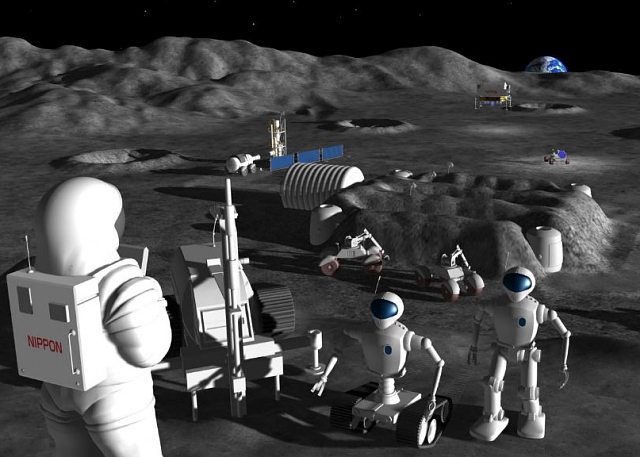
In an ambitious new project unveiled on April 27, an Osaka-area business group has vowed to put a humanoid robot on the moon by 2015.
The business group, known as SOHLA (Space Oriented Higashiosaka Leading Association), made headlines in January 2009 after their Maido-1 lightning observation microsatellite was launched into orbit. Their new project is to develop a bipedal humanoid robot -- named "Maido-kun" -- which can function in the harsh lunar environment. If all goes as planned, Maido-kun will be ready to travel to the moon in 2015.
SOHLA admits there are a number of obstacles to overcome -- most notably the astronomical development costs (now estimated at 1 billion yen, or $10.5 million) -- but they are optimistic about their pursuit and believe it can help stimulate the local economy by getting small and medium sized manufacturers involved in the development of space technology. At present, SOHLA consists of six local enterprises working in partnership with government-affiliated organizations such as the New Energy and Industrial Technology Development Organization (NEDO) and the Japan Aerospace Exploration Agency (JAXA).
In 2005, JAXA announced bold plans to send bipedal humanoid robots to the moon. However, after recognizing the numerous difficulties that the lunar landscape poses for two-legged humanoids, they decided it would be more feasible to send wheeled robots instead.
Wheels may be more practical than legs, but SOHLA board member Noriyuki Yoshida sees an advantage in robots that look like people. "Humanoid robots are glamorous, and they tend to get people fired up," he says. "We hope to develop a charming robot to fulfill the dream of going to space."
JAXA plans to send their first robot rover to the moon in or around 2015, and SOHLA hopes their Maido-kun humanoid will be able to hitch a ride on the same mission.
[Source: Yomiuri]
Tsutenkaku Robo -- a walking, talking robot modeled after Osaka's signature Tsutenkaku Tower -- has been spotted hanging with maids in Tokyo's Akihabara district.
+ Video
In addition to stopping in for a snack at a maid cafe, the robot reportedly went shopping and paid a visit to Asimo at the Akihabara Daibiru Building. Tsutenkaku Robo, which weighs 30 kilograms (66 lbs) and stands 170 centimeters (5 ft 7 in) tall -- 1/60 the size of the actual Tsutenkaku Tower -- has been traveling the country to promote tourism to its hometown of Osaka ever since it was unveiled there last month.
+ Video
Researchers from the Intelligent Robotics Laboratory at Osaka University have teamed up with robot maker Kokoro Co., Ltd. to create a realistic-looking remote-control female android that mimics the facial expressions and speech of a human operator.
Modeled after a woman in her twenties, the android -- called Geminoid F (the "F" stands for female) -- has long black hair, soft silicone skin, and a set of lifelike teeth that allow her to produce a natural smile.

According to the developers, the robot's friendly and approachable appearance makes her suitable for receptionist work at sites such as museums. The researchers also plan to test her ability to put hospital patients at ease.
The research is being led by Osaka University professor Hiroshi Ishiguro, who is known for creating teleoperated robot twins such as the celebrated Geminoid HI-1, which was modeled after himself.

The new Geminoid F can produce facial expressions more naturally than its predecessors -- and it does so with a much more efficient design. While the previous Geminoid HI-1 model was equipped with 46 pneumatic actuators, the Geminoid F uses only 12.
In addition, the entire air servo control system is housed within the robot's body and is powered by a small external compressor that runs on standard household electricity.

Geminoid F and her human counterpart, wearing outfits by fashion designer Junko Koshino
The Geminoid F's easy-to-use teleoperation system, which was developed by ATR Intelligent Robotics and Communication Laboratories, consists of a smart camera that tracks the operator's facial movements. The corresponding data is relayed to the robot's control system, which coordinates the movement of the pneumatic actuators to reproduce the expressions on the android's face.
The efficient design makes the robot much cheaper to produce than previous models. Kokoro plans to begin selling copies of the Geminoid F next month for about 10 million yen ($110,000) each.
+ Video
Doctors from the Showa University School of Dentistry have teamed up with Kyushu-based robot developer tmsuk to create a robotic dental patient. The female humanoid, named Hanako Showa, is designed to act as a training tool for dental students. In addition to wincing in pain when a dentist-in-training makes a mistake, the robot can roll her eyes, blink, move her jaw, and wiggle her tongue. To add to the realism, she slackens her jaw muscles when she grows tired. And she drools.
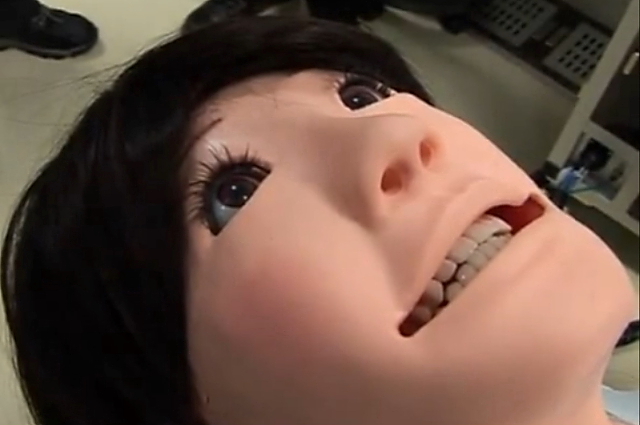
The robot research team was led by Waseda University professor Atsuo Takanishi, who previously worked with tmsuk to develop the KOBIAN emotional humanoid unveiled last year.
Hanako is now being used at Showa University to train and evaluate dental students. This month, 88 students tested their skills on the robot.
[Link: PhysOrg]
- See also: Simroid dental patient robot
"Robot Age," a series of illustrations published by Shōnen Sunday magazine in 1969, offers a glimpse into a utopian future populated by sophisticated robots.

Robot workers [View full image]
In the coming Robot Age, assembly lines will be manned by tireless robot workers. Once the robots start building newer and better versions of themselves, the need for human factory workers will cease to exist.

Robot nanny [View full image]
Autonomous robot nannies will care for the kids when mom is busy. In addition to singing and playing games, these gentle robots will breastfeed babies and cuddle them when they cry.

Surgical micro-robots [View full image]
Surgical micro-robots that navigate the human body will usher in a new era of medicine. Equipped with lasers and tiny hands, these miniature machines will be able to perform delicate operations inside the body (such as replacing damaged blood vessels with artificial ones), reducing the need for open surgery.
[Images via: Tokyo Scum Brigade]
- See also: Computopia: Old visions of a high-tech future
Researchers from the Machine Perception Laboratory at the University of California, San Diego have teamed up with Japanese robotics firm Kokoro Co., Ltd. to create a sophisticated humanoid robot modeled after a 1-year-old child.

The baby robot -- named "Diego-san" -- is designed to help researchers study how infants develop motor skills during the first year of life, according to a recent Kokoro newsletter (PDF). In addition to providing clues about how infants interact with the physical world, researchers will also use the robot to explore how babies acquire and refine the ability to use nonverbal communication such as gestures and facial expressions.


Diego-san's body has over 60 moving parts, making it Kokoro's most sophisticated robot to date. The robot weighs 30 kilograms (66 lbs) and is 1.3 meters (4 ft 3 in) tall, which is quite a bit larger than the average 1-year-old.
The baby humanoid also has a rather sizable head, thanks to 20 moving parts that allow it to make facial expressions, along with high-resolution cameras for eyes, an audio speaker in the mouth, and 6-axis accelerometers in the ears that allow it to detect orientation and movement.


Other features include 5-fingered hands capable of holding objects such as plastic bottles, sensors that detect the amount of pressure placed on different joints in its body, and the ability to stand up from a sitting position in a chair.
Apparently, Diego-san's face is still under development (the rubber face shown in the photos is just the first prototype). The researchers are still debating about whether the robot should have a realistic human-like face or one that looks more mechanical.
[Source: Kokoro News (PDF) via BotJunkie via somebadideas]


