Kage-e: Shadow pictures

Kage-e (”shadow pictures”) — a popular form of Edo-period woodblock print — were appreciated by children and adults and commonly used as party gags. These pictures consist of two parts: a “shadow” image and a “real” image. The shadow image, which typically bears the shape of a common, easily identifiable object, is viewed first. The real image, viewed second, reveals the surprising true identity of the shadow.

Here’s a nice example by ukiyoe master Kuniyoshi (ca. 1852). It shows what appear to be the silhouettes of goldfish…

Kage-e shadow picture --

But look again…

Kage-e shadow picture --

It’s a flying tanuki crushing a hunter under the weight of its mammoth testicles.

Here are a few more kage-e by Hiroshige (ca. 1842). The shadows cast on shoji doors belong to men in interesting poses.

Kage-e shadow picture --
Pine tree

Kage-e shadow picture --
Uguisu (Japanese bush warbler) on a plum branch

Kage-e shadow picture --
Salt-dried fish

Kage-e shadow picture --
Kettle

Kage-e shadow picture --
Hawk

Kage-e shadow picture --
Stone lantern

Kage-e shadow picture --
Goose on a rock

[Related: Joge-e: Two-way pictures]

Bento lunches decorated as album covers

Food hackers at Obacchi Jacket Lunch Box cut and arrange ordinary bento lunch box ingredients to recreate famous album covers.

Obacchi Jacket Lunch Box --

Rage Against The Machine - Evil Empire: Egg, paprika, nori (seaweed sheet), kamaboko (fish sausage), carrot, potato, ham, black sesame, rice

Obacchi Jacket Lunch Box --

Jimi Hendrix - Electric Ladyland: Nori, paprika (red & orange), egg, rice

Obacchi Jacket Lunch Box --

Aphex Twin - Richard D. James Album: Potato, umeboshi (pickled plum), fish/vegetable flakes, nori, kamaboko, rice

Obacchi Jacket Lunch Box --

KISS - Destroyer: Egg, nori, ume (Japanese plum), kamaboko, rice

Obacchi Jacket Lunch Box --

King Crimson - In The Court Of The Crimson King: Mentaiko (cod roe), kamaboko, ham, nori, rice

Obacchi Jacket Lunch Box --

Weezer - Green Album: Cabbage, nori, ham, kamaboko, paprika, rice

Obacchi Jacket Lunch Box --

The Velvet Underground & Nico - The Velvet Underground: Nori, egg, rice

Obacchi Jacket Lunch Box --

Public Enemy - Muse Sick-N-Hour Mess Age: Nori, kamaboko, umeboshi, rice

See more than 25 pages of these bentos at Obacchi Jacket Lunch Box (use the “Next” link at the bottom of each page to scroll through the site).

[Via: Zaeega]

Mona Lisa mutants & alien art by Naoto Hattori

Surreal artist Naoto Hattori’s huge monster painting collection includes a smattering of Mona Lisa mutants. Visit his gallery for more madness.

Maternity, by Naoto Hattori -- Bombing, by Naoto Hattori  --
Maternity, Bombing

Fabrication, by Naoto Hattori -- Watcher, by Naoto Hattori  --
Fabrication, Watcher

[Link: Naoto Hattori]

Simroid (a.k.a. ‘Pain Girl’) on TV

Simroid, a.k.a. Ita-girl --

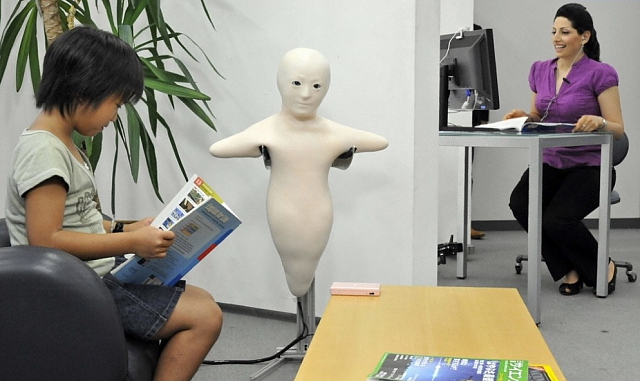
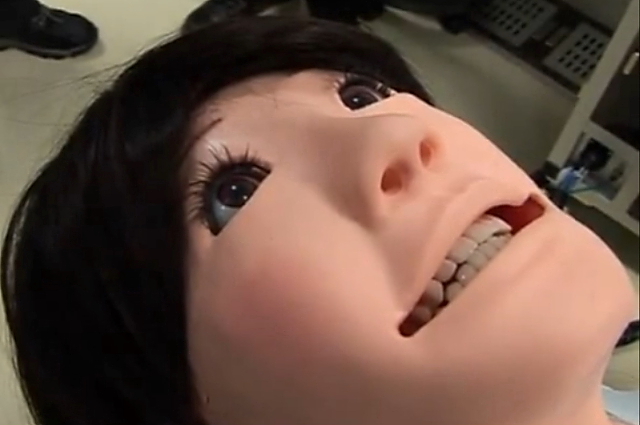
Simroid, the silicone-skinned, pneumatically-powered female patient robot designed to help train dental students, recently appeared on the Fuji TV show Idainaru Miraizukan. (Watch video.)

In addition to highlighting Simroid’s ability to interact with dentists and react to mouth pain, the show features an interview with Dr. Naotake Shibui of the Nippon Dental University in Tokyo, who helped develop the robot with engineers from Kokoro Co., Ltd. According to the interview, Simroid is modeled after a 28-year-old woman, and her fear of dentists and sensitivity to pain have earned her the nickname “Pain Girl” (Ita-gaaru). Asked why Simroid is female, Shibui explains that female patients must be treated with more sensitivity than male patients. With sensors embedded in her chest, Simroid can teach dentists-in-training to pay close attention to where they place their elbows.

Simroid’s primary purpose is to help dental students improve their patient communication skills.

Kirichimpo: Phallic promotional mascot

Kirichimpo --

Fresh on the Akita prefecture promotional gimmick scene is a unique and decidedly male mascot modeled after the region’s famed kiritampo grilled rice cake skewers. “Kirichimpo” (kiri means “cut” and chimpo is slang for the male organ), a lovey-eyed kiritampo stick with a conspicuous protuberance dangling from its lower end, is the brainchild of Fruru Co., Ltd., an Akita-based souvenir designer and wholesaler.

Mamemokkori and Marimokkori -- The company came up with the idea for Kirichimpo last year after witnessing the far-reaching success of Marimokkori, a happy, well-endowed green monster mascot from Hokkaido, whose name is a play on the words marimo (a type of giant algae ball found in Lake Akan) and mokkori (”erection”). Marimokkori’s popularity extends far beyond Hokkaido’s shores, to as far away as Chiba, the home of his younger peanut-headed cousin named Mamemokkori (mame means “bean”), and Tokyo, where mounds of the popular Marimokkori can be found inside UFO Catcher claw vending machines at game centers.

While Kirichimpo has yet to rise to Marimokkori status, it appears to be enjoying a measure of success. Last year’s initial shipment of 6,000 Kirichimpo keychains sold out in a matter of months. And with demand still strong, the company is rolling out a Kirichimpo ear pick and other new gimmicks, which are soon to appear at souvenir shops and train stations throughout Akita prefecture at a price of 350 yen ($3) each.

[Source: Akita Keizai Shimbun]

Ippon Zuri: Catch-and-eat fishing by phone

Ippon Zuri fishing game -- For mobile gamers in western Japan, a hearty seafood dinner awaits just a few key clicks away, thanks to a unique new cellphone fishing game that rewards successful players with home deliveries of fresh, real-world fish.

The game — called “Ippon Zuri” (which means “pole-and-line fishing”) — was created by FIT, a Fukuoka-based system development company who teamed up with a local seafood wholesaler. Game play is simple: players use the phone keys to cast bait to promising-looking fish in the game’s virtual waters, which include sea bream, crab, and other seasonal fish. When a fish takes the bait, the player is sent to a slot machine screen where, if luck prevails and 3 numbers line up appropriately, the virtual fish is hooked and reeled in. A message is then relayed to the wholesaler, who picks up the real-world equivalent from the local seafood market and delivers it, whole and raw, to the player’s doorstep.

FIT president Hiromi Fukuda suggests that Ippon Zuri is more enjoyable than other fishing games because it allows players to eat what they catch. The game (which seems rather like a fancy seafood ordering system) promises more entertainment than a mundane trip to the supermarket and more convenience than a fishing trip to the seaside, and it makes a great pick-me-up for hungry fishermen feeling down on their real-world luck.

The game is open to Fukuoka-area NTT DoCoMo users who register at the Ippon Zuri site and pre-pay for the games (1,000 yen for 3 games) using Edy electronic money.

[Source: Fuji Sankei]

Happy fun snow creatures

With winter in full force, now is the perfect time to explore the frozen wilds of the Japanese web in search of happy fun snowmen.

Snowman --

Arguably the best place to see snowmen is the annual Sapporo Snow Festival, one of Japan’s most celebrated winter events. This photo (by Flickr user kozyndan) shows a sea of snowmen (yuki-daruma) built by visitors to the festival, who attach written wishes for good luck.

Snowman --

The week-long festival held in early February is home to Japan’s largest snow and ice sculpture competition, and all sorts of wacky snow creations can be seen at venues around town — like this giant chihuahua and Asimo.

Snowman --

Or your favorite anime character. (Photo from Jonas’s Travels in Sapporo website.)

Snowman --

Or much more impressive creations like these dinosaurs. For more pictures from the festival, try a Google image search for “札幌雪祭り” (Sapporo Yuki Matsuri).

Of course, the Sapporo Snow Festival is not the only place to encounter snowmen — they appear wherever there is snow.

Snowman --

This photo, taken in the town of Kuroishi (Aomori prefecture), shows what is proudly labeled as Japan’s largest snowman. The 31-meter-tall (100 ft) monster has a face composed of local agricultural products, such as charred apple trees for the eyebrows, seashells for the eyes, rice for the cheeks, apples for the mouth, daikon radishes for the ears, and carrots for the collar.

Snowman --

This Namahage folk demon was spotted at last year’s Lake Tazawa Snow Festival.

Snowman --

These glowing snowmen were seen standing watch at Kanazawa castle.

Snowman --

And this one. Haven’t we seen this somewhere before?

Sometimes happy snowmen can be found where there is no snow — like in Tokyo. For this year’s Kanda Yuki-Daruma Fair in late January, organizers trucked in 70 tons of snow from rural Gunma prefecture and built 30 large snow creatures on the sidewalks of Kanda.

Snowman --

Here is a snowy incarnation of Baikinman, an evil character from the Anpanman anime series. (Photo via Mycom.)

Snowman --

And here are Kurohige Kiki Ippatsu (Pop-up Pirate game) and Shiisaa (a mythical Okinawan creature). For more from the Kanda Yuki-Daruma Fair, see these photos.

Larva Chocolate looks sick, tastes sweet

Larva chocolate --

A unique chocolate made to look like a beetle larva has captured the fancy of candy aficionados in Japan. Produced by the Komatsuya confectionery and bakery based in Akita prefecture, the bite-sized Larva Chocolates (Youchu Choco) have a grub-shaped body made from milk chocolate and corn flakes, a layer of skin made from white chocolate, legs made from tiny strips of dried squid, and a dainty mouth made from orange peel. Komatsuya, which is struggling to keep up with demand, hand-produces about 400 per day and sells them online (shipping in Japan only) for 210 yen ($2) each. The company also offers up the repulsive-yet-cute candy grubs at product fairs, where they tend to get snapped up in a hurry. Larva Chocolates are now available in Tokyo at the Chocolate and Sweets Expo, which is being held at Sunshine City (Ikebukuro) until March 9.

[Source: Akita Keizai Shimbun]

Video: Nobuo Takahashi’s animated landscapes

Musashino Plateau --

“Musashino Plateau” and “Japan” — a pair of 3D computer animations directed by Nobuo Takahashi — illustrate (in dramatic fashion) how Japan’s landscape changed during the postwar period of rapid economic growth. The animations begin slowly with the early postwar recovery years, but the pace quickens to a frenzy as explosive growth during the bubble years (late ’80s/early ’90s) transforms the cityscape into a chaotic, tightly packed jumble of single-family homes, large apartment complexes and high-rise buildings. In the end, development grinds to a halt with the collapse of the bubble.


Video 1: Musashino Plateau


Video 2: Japan

[Source: Yoshida Gakuen Joho Business]

Brides of Kimiko Yoshida

Photographer Kimiko Yoshida transforms herself into the brides of the world in an ongoing series of self-portraits taken over the last seven years.

The Sakura Bride --
The Sakura Bride, 2006

The Cyber Bride --
The Cyber Bride, 2003

The Green Tea Bride --
The Green Tea Bride, 2006

The Mao Bride --
The Mao Bride, 2006

The Pokemon Bride --
The Pokemon Bride, 2002

The Tamates Bride, Vanuatu --
The Tamates Bride, Vanuatu, 2003

The Afghani Bride with a Bukhara Cap --
The Afghani Bride with a Bukhara Cap, 2005

The Shinto Bride --
The Shinto Bride, 2002

Browse the entire collection of 150+ nuptial beauties at Yoshida’s website (not entirely safe for work).