Realistic robot hand handles sushi like a pro

It can’t make sushi yet, but a human-like robotic hand developed by Kyoto-based factory automation firm Squse is dexterous enough to handle it like a pro.


+ Video

The fleshy robot hand, which weighs 340 grams and consists of soft silicone skin stretched over a polycarbonate skeleton, has 22 pneumatically-powered artificial muscles that enable it to bend its fingers like a human hand. The robot can perform 20 different moves, ranging from a delicate two-finger pinch to a full-hand squeeze.

According to Squse, the robot’s delicate grip makes it suitable for a variety of manual labor jobs that require a human touch, such as handling parts in the factory, packing food, or even harvesting crops on the farm. The hand might also be used as a prosthetic limb, say the developers.

KOBIAN: Emotional humanoid robot (pics/video)

KOBIAN --
Surprise

Researchers from Waseda University have teamed up with Kyushu-based robot manufacturer tmsuk to develop a humanoid robot that uses its entire body to express a variety of emotions. (Watch video.)

Named “KOBIAN,” the android integrates features of two previously developed robots — the WABIAN-2 bipedal humanoid and the WE-4RII emotion expression humanoid — into a bipedal machine that can walk around, perceive its environment, perform physical tasks, and express a range of emotions. The robot also features a new double-jointed neck that helps it achieve more expressive postures.

KOBIAN --
Delight

KOBIAN can express seven different feelings, including delight, surprise, sadness and dislike. In addition to assuming different poses to match the mood, the emotional humanoid uses motors in its face to move its lips, eyelids and eyebrows into various positions. To express delight, for example, the robot lifts its soft rubbery hands over its head and opens its eyes and mouth wide.

KOBIAN --
Sadness

To show sadness, the robot slouches over, hangs its head down and holds a hand up to its face in a gesture of grief.

KOBIAN --
Aversion

According to KOBIAN’s developers, the robot’s expressiveness makes it better equipped to interact with humans and assist with daily activities. In the future, the robot may seek work in the field of nursing.

[Source: Nikkei Net // Photos, video: Robot Watch]

19th-century pregnant dolls

Edo-period obstetric training doll, Japan --
19th-century obstetric training doll - Wada Museum [+]

In the 18th and 19th centuries, sideshow carnivals known as misemono were a popular form of entertainment for the sophisticated residents of Edo (present-day Tokyo). The sideshows featured a myriad of educational and entertaining attractions designed to evoke a sense of wonder and satisfy a deep curiosity for the mysteries of life. One popular attraction was the pregnant doll.

Vintage wooden pregnant mannequin, Japan --
“Light-skinned” pregnant doll - Edo-Tokyo Museum [+]

Although it is commonly believed that these dolls were created primarily to teach midwives how to deliver babies, evidence suggests they were also used for entertainment purposes.

Edo-era obstetric doll, Japan --
“Dark-skinned” pregnant doll - Edo-Tokyo Museum [+]

For example, records from 1864 describe a popular show in Tokyo’s Asakusa entertainment district that educated audiences about the human body. The show featured a pregnant doll whose abdomen could be opened to reveal fetal models depicting the various stages of prenatal development.

Old wooden baby dolls, Japan --
Baby doll - Edo-Tokyo Museum [+]

Similarly, records of Japan’s first national industrial exhibition in 1877 indicate a Yamagata prefecture hospital doctor named Motoyoshi Hasegawa showed off an elaborate set of fetus models illustrating seven different stages of growth, from embryo to birth.

Japanese pregnancy manikin, Japan --
Fetus model set (circa 1877) - Toyota Collection [+]

Although it is unclear whether the fetus model set pictured here is the same one Hasegawa showed in 1877, records suggest his model was a hit at the exhibition.

[Source: Geijutsu Shincho magazine, July 2001]

Saya-sensei: Synthetic substitute teacher

Saya humanoid robot teacher --

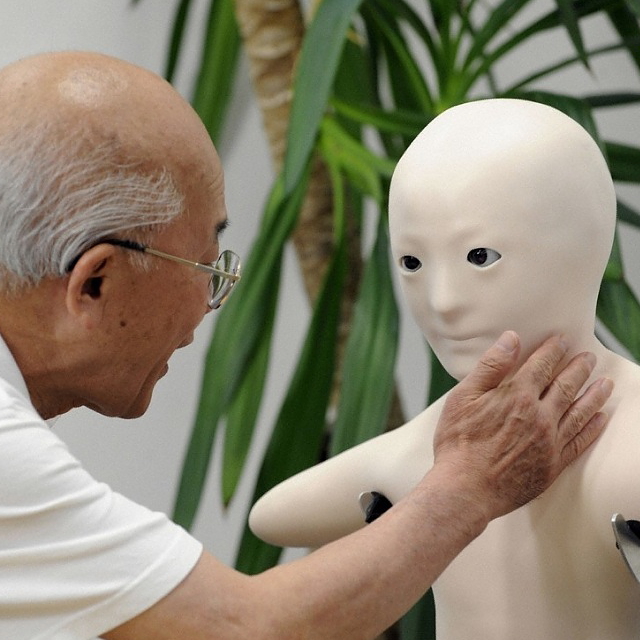
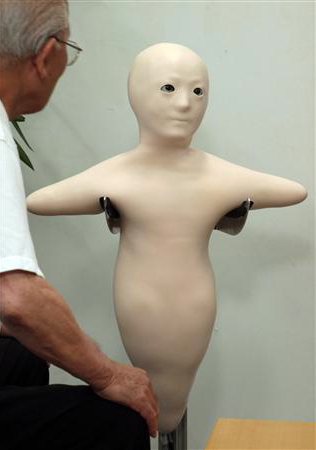
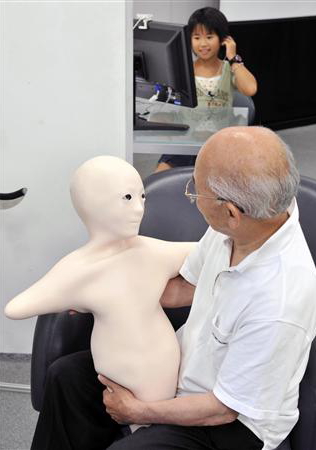
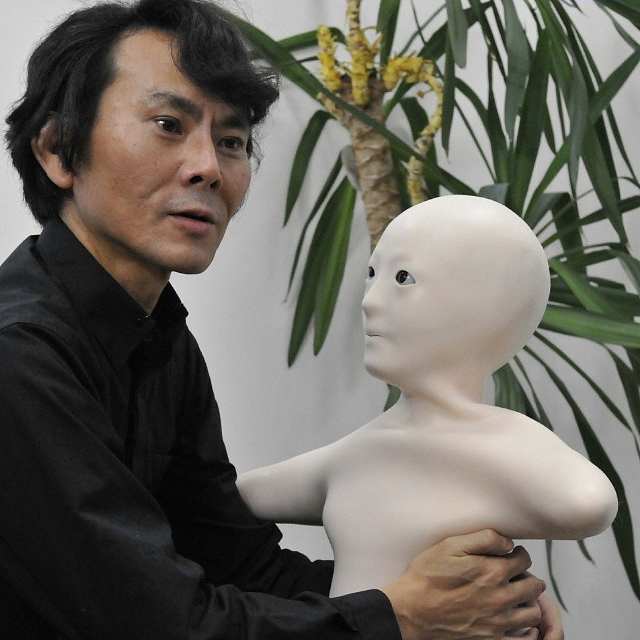
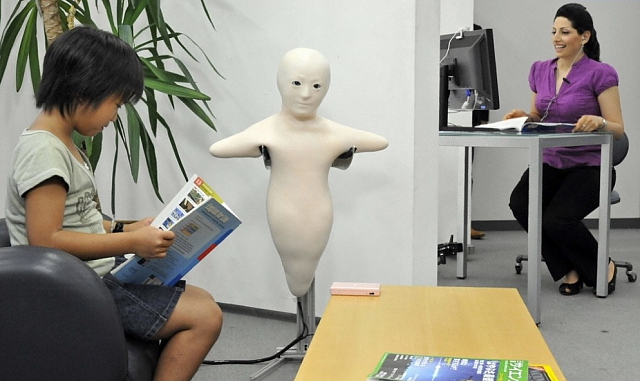
Upon returning to class after the Golden Week holidays, students at a Tokyo elementary school were delighted to find their teacher had been replaced by a robot. The talking humanoid, named “Saya,” was originally developed as a receptionist robot in 2004 by professor Hiroshi Kobayashi of the Tokyo University of Science, but has recently begun taking on work as a substitute teacher.

Saya humanoid robot teacher --
Amused students poke Saya’s soft face

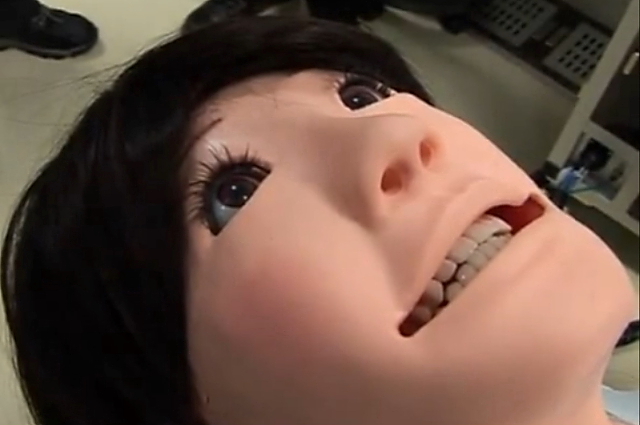
The robot, which can speak multiple languages, uses facial expressions to facilitate communication. With an array of motors in her head that stretch the soft synthetic skin into various positions, Saya can display emotions ranging from happiness and surprise to sadness and anger.

However, Saya needs to work on improving her classroom management skills. At present, she can’t do much more than call out names and shout orders like “Be quiet.” But that does not make her any less popular with the kids.

Saya humanoid robot teacher --

“Robots that look human tend to be a big hit with young children and the elderly,” Kobayashi recently told the Associated Press. “Children even start crying when they are scolded.”

[Source: Sankei]

Fish market alien sighting

Seafood shoppers may on rare occasions encounter the preserved bodies of aliens — or even Jenny Haniver specimens — at fish markets in Japan.

Jenny Haniver at Japanese seafood market --

These two darlings were photographed at a shop on Oharai-machi Street near the entrance to Ise Shrine in Mie prefecture.

[Photo: ~MVI~]

Giant robot spider in Yokohama (pics/ video)

La Princesse mechanized spider in Yokohama --
[+]

A pair of giant robotic spiders designed and built by French performance art group La Machine have come to Yokohama to take part in the upcoming Expo Y150, a 5-month festival commemorating the 150th anniversary of the opening of the city’s port.

La Princesse giant spider robot in Yokohama --
[+]

Although the Expo Y150 festivities are not scheduled to officially begin until the end of April, the enormous steampunk spiders could be seen prowling the Yokohama waterfront this weekend.

Here is some superb video of the spectacle on Friday (April 17) night, when one of the 12-meter (40-ft) tall, 37-ton mechanical spiders was observed in the red brick warehouse area of Yokohama — far from its natural habitat of Nantes, France.


+ Video

On Saturday (April 18) evening, one of the mechanical spiders performed a water dance at Shinko Pier while the other looked on from its perch atop a nearby shipping container. For the performance, the spider moved its mechanical legs and shot steam and water and from its mouth and rear end, while suspended over the water from a large crane. Water cannons, fog machines, lights and live atmospheric music added to the drama.

La Machine's mechanical spider in Yokohama --
[+]

On Sunday (April 19), both spiders were scheduled to depart Shinko Pier, take a stroll up Nihon-Odori street, and head back to the red brick warehouse area.

La Machine's giant arachnid robot in Yokohama --
[+]

La Machine’s giant spiders will be on public display at Expo Y150 from April 28 to September 27.

Video: Close encounter with mysterious creature

Mysterious creature -- Mysterious creature --

Here is some provocative video of a mysterious creature encountered by Japanese fishermen on a rocky seashore.

The excitement begins when the three men notice a group of strange animals on the side of a nearby cliff. Curious, they approach for a closer look and eventually manage to corner one. (The close encounter begins at 1:45 into the video.)

The slimy, pulsating beast — like something out of a Cronenberg film — appears to be some sort of amphibious sea animal that ventured ashore. After poking and prodding the creature with a stick and flipping it over to reveal an undulating, sphincter-like orifice, one of the men rashly — and unwisely — decides to give it a swig of his carbonated beverage. You don’t want to miss the explosive conclusion.

Is this a bizarre new species? Alien creature? Spectacular hoax? You be the judge.

[Link: New bizarre animal discovered in Japan]

CB2 baby robot developing social skills

CB2 baby robot --

In the nearly two years since it was first unveiled to the world, the Child-robot with Biomimetic Body, or CB2, has been developing social skills by interacting with humans and watching their facial expressions, according to its creators at Osaka University.

Comprised of robotics engineers, brain specialists, psychologists and other experts, the research team has been teaching the android to think like a baby by having it evaluate facial expressions and classify them into basic categories, such as happiness and sadness.


+ Video of CB2 from June 2007

The 130-centimter (4 ft 4 in) tall, 33-kilogram (73 lb) robot is equipped with eye cameras that record emotional expressions. Designed to learn like an infant, the robot can memorize facial expressions and match them with physical sensations, which it detects via 197 pressure sensors under a suit of soft, silicone skin.

CB2 baby robot --

In addition to watching faces, CB2 has been learning to walk. With 51 pneumatic “muscles,” the little android can now amble through a room more smoothly than it could nearly two years ago, though it still requires the aid of a human.

CB2 baby robot --

Within two years, the researchers hope the robot will gain the intelligence of a two-year-old child and the ability to speak in basic sentences. In the coming decades, the researchers expect to develop a “robo species” that has learning abilities somewhere between those of humans and chimps.

CB2 baby robot --

[Link: AFP]

Video: HRP-4C fashion model robot

The HRP-4C, a walking, talking humanoid fashion model fembot developed by Japan’s National Institute of Advanced Industrial Science and Technology (AIST), is ready for the runway. (Watch her strut her stuff.)

HRP-4C fashion model robot -- HRP-4C fashion model robot --

With 30 motors in her body, the 158-centimeter (62-in) tall, 43-kilogram (95-lb) HRP-4C can walk around and strike a range of poses.

HRP-4C fashion model robot -- HRP-4C fashion model robot --

The black-haired robot also has 8 motors in her face, allowing her to wow the crowds with expressions of simple emotions like anger and surprise.

HRP-4C fashion model robot --
Anger // Surprise

HRP-4C is scheduled to make her official runway debut in a special fashion show in Tokyo next week, though she will not be wearing any clothes.

HRP-4C fashion model robot --

But really, who needs clothes with a body like that?

[Sources: AIST, IHT, Daily Mail]

Monster mummies of Japan

Lurking the halls of Buddhist temples and museums across Japan are a host of monster mummies — the preserved remains of demons, mermaids, kappa, tengu, raijū, and even human monks. Here are a few remarkable specimens for the adventurous and brave at heart.

- Demon mummies

It might seem odd that Buddhist temples in Japan house the occasional stray mummified demon (oni), but then again it probably makes sense to keep them off the streets and under the watchful eye of a priest.

Zengyōji (善行寺) temple in the city of Kanazawa (Ishikawa prefecture) is home to the mummified head of a three-faced demon. Legend has it that a resident priest discovered the mummy in a temple storage chamber in the early 18th century. Imagine his surprise.

Triple-faced demon mummy --
Three-faced demon head at Zengyōji temple [Photos]

Nobody knows where the demon head came from, nor how or why it ended up in storage.

The mummified head has two overlapping faces up front, with another one (resembling that of a kappa) situated in back. The temple puts the head on public display each year around the spring equinox.

Demon mummy -- Another mysterious demon mummy can be found at Daijōin temple in the town of Usa (Oita prefecture).

The mummy is said to have once been the treasured heirloom of a noble family. But after suffering some sort of misfortune, the family was forced to get rid of it.

The demon mummy changed owners several times before ending up in the hands of a Daijōin temple parishioner in 1925. After the parishioner fell extremely ill, the mummy was suspected of being cursed.

The parishioner quickly recovered from his illness after the mummy was placed in the care of the temple. It has remained there ever since. Today the enshrined demon mummy of Daijōin temple is revered as a sacred object.

A much smaller mummy — said to be that of a baby demon — was once in the possession of Rakanji Temple at Yabakei (Oita prefecture).

Demon mummy --
Baby demon mummy at Rakanji temple

Unfortunately, the treasured mummy was destroyed in a fire in 1943.

* * * * *

- Mermaid mummies

In Edo-period Japan — particularly in the 18th and 19th centuries — mermaid mummies were a common sight at popular sideshow carnivals called misemono. Over time, the practice of mermaid mummification blossomed into an art form as fishermen perfected techniques for stitching the heads and upper bodies of monkeys onto the bodies of fish.

The mummy pictured below is a prime example of a carnival mermaid. It appears to consists of fish and other animal parts held together with string and paper.

Feejee mermaid gaff --
Mermaid mummy at the National Museum of Ethnology, Leiden

The mummified creature was obtained by Jan Cock Blomhoff while serving as director of Dejima, the Dutch trading colony at Nagasaki harbor from 1817 to 1824. It now resides at the National Museum of Ethnology in Leiden.

Another old mermaid mummy exhibited at a museum in Tokyo several years ago appears to belong to the founder of the Harano Agricultural Museum.

Fiji mermaid gaff --
Mysterious mermaid mummy

The mummy’s origin is unknown, but the collector says it was found in a wooden box that contained passages from a Buddhist sutra written in Sanskrit. Also in the box was a photograph of the mermaid and a note claiming it belonged to a man from Wakayama prefecture.

>>> More mermaid mummies

* * * * *

- Kappa mummies

Like the mermaid mummies, many kappa (river imp) mummies are thought to have been crafted by Edo-period artists using parts of animals ranging from monkeys and owls to stingrays.

Kappa mummy --
Kappa mummy at the National Museum of Ethnology, Leiden (Netherlands)

This mummified kappa, which now resides in a Dutch museum, appears to consist of various animal parts put together in a seamless whole. It is believed to have been created for the purpose of carnival entertainment in the Edo period.

Another mummified kappa can be found at Zuiryūji temple in Osaka.

Kappa mummy --
Kappa mummy at Zuiryūji Temple, Osaka [Photo]

The 70-centimeter long humanoid purportedly dates back to 1682.

Another notable kappa mummy can be seen in a seemingly unlikely place — at a sake brewery in the town of Imari (Saga prefecture).

Kappa mummy --
Kappa mummy at Matsuura Brewery

According to a company brochure, the mummified kappa was discovered inside a wooden box that carpenters found hidden in the ceiling when replacing the roof over 50 years ago.

Reckoning the creature was an old curiosity their ancestors had passed down for generations, the company owners built a small altar and enshrined the kappa mummy as a river god.

>>> Read more about the kappa.

* * * * *

- Raijū

With a limited scientific understanding of the sky above, the common person in Edo-period Japan looked upward with great awe and mystery. Supernatural creatures called raijū (雷獣) — lit. “thunder beast” — were believed to inhabit rain clouds and occasionally fall to earth during lightning strikes.

The earliest known written records of the raijū date as far back as the late 18th century, though the creature appears to borrow characteristics from the nue — a cloud-dwelling, illness-inducing chimera first described in The Tale of the Heike, a 12th-century historical epic.

Details about the raijū’s appearance vary. Some Edo-period documents claim the raijū resembled a squirrel, cat or weasel, while others describe it as being shaped more like a crab or seahorse.

Raiju Raiju
Raijū depicted in the Kanda-Jihitsu (ca. 1800) // Raijū seen in Tottori, 1791

However, most descriptions agree that the raijū had webbed fingers, sharp claws, and long fangs that, by some accounts, could shoot lightning. The beast also sometimes appeared with six legs and/or three tails, suggesting the ability to shape-shift.

One illustrated document tells of a raijū that fell from the sky during a violent storm on the night of June 15, 1796 in Higo-kuni (present-day Kumamoto prefecture).

Raiju
Illustration of raijū encountered on June 15, 1796

Here, the raijū is described as a crab-like creature with a coat of black fur measuring about 11 centimeters (4 inches) thick.

Another notorious encounter took place in the Tsukiji area of Edo on August 17, 1823. Two versions of the incident offer different descriptions of the beast.

Raiju
Raijū encounter, August 17, 1823 - Version 1

One document depicts the raijū as being the size of a cat or weasel, with one big bulging eye and a single long horn, like that of a bull or rhino, projecting forward from the top of its head.

Raiju
Raijū encounter, August 17, 1823 - Version 2

In the other account, the raijū has a more roundish look and lacks the pointy horn.

In Volume 2 of Kasshi Yawa (”Tales of the Night of the Rat”), a series of essays depicting ordinary life in Edo, author Matsuura Seizan writes that it was not uncommon for cat-like creatures to fall from the sky during thunderstorms. The volume includes the story of a family who boiled and ate one such creature after it crashed down onto their roof.

Given the frequency of raijū sightings, it should come as no surprise that a few mummies have turned up.

In the 1960s, Yūzanji temple in Iwate prefecture received a raijū mummy as a gift from a parishioner. The origin of the mummy, as well as how the parishioner obtained it, is a mystery.

Raiju
Raijū mummy at Yūzanji temple

The mummy looks like that of a cat at first glance, but the legs are rather long and the skull has no visible eye sockets.

Raiju
Raijū mummy at Saishōji temple [Photo]

A similar raijū mummy is on display at Saishōji temple in Niigata prefecture.

* * * * *

- Tengu mummy

Another legendary supernatural sky creature is the tengu, a dangerous demon often depicted in art as being part human and part bird. The Hachinohe Museum (Aomori prefecture) in northern Japan is home to a tengu mummy, which is said to have once belonged to Nambu Nobuyori, a Nambu clan leader who ruled the Hachinohe domain in the mid-18th century.

Tengu mummy
Tengu mummy at Hachinohe Museum

The mummy, which appears to have a humanoid head and the feathers and feet of a bird, is believed to have originated in the town of Nobeoka (Miyazaki prefecture) in southern Japan. Theories suggest the tengu mummy made its way north after being passed around between members of Japan’s ruling samurai families, some of whom were deeply interested in collecting and trading these curiosities.

* * * * *

- Self-mummified monks

A few Buddhist temples in northern Japan are home to “living mummies” known as sokushinbutsu (即身仏). The preserved bodies are purportedly those of ascetic monks who willingly mummified themselves in the quest for nirvana.

Self-mummified monk
Shinnyokai-Shonin “living mummy” at Dainichibo Temple (Yamagata prefecture)

To become a living mummy, monks had to undergo a long and grueling three-step process.

Step 1: For 1,000 days, the monks would eat a special diet of nuts and seeds, and engage in rigorous physical training to strip the body of fat.

Living monk
Tetsumonkai-Shonin “living mummy” at Churenji temple (Yamagata prefecture)

Step 2: For another 1,000 days, they would eat only bark and roots in gradually diminishing amounts. Toward the end, they would start drinking tea made from the sap of the urushi tree, a poisonous substance normally used to make Japanese lacquer bowls, which caused further loss of bodily fluid. The tea was brewed with water from a sacred spring at Mt. Yudono, which is now known to contain a high level of arsenic. The concoction created a germ-free environment within the body and helped preserve whatever meat was left on the bone.

Living monk
Arisada Hōin, 300-yr-old “living mummy” at Kanshūji temple (Fukushima)

Step 3: Finally, the monks would retreat to a cramped underground chamber connected to the surface by a tiny bamboo air pipe. There, they would meditate until dying, at which point they were sealed in their tomb. After 1,000 days, they were dug up and cleaned. If the body remained well-preserved, the monk was deemed a living mummy.

Unfortunately, most who attempted self-mummification were unsuccessful, but the few who succeeded achieved Buddha status and were enshrined at temples. As many as two dozen of these living mummies are in the care of temples in northern Honshu.

The Japanese government outlawed the practice of self-mummification in the late 19th century.

>>> More background info on living mummies