Photos: Robots at CEATEC 2008

Robots old and new are on display at the CEATEC 2008 home electronics trade show currently underway in Chiba, Japan.

Nissan BR23C Biomimetic Robot Car at CEATEC 2008 --
Nissan BR23C Biomimetic Robot Car

Nissan unveiled the bumblebee-inspired BR23C Biomimetic Robot Car, which is equipped with a prototype collision avoidance system developed in cooperation with the University of Tokyo. The next-generation safety technology is modeled after the way that bees avoid crashing into each other.

* * * * *

Mechadroid Type C3 at CEATEC 2008 --
Mechadroid Type C3

The Mechadroid Type C3 receptionist robot developed by Business Design Laboratory relies on face recognition technology, a touch panel display, speech, and facial expressions to interact with visitors and guide them to their destination.

* * * * *

ifbot at CEATEC 2008 --
ifbot

Ifbot — also developed by Business Design Laboratory — is a speech-capable robot that can identify emotions in the voice and word choice of the person talking. The robot can also communicate its own emotions with a range of facial expressions.

* * * * *

Murata Seiko-chan and Seisaku-kun (Murata Boy) at CEATEC 2008 --
Murata Seiko-chan and Seisaku-kun (a.k.a. Murata Boy)

Murata Manufacturing Co., Ltd.’s popular robot bicyclist, Murata Seisaku-kun (a.k.a. Murata Boy), was joined on stage by his recently-unveiled younger cousin, Murata Seiko-chan, who is well-balanced enough to ride a unicycle.

* * * * *

Nabaztag at CEATEC 2008 --
Nabaztag

The Nabaztag Wi-Fi Smart Rabbit manufactured by Violet is a bunny-shaped personal assistant that connects to your home wireless network.

Nabaztag at CEATEC 2008 --
Nabaztag

In addition to announcing the latest news, weather and traffic information, the rabbit can tell the time, light up when email arrives, stream Internet radio and podcasts, and respond to spoken commands.

* * * * *

Enon at CEATEC 2008 --
Enon leads the way to the wine section

Fujitsu’s Enon robot demonstrated the ability to interact with customers and guide them to the wine section.

Enon at CEATEC 2008 --
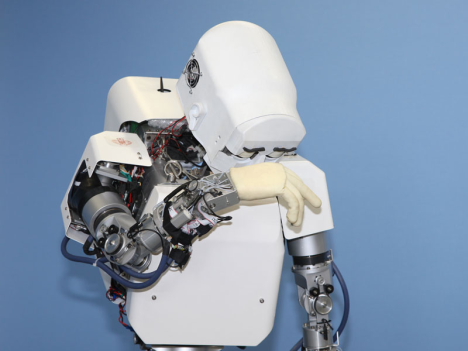
Enon takes a break

TETRA erasers

Tetra erasers --

These TETRA erasers spotted at the recent Good Design Expo in Tokyo are the perfect editing tool for pencil-pushing tetrapod enthusiasts. Produced by Sun-Star Stationery Co., Ltd., the shapely erasers come in 9 colors and are available at stores like Tokyu Hands for 120 yen (about $1) a pop. Pile them on your desk to inspire daydreams of the beach in Japan.

Tetra erasers --

Man charged with dumping silicone girlfriend

Silicon sex doll dumped in woods --

Breaking up is hard to do, and few know this better than a lifelike sex doll owner who Shizuoka police have charged with illegal dumping.

On August 21, the 60-year-old unemployed resident of Izu (Shizuoka prefecture) wrapped his 1.7-meter tall, 50-kilogram silicone girlfriend in a sleeping bag, drove to a remote wooded area, and dumped her. A nice, clean break, he thought.

But nearly two weeks later, on September 1, a couple alerted police after discovering what appeared to be a corpse while walking their dog. The body had been wrapped in a bag and bound around the neck, waist and ankles. A head of black hair protruded from one end of the bag.

Police retrieved the body and immediately launched a criminal investigation. But several hours later, when forensic pathologists began to unwrap the “corpse” to perform the post-mortem, they realized it was actually a state-of-the-art sex doll. Seeing themselves as victims of a malicious prank, the authorities vowed to track down the perpetrator and charge him with interfering with police business.

The incident quickly captured the attention of the national (and international) press. After seeing the news reports, the culprit realized the trouble he had caused and contacted police on September 6.

According to investigators, the man had lived with the sophisticated doll for several years after his wife passed away, but decided to part with her after making plans to move in with one of his children. “It seems he grew attached to the doll over the years,” said the chief investigator. “He was confused about how to get rid of her. He thought it would be cruel to cut her up into pieces and throw her out with the trash, so he proceeded to dump her illegally.”

The man, who regrets his lifelike doll was mistaken for a corpse, now faces fines for violating Japan’s Waste Management Law.

[Source: ZAKZAK, Yomiuri]

Robot sea bream

Robot sea bream --

Engineers at the University of Kitakyushu have developed an underwater survey robot that looks good enough to eat. “Tai-robot-kun,” a 7-kilogram (15.4 lb) robotic sea bream (red snapper) with a silicone body covered in realistically hand-painted scales, features a unique propulsion system that allows it to move its tail and drift silently through the water like a real fish. (Watch a video.)

The robotic fish can swim for an hour on a full battery charge, and it relies on a ballast system similar to those used in submarines to adjust its buoyancy and depth.

Tai-robot-kun’s creator, professor Ikuo Yamamoto, says the robot can easily be mass-produced, outfitted with various cameras and sensors, and released into the sea to perform a wide range of oceanographic survey tasks. He adds that because the robot swims silently and looks like a real fish, it would be able to gather data without alarming the creatures it encounters.

Yamamoto and his team are also reportedly developing a robotic manta ray that uses some of the same technology.

[Source: Robot Watch]

Video: Actroid stars in TV commercial

Actroid female robot actress --

Actroid DER-2, Kokoro’s uncannily lifelike fembot, has made her acting debut in a TV commercial for Kincho’s Preshower UV insect repellent/sunscreen spray. Titled “The Woman Who Doesn’t Rust,” the 15-second commercial spot shows Actroid outdoors at a campground, where she recommends using Preshower because, as a female, her skin is important. After a few squirts of the spray, she cheerily adds, “Surprisingly, I don’t rust.” (Watch it.)

*** Updated with higher quality video ***

Fake Mickey Mouse Olympic statues in Beijing

Fake Mickey Mouse Olympic statues in Beijing --

The Yomiuri Online has posted a photo of some new Olympic-themed statues on display in Beijing’s financial district. The statues — which appear about one year after Disney cried copyright infringement in response to a host of knock-off Disney characters at Beijing’s Shijingshan Amusement Park — depict five Mickey Mouse-like characters engaging in Olympic sports. When asked about the resemblance to Mickey, a spokesperson replied, “They have square holes in their ears. They are not copies.” The spokesperson suggested the statues are unique because they incorporate the themes of old Chinese coins (the square holes), the year of the rat, the Olympics and the financial district into the design. However, children passing by the statues were seen pointing and saying, “Look! It’s Mickey!”

Robot teddy bear car navigation system

Robot teddy bear car navigation system -- On June 3, engineers at iXs Research Corporation unveiled a robotic teddy bear designed to work as a talking car navigation system. The prototype robot stands 30 centimeters (1 ft) tall and has 6 joints in its arms and neck, which it uses to make gestures while providing spoken directions.

The robot bear is also equipped with functions to improve auto safety, such as an alcohol detection sensor embedded in its neck. If it smells booze, the robot confronts the driver, saying, “You haven’t been drinking, have you?” Other sensors detect reckless driving, so if the driver suddenly accelerates or slams on the brakes, the robot says, “Watch out!”

As a bonus feature, the robot bear provides information about nearby landmarks when you stroke its head.

The company hopes to make the robot commercially available next year. “We want to make it more compact,” says CEO Fuminori Yamasaki, “and we’d like to offer a variety of shapes, including other characters and a plain mechanical version.”

Fujitsu has patented the idea of merging car navigation systems with dolls, but it has granted iXs Research Corporation permission to use the patent through a Kawasaki-area project encouraging major corporations to share intellectual property rights with small-to-medium-sized companies.

[Source: Mainichi]

World’s smallest bowl of ramen

Nano-ramen --

It won’t fill you up, but it is a feast for the eyes (if you look through a microscope). This so-called “world’s smallest bowl of ramen” — a 1-micron (1/1000-mm, or 1/100th the width of a human hair) wide bowl containing dozens of 20-nanometer (1/50,000-mm) thick noodles — was created by University of Tokyo professor Masayuki Nakao as part of an effort to develop new carbon nanotube-based microcircuit fabrication technology. Nakao used a metal particle beam to carve the bowl from silicon, and he mixed up a soup of ethanol and catalyst inside the bowl to form the carbon nanotube “noodles.” According to Nakao, it was a major challenge to keep the bowl from overflowing. No word yet on how the tiny meal tastes.

[Source: Yomiuri]

Woodblock prints of men posing as birds (1809)

In early 19th-century Japan, it became fashionable for the culturally sophisticated theatergoing population of Edo to entertain themselves at parties by imitating the voices and gestures of famous actors. As this fad spread, people began to expand their repertoires by mimicking animals, and as animal poses became all the rage at parties, writers and artists collaborated to produce illustrated books containing model examples of these poses. One such document written by poet Santo Kyoden in 1809 included copies of these Utagawa Toyokuni ukiyo-e prints of men imitating birds.

Miburi-e by Utagawa Toyokuni --
Crow pose

Miburi-e by Utagawa Toyokuni --
Hawk pose

Miburi-e by Utagawa Toyokuni --
Duck pose

The work, titled Harasuji Omuseki (腹筋逢夢石), consisted of several volumes that also featured poses for animals other than birds. Waseda University has an online copy of Volume 3, which includes the animal poses below.

Miburi-e by Utagawa Toyokuni --
Chicken pose

Miburi-e by Utagawa Toyokuni -- Miburi-e by Utagawa Toyokuni --
Crane pose, Owl pose

Miburi-e by Utagawa Toyokuni --
Squid pose

Miburi-e by Utagawa Toyokuni --
Goby pose

Miburi-e by Utagawa Toyokuni --
Shrimp pose

Kage-e: Shadow pictures

Kage-e (”shadow pictures”) — a popular form of Edo-period woodblock print — were appreciated by children and adults and commonly used as party gags. These pictures consist of two parts: a “shadow” image and a “real” image. The shadow image, which typically bears the shape of a common, easily identifiable object, is viewed first. The real image, viewed second, reveals the surprising true identity of the shadow.

Here’s a nice example by ukiyoe master Kuniyoshi (ca. 1852). It shows what appear to be the silhouettes of goldfish…

Kage-e shadow picture --

But look again…

Kage-e shadow picture --

It’s a flying tanuki crushing a hunter under the weight of its mammoth testicles.

Here are a few more kage-e by Hiroshige (ca. 1842). The shadows cast on shoji doors belong to men in interesting poses.

Kage-e shadow picture --
Pine tree

Kage-e shadow picture --
Uguisu (Japanese bush warbler) on a plum branch

Kage-e shadow picture --
Salt-dried fish

Kage-e shadow picture --
Kettle

Kage-e shadow picture --
Hawk

Kage-e shadow picture --
Stone lantern

Kage-e shadow picture --
Goose on a rock

[Related: Joge-e: Two-way pictures]