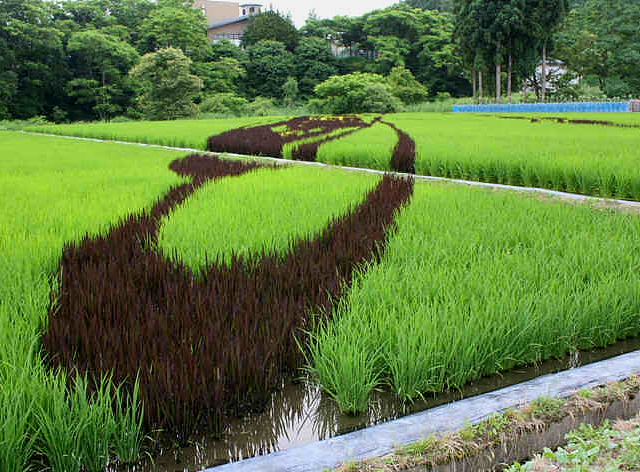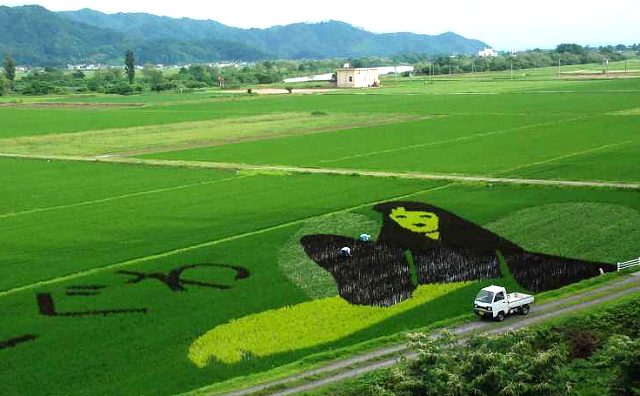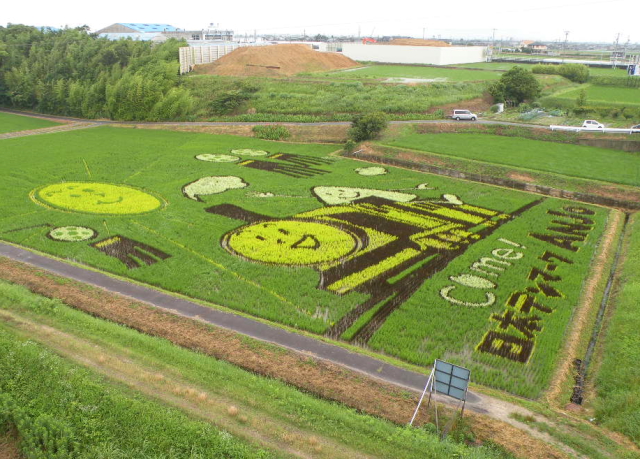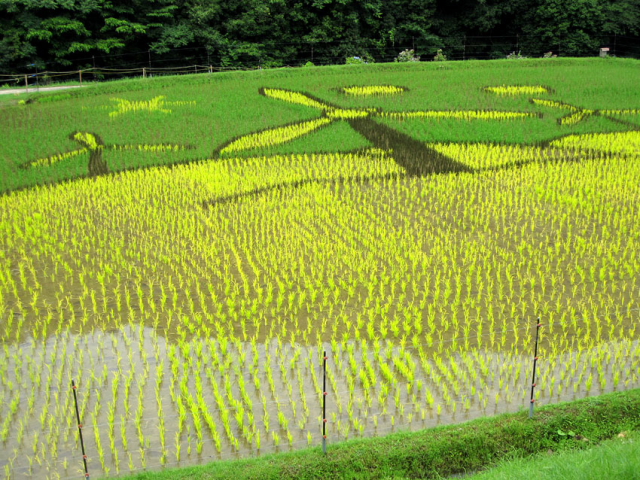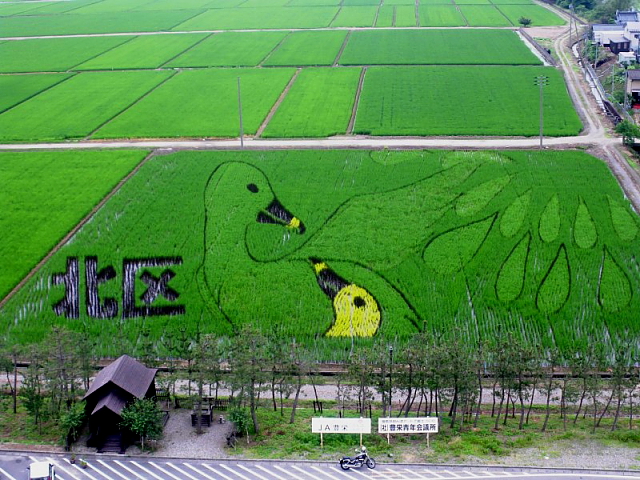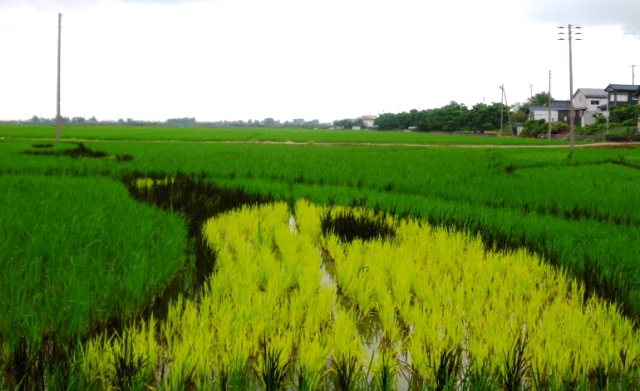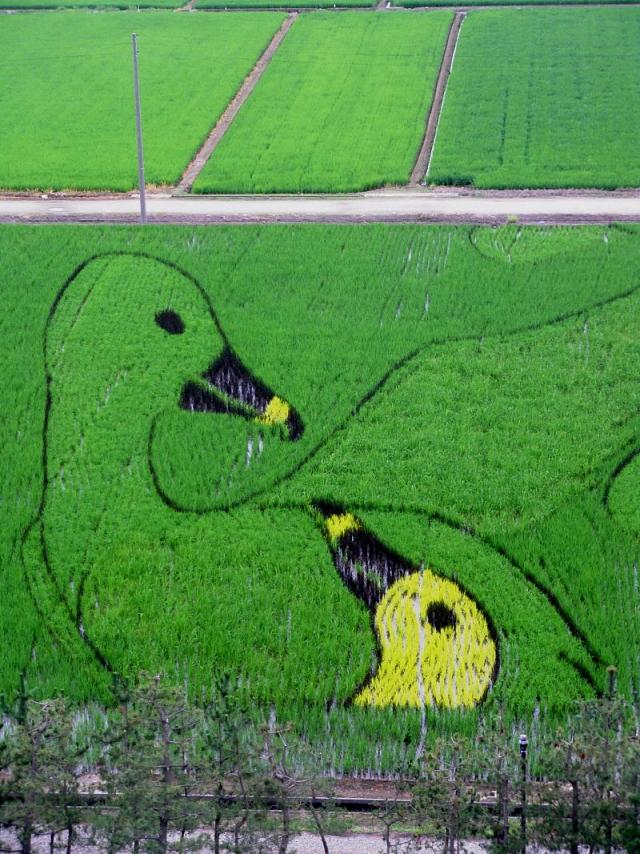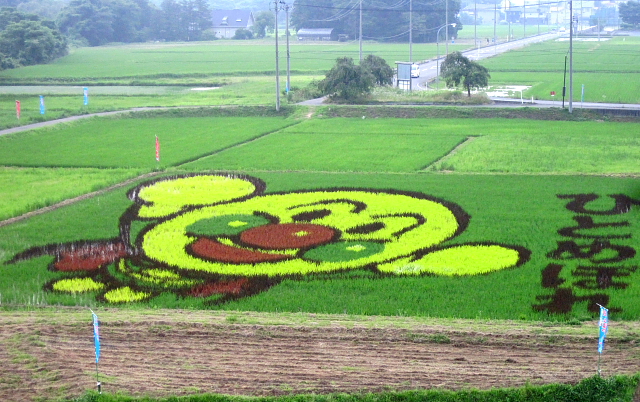
Photos: Rice paddy art harvest

Art rice harvest --

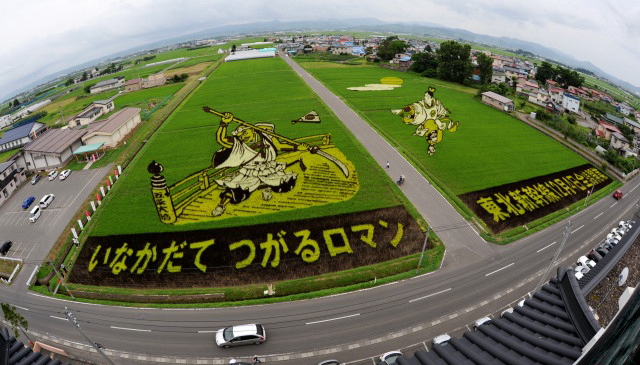
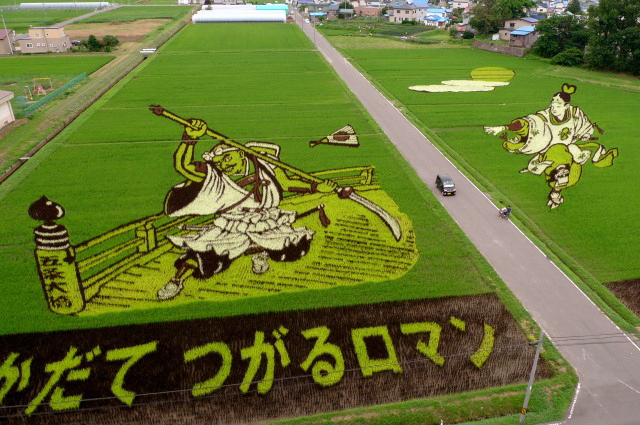
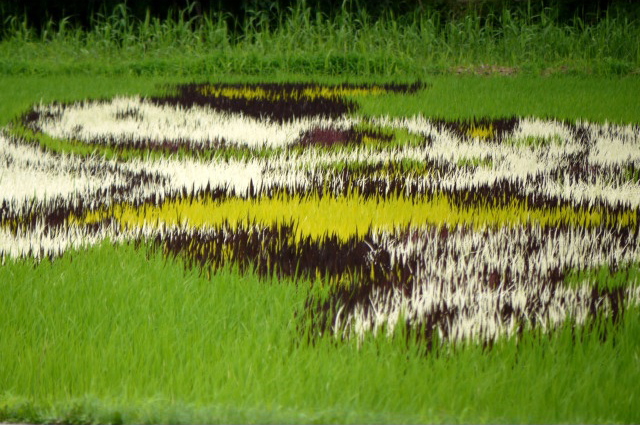
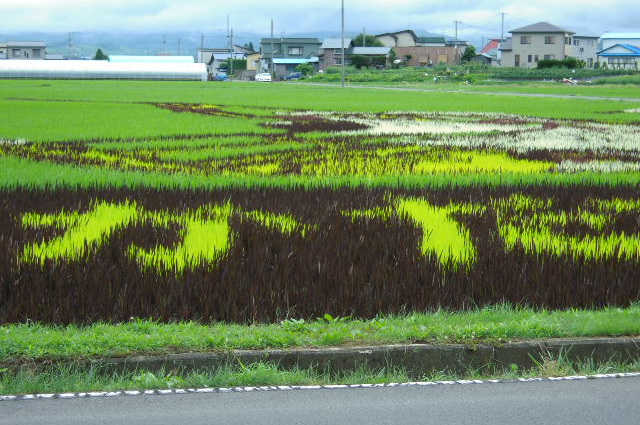
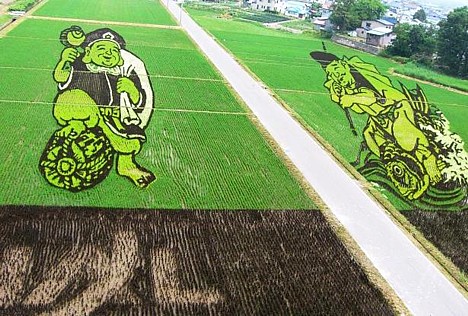
On September 30, about 900 volunteers participating in a hands-on rice farming tour began the annual harvest of the Inakadate village (Aomori prefecture) rice paddy art, which this year depicted a pair of famous Hokusai woodblock prints created with four different varieties of rice.

Art rice harvest --

Art rice harvest --

Art rice harvest --

View more photos of rice paddy art HERE.

[Photos via: Inakadate Village, Mainichi, Sankei, Yomiuri]

Pimp my rice paddy

Rice field art --

Each year, farmers in the town of Inakadate in Aomori prefecture create works of crop art by growing a little purple and yellow-leafed kodaimai rice along with their local green-leafed tsugaru-roman variety. This year’s creation — a pair of grassy reproductions of famous woodblock prints from Hokusai’s 36 Views of Mount Fuji — has begun to appear (above). It will be visible until the rice is harvested in September.

Hokusai woodblock prints --

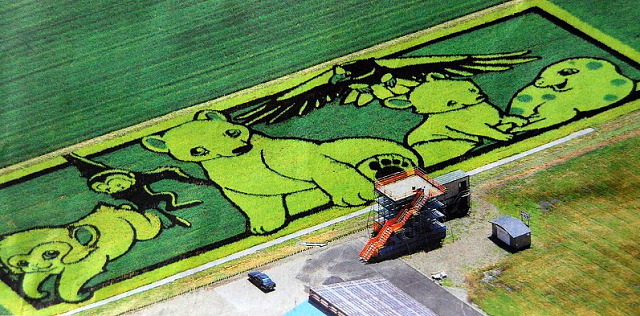
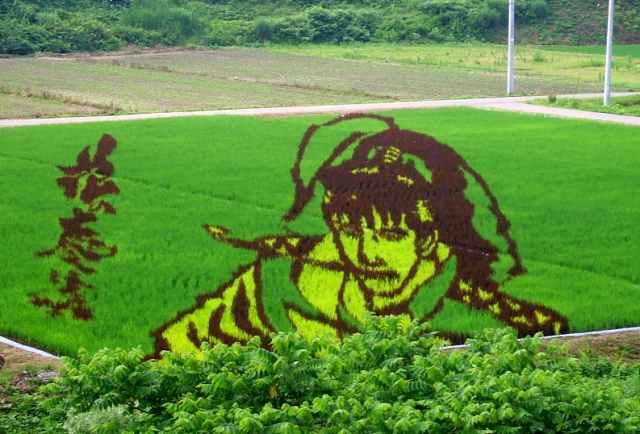
The residents of Inakadate have been drawing pictures with rice since 1993. Here are a few crops from the recent past, found at this site.

Rice field art --
2006

Rice field art --
2005

Rice field art --
2002

While Inakadate is Japan’s most famous rice paddy decorating town, a couple of other places in Japan have joined in the fun.

Rice field art ---
Yonezawa, Yamagata prefecture, 2007

Rice field art --
Yonezawa, Yamagata prefecture, 2006

Rice field art --
Nishio, Aichi prefecture (2005, 2006)

UPDATE (Oct 1, 2007): Check out photos of the 2007 harvest HERE.

Seaweed as biofuel

Sargasso seaweed as biofuel --- On March 22, a group of Japanese scientists released details of an ambitious proposal calling for the large-scale production of bioethanol made from cultivated seaweed.

Researchers from Tokyo University of Marine Science and Technology, Mitsubishi Research Institute, Mitsubishi Heavy Industries and several other private-sector firms envision a 10,000 square kilometer (3,860 square mile) seaweed farm at Yamatotai, a shallow fishing area in the middle of the Sea of Japan. They claim a farm of this scale could produce about 20 million kiloliters (5.3 billion gallons) of bioethanol per year, which is equivalent to one-third the 60 million kiloliters (16 billion gallons) of gasoline that Japan consumes each year.

Seaweed has long been discussed as a potential source of bioethanol, which is typically made from crops such as sugar cane and corn, but the idea has never been brought to fruition. According to the proposal, giant nets used in nori and wakame seaweed cultivation would be laid out to cultivate sargasso seaweed (hondawara), which grows rapidly. Floating bioreactors — special facilities that use enzymes to break the seaweed down into sugars — would prepare the seaweed for conversion into ethanol, which would also be done at sea. Tankers would then transport the ethanol to land.

The main components of seaweed are fucoidan and alginic acid. While an enzyme for breaking down fucoidan has already been discovered, the scientists are looking for an enzyme that breaks down alginic acid. They are also looking at the possibility of using genetic modification technology.

The group is also conducting research on how to develop the production plants and attract investment. Other participants in the project include NEC Toshiba Space Systems, Mitsubishi Electric, IHI, Sumitomo Electric Industries, Shimizu Corporation, Toa Corporation, Kanto Natural Gas Development Co., Ltd., and the Japan Agency for Marine-Earth Science and Technology (JAMSTEC).

The researchers claim that in addition to serving as a source of fuel, the seaweed would help clean up the Sea of Japan. According to Professor Masahiro Notoya from Tokyo University of Marine Science and Technology, the seaweed would work to remove some of the excess nutrient salts that flow into the sea from the surrounding land masses.

Professor Notoya will formally present the proposal at the International Seaweed Symposium, which is set to begin on March 26 in Kobe, Japan.

[Source: Fuji Sankei]

Instant bonsai

Mini-petunias (top left) and ordinary petunias -- On January 18, researchers from Japan’s Institute of Physical and Chemical Research (RIKEN) and the University of Michigan announced the development of a technique for engineering “mini-plants” that are 1/10th their ordinary size.

The researchers claim it is possible to tailor the size of plants by manipulating the genes that regulate the activity of growth hormones. The technique is expected to lead to the creation of miniaturized versions of decorative houseplants, as well as dwarf crops that are easier to harvest and more resistant to wind damage.

In studying dwarf varieties of rice and wheat created through ordinary hybridization, the researchers found damage to the genes that synthesize gibberellin, a growth hormone. When researchers looked for a mechanism to control the growth hormone, they discovered that the GAMT1 and GAMT2 genes commonly found in plants were responsible for producing an enzyme that neutralizes gibberellin.

When the researchers engineered strains of petunias and thale cress (Arabidopsis thaliana) in which the two genes were constantly expressed, the plants grew to 1/10th their ordinary size. When plants were administered gibberellin, they grew to their normal size, demonstrating that the size of plants can be freely adjusted.

[Source: Yomiuri]

Sweet wheat

Sweet wheat -- On December 12, researchers from Japan’s National Agriculture and Food Research Organization (NARO) and Nippon Flour Mills announced the development of sweet wheat, a hybridized variety of wheat with twice the sugar concentration of common wheat. This first-of-its-kind sweet wheat eliminates the need to add sugar when it is used in cakes or other baked goods, researchers claim.

By repeatedly breeding varieties of wheat with low levels of enzymes associated with starch production, the researchers were able to lower the wheat’s starch content — which is ordinarily around 70% — to 25%. The result is a variety of wheat with a significantly higher concentration of sugars such as maltose and sucrose.

In this way, sweet wheat is similar in concept to sweetcorn, which also was specifically bred to increase its sugar content.

Sweet wheat is identical in appearance to common wheat, except that it withers and develops wrinkles when dehydrated. Its natural sweetness gives it a distinctive flavor when it is ground into flour and used as an ingredient in baked goods.

Nippon Flour Mills hopes to make sweet wheat commercially available in two to three years. In the meantime, the company is looking into the possibility of developing new types of food products that draw upon the natural flavor of sweet wheat.

[Source: Chunichi, Yomiuri]

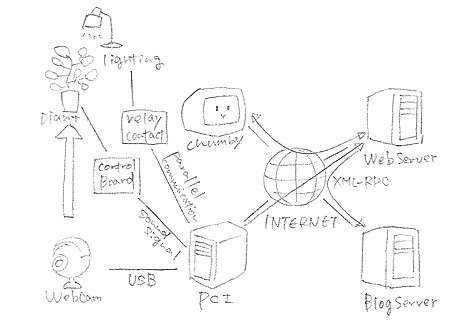
Aiterrarium: Remote-control gardening

Aiterrarium --

On October 11, Matsushita Electric Works, Ltd. (Panasonic’s parent company) announced plans to begin selling an indoor gardening system whose lighting, temperature and water supply can be remotely monitored and controlled via the Internet. The system, called Aiterrarium, is slated for release on December 20 and will initially target research facilities for universities and businesses.

The system consists of a growing chamber that is 50 centimeters wide and 1.2 meters tall. The chamber is outfitted with 190 watts of fluorescent lighting on the walls and ceiling, and sensors measure 15 different growing conditions, including soil temperature and moisture level. If a heater and automatic watering system are added, users can connect to a Matsushita server over the Internet to set ideal temperatures and perform watering. A webcam allows users to monitor growing conditions from anywhere in the world via cellphone or computer.

The system was exhibited at the 2005 World Expo (which may explain the “Ai” in “Aiterrarium,” since Aichi prefecture played host to the Expo), where it received a favorable response, prompting Matsushita to make improvements and begin test marketing it to research facilities.

The standard system will cost 360,000 yen (US$3,000) plus monthly server fees, while the fully-optioned model will run 600,000 yen (US$5,000). The company is aiming for sales of 600 units in 2007.

In an effort to expand its business in the market for automated agricultural systems, Matsushita is developing remote-control systems for greenhouses, which they aim to release in April 2007.

[Source: Fuji Sankei]

Rooftop lawn-planting made simple

TM9 turf mat

On August 25, Toyota Roof Garden (a subsidiary of the Toyota Motor Corporation) began taking orders for its TM9 turf mats, modular grass tiles developed specifically for converting rooftops into fields of green. In addition to providing an extra layer of thermal insulation to a building, a grassy rooftop can also be used as a putting green, says the company.

The mats act as a foundation upon which to grow Toyota’s TM9 brand of Korean velvet grass (korai shiba), which only needs to be cut once a year (as opposed to 3 to 4 times for other varieties) due to its slow growth. Each 50 x 50 cm (20 x 20 in.) mat is 6 cm (2 in.) thick. Setting up a field is fast and easy — just arrange the mats where you want them and voila, your grass is ready to be enjoyed.

The mats also include space for water tubes that can be used as an automated irrigation system. Water flows through the tubes into a series of channels beneath the grass, providing an even supply of moisture to the roots. Each square meter (10 sq.ft.) needs 17 liters (4.5 gallons) of water every 3 days.

For the time being, TM9 turf mats are made to order. At 5,000 yen (US$43) per square meter (10 sq.ft.), the company aims to sell 3,000 square meters (30,000 sq.ft.) in 2006.

Green rooftops provide thermal insulation for buildings and can help combat the urban heat island effect. The annual Japanese market for rooftop and wall gardening products is expected to grow to between 10 and 15 billion yen (US$90 to 130 million) in the near future.

[Source: Fuji Sankei]

Pyramid-shaped watermelons

Pyramid-shaped watermelon

Toshimichi Boui (55), a Nara prefecture resident in the furniture business, is making a name for himself by successfully growing pyramid-shaped watermelons.

Each melon is cultivated inside a hand-made acrylic box from a very young age. The vines grow on a wooden trellis so that the melons can be exposed to full sunlight. This allows them to develop nice, evenly colored rinds.

“Next year I hope to grow melons shaped like gourds and bottles,” says Boui.

The melons are lacking in flavor because they are unable to fully mature, so Boui has put them on display at the neighborhood hair salon, among other places. “You taste them with your eyes,” he says.

[Source: Asahi Shimbun]

Mutant tomato harvested in Kyoto

Mutant tomato A mutant tomato with a face resembling a Chinese lion mask was harvested from a field in the city of Yahata in Kyoto prefecture. The common momotaro tomato is 3 times the normal size, measuring 10 cm in diameter and weighing 150 grams.

The unusually long rainy season is believed to have caused the fruit to absorb too much moisture.

The surprised farmer, who has been raising tomatoes for more than 30 years, says, “It’s the first time I’ve ever seen a tomato with a fully formed face.”

No word yet on how it tastes.

Spoo's tomato cousin
(Spoo’s tomato cousin?)

[Source: Mainichi Shimbun]
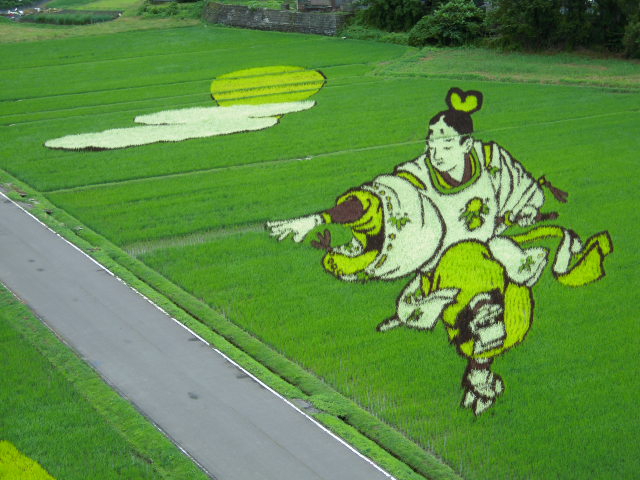
Image of Raijin (God of Thunder) appears in rice field

Raijin (God of Thunder) appears in rice field A giant image of Raijin, the God of Thunder, has appeared in a rice field in the village of Inakadate in Aomori prefecture. The different colors consist of different varieties of rice — the green areas are tsugaru-roman (the local variety), while the purple, yellow and red areas consist of so-called kodaimai, or ancient strains of rice. Mid-August is reportedly the best time to view the rice field.

Not shown in the photo is the image of Fujin, the God of Wind, presumably located in a nearby field. Fujin and Raijin usually appear together and are perhaps most well-known for their depiction in the Fujin-Rajin Folding Screen (Fujin-Raijin Zu Byobu), an Edo-period work by Tawaraya Soutatsu. The original screen is on display at Kennin-ji Temple in Kyoto and has been officially designated a national treasure.

[Source: Yomiuri]