With winter in full force, now is the perfect time to explore the frozen wilds of the Japanese web in search of happy fun snowmen.

Arguably the best place to see snowmen is the annual Sapporo Snow Festival, one of Japan's most celebrated winter events. This photo (by Flickr user kozyndan) shows a sea of snowmen (yuki-daruma) built by visitors to the festival, who attach written wishes for good luck.

The week-long festival held in early February is home to Japan's largest snow and ice sculpture competition, and all sorts of wacky snow creations can be seen at venues around town -- like this giant chihuahua and Asimo.

Or your favorite anime character. (Photo from Jonas's Travels in Sapporo website.)

Or much more impressive creations like these dinosaurs. For more pictures from the festival, try a Google image search for "札幌雪祭り" (Sapporo Yuki Matsuri).
Of course, the Sapporo Snow Festival is not the only place to encounter snowmen -- they appear wherever there is snow.

This photo, taken in the town of Kuroishi (Aomori prefecture), shows what is proudly labeled as Japan's largest snowman. The 31-meter-tall (100 ft) monster has a face composed of local agricultural products, such as charred apple trees for the eyebrows, seashells for the eyes, rice for the cheeks, apples for the mouth, daikon radishes for the ears, and carrots for the collar.

This Namahage folk demon was spotted at last year's Lake Tazawa Snow Festival.

These glowing snowmen were seen standing watch at Kanazawa castle.

And this one. Haven't we seen this somewhere before?
Sometimes happy snowmen can be found where there is no snow -- like in Tokyo. For this year's Kanda Yuki-Daruma Fair in late January, organizers trucked in 70 tons of snow from rural Gunma prefecture and built 30 large snow creatures on the sidewalks of Kanda.

Here is a snowy incarnation of Baikinman, an evil character from the Anpanman anime series. (Photo via Mycom.)

And here are Kurohige Kiki Ippatsu (Pop-up Pirate game) and Shiisaa (a mythical Okinawan creature). For more from the Kanda Yuki-Daruma Fair, see these photos.






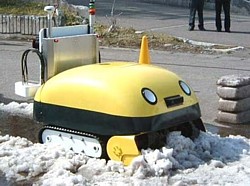 The friendly-looking Yuki-taro measures 160 x 95 x 75 cm (63 x 37 x 30 in.) and weighs 400 kg (880 lbs). Armed with GPS and a pair of video cameras embedded in its eyes, the self-guided robot seeks out snow and gobbles it up into its large mouth. Yuki-taro's insides consist of a system that compresses the snow into hard blocks measuring 60 x 30 x 15 cm (24 x 12 x 6 in.), which Yuki-taro expels from its rear end. The blocks can then be stacked and stored until summer, when they can be used as an alternative source of refrigeration or cooling.
 In a tradition that stretches back 700 years, local farmers in Hanamaki, Iwate prefecture measure the circumference of the frozen waterfall at Taroshi Falls to predict the yield of the year's rice crop.