JR tests fuel cell hybrid train

NE Train -- On October 19, East Japan Railway Company (JR East) made a test run of its NE Train (New Energy Train) — the world’s first fuel cell hybrid train — in Yokohama’s Kanazawa ward.
With two 65-kilowatt fuel cells and six hydrogen tanks under the floor and a secondary battery on the roof, the clean train emits only water and runs without receiving juice from power lines. The train can travel at a maximum speed of 100 kph (60 mph) for 50 to 100 km (30 to 60 miles) without a hydrogen refill.

Thirty passengers boarded the train for the test run, which consisted of a series of back-and-forth jaunts along a 300-meter test track. The train smoothly accelerated to a maximum speed of 50 kph (30 mph), providing a ride quality no different from an ordinary train.

A separate fuel cell train is under development by the Railway Technical Research Institute (RTRI), but the NE Train differs in that it is a hybrid relying on a secondary battery that stores electricity generated during braking. The secondary battery provides auxiliary power during acceleration or when fuel cell power is insufficient.

JR East hopes to see hybrid commuter trains in widespread use in 10 to 20 years. Lowering the cost and improving the mileage of fuel cells is a serious challenge, but the effort is not without reward. In addition to environmental benefits, eliminating the need for unsightly power lines means lower infrastructure costs and a prettier landscape to look at from the train window.

Testing of the train on public tracks will begin next April.

[Source: Chunichi Shimbun]

Petaflops-level supercomputer to be unveiled

MDGRAPE-3

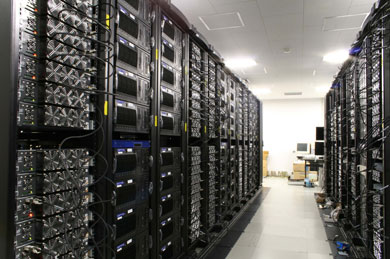
On June 19, Japan’s Institute of Physical and Chemical Research (Riken), SGI Japan and Intel announced the development of a supercomputer with a theoretical peak performance of 1 petaflops (one million billion floating point operations per second). Known as the MDGRAPE-3 (or the Protein Explorer), the computer system is designed to perform molecular dynamics simulations of such phenomena as non-bonding interactions between atoms.

The system consists of 201 units equipped with 24 of RIKEN’s MDGRAPE-3 LSI chips for molecular dynamics simulation (total of 4,808 chips), which are connected to 64 parallel servers equipped with 256 of Intel’s Xeon 5000-series cores and 37 parallel servers equipped with 74 Xeon 3.2 GHz cores.

In the future, RIKEN plans to further upgrade the system with Xeon 5100-series processors (codenamed Woodcrest), and testing is now underway.

The LINPACK Benchmark, which is the standard for the Top 500 List, could not be performed on the system, so the performance cannot be compared directly with the world’s other top supercomputers. However, the system’s theoretical peak performance of 1 petaflops will set the computer firmly at the top of the list, with a speed about three times that of IBM’s BlueGene/L at Lawrence Livermore National Laboratory (currently No.1 on the list).

The system will be unveiled to the public on June 24 at RIKEN’s Yokohama laboratory.

[Source: IT Media]

Electrical Fantasista: Hip technology you can feel

Cutting-edge technology meets art at Electrical Fantasista, an exhibit and series of events held at BankART Studio NYK in Yokohama (Feb 24 – Mar 14). The exhibit is divided into four zones that explore the future of modern lifestyle.

ZONE 1: Positive Living
Artists and scientists from Japan have created robots and machines that rely on IT to bring comfort to people. The works in this zone fuse art with the latest in technology to evoke true delight, providing a glimpse into the future of relaxation.

ZONE 1 works
- Tabby: Communicative healing IT interior that reacts to voice and touch
- PARO: Interactive seal robot with therapeutic powers recognized by the Guinness Book of World Records
- Co-animation table: Table that anyone can enjoy to create animation
- Mutant Critter: “Skins” that transform things into furry creatures
- Mr. Jones Watches: Series of retro-futuristic watches with a variety of unique functions
- Katazukue: Tidy table that forces slobs to clean up

PARO
PARO, the healing seal robot

ZONE 2: Game Is Life
The “games” in Zone 2 are the stuff that fuels the development of games. But beware, these works of art from Germany and Japan venture dangerously into realms ordinary games only dream to go, which explains why gamers and developers from across the globe are dying to try them out.

ZONE 2 works
- PainStation: Arcade game that exposes the loser to electric heat/shock and lashings
(Note: Due to the possibility of physical harm, play is limited to those who agree to bear full responsibility for any injury incurred.)
- Through the looking glass: Air hockey game that pits you against your mirror image
- MisLeading MisReading: Artificial intelligence message game that uses advanced speech recognition and machine translation technology to translate your spoken words

PainStation
PainStation

ZONE 3: Electrical Lounge

MorphoTowerZone 3 explores new types of experience in optics. Relying on the latest in optic technology, such as LED and sensors, the works in this zone go beyond the flashing of lights to magically stimulate all the senses. Here, visitors experience new forms of comfort and stimulation.

ZONE 3 works
- Kaze-no-michi: Light sculpture that transforms the beauty of wind into light that illuminates the floor
- MorphoTower: Living sculpture of magnetic fluid that continuously morphs into magical shapes
- Fuwa Pica: Sofas that change color when you sit — soft on the eyes, soft to the touch

ZONE 4: Flash Fantasista
Zone 4 features a selection of interactive art chosen the curators. See http://www.shift.jp.org for details.

(Map to BankART Studio NYK)

[Source: Creative Cluster]

Exotic chocolate exhibit at Yokohama Curry Museum

An unusual chocolate exhibit at the Yokohama Curry Museum may provide the perfect opportunity for gag gift shopping, whether it’s for your despicable boss or for yourself. The exhibit features a selection of around 70 varieties of novelty chocolate, alcoholic chocolate, fruit chocolate, and joke chocolate, all of which are available for purchase. The exhibition will be held until March 31 in the Masaraya museum shop on the 7th floor of the museum.

Some of the featured items include:

- Curry chocolate: Amazing, award-winning chocolate
- Wasabi chocolate: White chocolate with wasabi mustard
- Dried kelp chocolate: Chocolate with powdered gagome dried kelp from Hokkaido
- Hokkaido salt chocolate: White chocolate spiced with salt from the Sea of Okhotsk
- Korean red chili pepper chocolate: Chocolate with red chili pepper extract


(Curry chocolate, wasabi mustard chocolate and gagome dried kelp chocolate)


(Chocolate Factory Series: Car Mania Set, squid chocolate and Sapporo Beer chocolate)

The curry chocolate, a Yokohama Curry Museum original, has sold particularly well — 25,000 packages in January. “At first it seems like regular chocolate,” says museum official Takehisa Inoue, “but its subtle spicy aftertaste gives it an exquisite flavor.” Created with the cooperation of confectionery manufacturer Meiji Seika, the curry chocolate is made with a blend of various spices.

In conjunction with the exhibit, the Petit Vert cafe on the 8th floor is serving fruitcake that looks just like a plate of curry (1,200 yen) until March 31. Created by Nobuyuki Yamamoto, former head pastry chef at Hotel New Grand (Yokohama), this dessert is a museum original with local roots. The “rice” is made from chocolate and sponge cake, and the “curry roux” consists of a mixture of turmeric and orange juice.
[Source: MYCOM PC WEB]