
KOTOHANA communicates emotions from afar
NEC, NEC Design and SGI Japan have teamed up to develop KOTOHANA, flower-shaped terminals that use LED light to remotely communicate human emotions.
Each KOTOHANA set consists of two flower-shaped terminals equipped with LEDs that change color according to the emotions of the person who owns the counterpart. Each flower contains a microphone that captures voice data for processing, the results of which are sent via wireless LAN to the other terminal, where it is expressed as LED light.
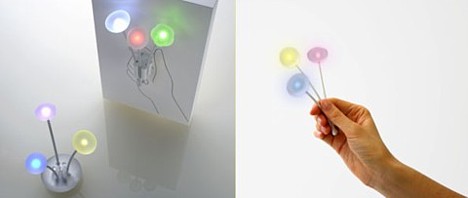
KOTOHANA’s Sensibility Technology (ST) emotion recognition engine, which was developed by SGI Japan with the cooperation of AGI, detects joy, sorrow, calmness and excitement in speech patterns. Happiness is expressed as yellow, sadness as blue, calmness as green, and excitement as red. Changing emotions are expressed through subtle color gradations and variations in light brightness.
The product is still in the prototype stage, with the ST engine running on a separate computer connected to KOTOHANA. NEC plans to showcase KOTOHANA at CeBIT, the international trade show for information and telecommunications technology to be held from March 9 to 15 in Hannover, Germany.
[Source: Yahoo! News Japan via japan.internet.com]

[…] [Check it out via GearLog.com] […]
Kotohana’s Emotive Votives…
For the people with biologically lousy facial recognition systems Kotohana has introduced prototype LED flowers that interpret human emotion. The glowing flowers contain little mics that capture voice data. The info is sent it to a processor (a.k.a, t…
Mood flowers - who needs words anyway?…
This is great: a live back-channel for a fundamental component of communication - mood. Talk in the vicinity……
[…] via: pinktentacle Technorati Tags: emotions flowers japan kotohana led led flower technology […]
[…] KOTOHANA communicates emotions from afar […]
[…] KOTOHANA are flower-shaped terminals that use LED light to remotely communicate human emotions. Each KOTOHANA set consists two flower-shaped terminals equipped with LEDs that change color according to the emotions of the person who owns the counterpart. Each flower contains a microphone that captures voice data for processing, the results of which are sent via wireless LAN to the other terminal, where it is expressed as LED light. [ PinkTentacle.com through information aesthetics ] […]
[…] The system, called SHOJI (Symbiotic Hosting Online Jog Instrument), is similar in concept to KOTOHANA (developed by NEC and SGI), which are pairs of flower-shaped terminals that share data and change color according to emotion detected in voice patterns. […]
[…] The system, called SHOJI (Symbiotic Hosting Online Jog Instrument), is similar in concept to KOTOHANA (developed by NEC and SGI), which are pairs of flower-shaped terminals that share data and change color according to emotion detected in voice patterns. […]
[…] El invento de marras se llama SHOJI y tiene un hermano muy parecido, casi gemelo, el KOTOHANA que hace algo bastante similar pero en este caso son flores y no terminales. […]
[…] RoomRender also includes features that respond to the mood of its occupants. FeelingWall — a wall whose colored lights change according to the mood of the people in the room — relies on Sensibility Technology (developed by SGI and AGI), the same technology used in KOTOHANA, which was developed by SGI Japan and NEC. Like KOTOHANA, FeelingWall interprets emotions based on the intonation and rhythm of voices, adjusting the color and lighting accordingly. RoomRender can also be programmed to control an aroma diffuser, releasing fragrances that correspond to various moods. Features like these mean that if an inhabitant sighs “I’m tired,” the room can automatically respond by dimming the lights, causing the light of the FeelingWall to pulsate gently, turning on some relaxing background music and emitting a soothing fragrance from the aroma diffuser. […]
[…] RoomRender also includes features that respond to the mood of its occupants. FeelingWall — a wall whose colored lights change according to the mood of the people in the room — relies on Sensibility Technology (developed by SGI and AGI), the same technology used in KOTOHANA, which was developed by SGI Japan and NEC. Like KOTOHANA, FeelingWall interprets emotions based on the intonation and rhythm of voices, adjusting the color and lighting accordingly. RoomRender can also be programmed to control an aroma diffuser, releasing fragrances that correspond to various moods. Features like these mean that if an inhabitant sighs “I’m tired,” the room can automatically respond by dimming the lights, causing the light of the FeelingWall to pulsate gently, turning on some relaxing background music and emitting a soothing fragrance from the aroma diffuser. […]
[…] So wurde schon die Produktreihe Kotohana, von SGI und NEC, mit stimmungsvollen Lichtern versehen. […]
[…] Pink Tentacle emoción, flores, Kotohana, Nec Design var uri = […]