
In the sophisticated popular culture of the Edo period (1603-1868), much attention was devoted to Japan's rich pantheon of traditional monsters and apparitions, known as yokai. Sometimes frightening, sometimes humorous, these compelling Japanese folk creatures were the subject of numerous artistic and literary works. One such work was Hyakkai Zukan, a collection of picture scrolls completed in 1737 by Sawaki Suushi, a relatively unknown artist who studied under master painter Hanabusa Itcho (1702-1772). Hyakkai Zukan's colorful depictions of Japan's most notorious creatures inspired (and were copied by) yokai artists for generations. Here is a peek inside.

Ushi-oni [Enlarge]
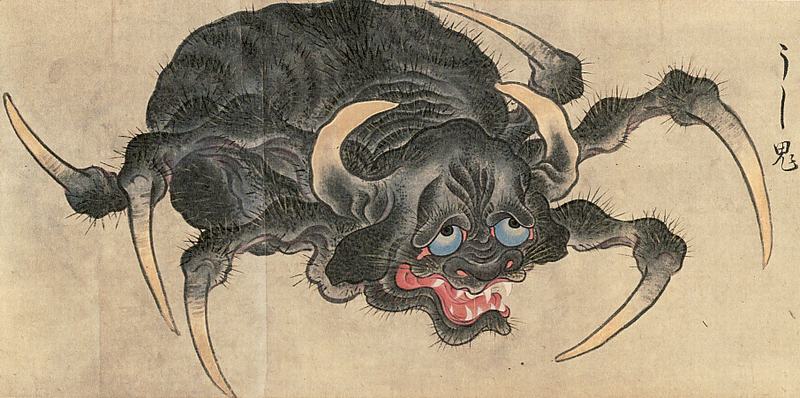
Ushi-oni (lit. "cow devil") is a malevolent sea monster with the head of a bull and the body of a giant spider or crab. It is most often encountered in the coastal waters of western Japan, particularly in Shimane prefecture, where it is feared for its vicious attacks on fishermen. [More]
Ushi-oni is usually seen in connection with a related monster, called Nure-onna.

Nure-onna
Nure-onna (lit. "wet woman") is a fast-swimming amphibious creature with the head of a human female and the body of a gigantic snake. Her appearance varies slightly from story to story, but she is usually described as having beady, snake-like eyes and long, sharp claws and fangs. Nure-onna is typically seen at the water's edge, washing her long, flowing hair. In some stories, she carries a small child, which she uses to attract potential victims. When a well-intentioned person offers to hold the baby for Nure-onna, the child attaches itself to the victim's hands and grows heavy, making it nearly impossible to flee. In some stories, Nure-onna uses her long, powerful tongue to suck all the blood from her victim's body. [More]

Uwan
In ancient Aomori prefecture legends, Uwan is a disembodied voice that inhabits old, abandoned temples and homes. When a person enters a haunted building, the formless spirit belts out an ear-piercing "Uwan!" (hence the name). The voice is only audible to people inside the building -- those standing outside hear nothing. Uwan consists only of sound and poses no physical danger.
Ancient Japanese legends are rife with examples of formless yokai like Uwan, which consist of nothing but sound, light or other natural phenomena. In the Edo period, however, these yokai assumed physical bodies as artists incorporated them into their work.

Nurarihyon (left), Mehitotsubou (right)
Another yokai that got a facelift in the Edo period is Nurarihyon, pictured here as as a well-dressed old man with an elongated bald head. Ancient Okayama prefecture legends describe Nurarihyon (lit. "slippery strange") as a marine creature found in the Seto Inland Sea, often seen bobbing around on the surface of the water like some sort of giant jellyfish or octopus. Nurarihyon eludes capture by diving underwater when people approach to investigate.
In the Edo period, Nurarihyon came to be known as a mysterious old man with the uncanny ability to sneak into homes and "take over." When the residents of a home encounter him sitting around drinking tea, they are unable throw him out and cannot help but treat him as the head of the household. Nurarihyon is said to be a highly respected figure in the world of yokai.
Mehitotsubou (above right), a large monk with a cyclopean eye, is a variant of the large shape-shifting monks commonly found in Japanese folk tales.

Mikoshi-nyudo
Another monster monk is Mikoshi-nyudo (a.k.a. Miage-nyudo), a large, cross-eyed mendicant encountered on mountain passes or on lonely roads at night. Mikoshi-nyudo grows taller when you look up at him -- and the higher you look, the taller he grows. Look up for too long and you will die, goes the legend, but say "mikoshita" ("I see higher") and he disappears. Mikoshi-nyudo's true identity is unknown, but in some areas he is believed to be a shape-shifting weasel, fox or tanuki.

Yama-warau
Yama-warau (a.k.a. Yama-waro) are hairy, one-eyed Garappa (a variety of Kappa found in Kumamoto prefecture) who have gone into the mountains for the winter. These child-sized creatures are known to provide assistance to lumberjacks in the mountains, and they eagerly return again and again to help, as long as they are rewarded with liquor and rice balls.
Like other varieties of Kappa, Yama-warau are fond of playing tricks on people, and they enjoy sumo wrestling. They sometimes break into people's homes to take a bath, and they have a sixth sense for danger, which allows them to escape from people with evil intentions.
At the spring equinox, Yama-warau return to the rivers to live as Garappa. They travel in groups, jumping from one rooftop to the next, all the way down to the water. If, along the way, they come across a new home under construction, they get angry and poke holes in the walls. Legend has it that anyone who goes to the river to catch a glimpse of a returning Yama-warau will become sick.

Inugami
An Inugami (lit. "dog god") is a familiar spirit that looks like a dog and acts as a protective guardian. Inugami are extremely powerful and loyal, and they are known to carry out acts of revenge on behalf of their "owners." They can also exist independently, and under some circumstances they may turn against their owners. Inugami also have the ability to possess humans. [More]

Ouni
Ouni is a mountain hag with a mouth stretching from ear to ear and a thick coat of long, black hair covering her entire body. According to an old Niigata prefecture legend, Ouni appeared one day to a group of women as they were spinning hemp into yarn. After accepting the hairy hag's offer to help, the women watched in surprise as she repeatedly placed raw hemp fiber into her mouth and pulled out finished yarn. After quickly producing a large quantity in this way, Ouni stepped outside and suddenly disappeared. Legend has it that she left footprints in the nearby rocks, which can still be seen to this day.

Kami-kiri [Enlarge]

Kami-kiri (lit. "hair-cutter") are ghostly spirits known for sneaking up on people and cutting all their hair off, particularly when they are unknowingly engaged to marry a yokai, spirit or other supernatural creature posing as a human. These hair-cutting attacks are intended to delay or prevent weddings between humans and otherworldly beings, which are typically doomed to failure. [More]
For more images from Hyakkai Zukkan, see the Sawaki Suushi collection at Wikipedia Commons.
NiceGuyJin
The Ushi-oni kind of reminds me of the monster in Cloverfield.
[]Akiba
I have an album by that name!
[]ChrisG
Very interesting. I like the Kami-kiri.
[]Brian
Great, NiceGuy just ruined Cloverfield for me
[]sanjuro
I haven't had time to read the article yet, but this is great stuff ! I love ukiyo-e, Hokusai's and Hiroshige's works in particular, but I had never heard of Sawaki Ushii. Nice find !
[]sanjuro
Suushi, typo. (besides his name is easy to remember, yum !)
[]Bill
Isn't there a live action japanese movie made recentlyish featuring a boy and a lot of these monsters trying to fend off evil monsters?
[]Bill
III found it
The Great Yokai War. Sorry.
[]Jake
Others of interest are the kappa, oni, ten-gu, ninyo.
[]misteralbundy
very nice, my favorite is nure-onna.
[]genji
arrr
[]sad
no tentacle-rape monsters? awww mann!
[]urotosukidoji
Has alot of similarities with egyptian mythology, horus, isis. And some reference to islamic idea of Jinn.
[]Johnny
That Yama-warau looks like Buddy Bradley:
[]http://www.fantagraphics.com/components/com_virtuemart/shop_image/product/bookcover_budsea.jpg
renchamploo
yeah.,. yama is only emo in the group.. "the arm cutter" xD.. i hate emo's..
[]Mr Surbade
Looks like my dad
[]BledDry
I think I was married to Nure-onna once. She slowly bled me dry and I felt as if I couldn't escape.
[]Richard
Wow these are really great, love that style of line drawing. Add it to the fun monster culture of the times, and it's about perfect.
[]Alper
For the record, I'm pretty sure I read that you die if you don't shout back "Uwan!" at the monster. But there are usually several variations of a myth anyways.
[]adam uk
These actual works, and others, are currently on exhibit at the San Francisco Asian Art Musuem as part of a new programme that opened a couple of weeks ago entitled "Drama and Desire".
[]Cecil
Are you certain it is Uwah and not Uran? The second hiragana symbol looks like ra and not wa. Take a look at http://www.japanorama.com/images/hiragana.gif
Regards,
Cecil
[]Azalia Short
The monsters look very modern.
[]I wonder how they came to draw a cyclop with no knowledge of a greek myth about it.
TT
Brings chill down my spine....... I grew up this stuff and is always so much more scarier than Western monsters which all seem too candy-related. Hahaha
[]renchamploo
western monster are noting compare to kami-kimi.. you should know that.. cause he will cut your hair with no style.. and thats barbaric
[]slig
thanks allot, I found this really fascinating! :)
[]Ryan
nure-onna looks like orochimaru and uwan looks like this hobo i saw on the street i saw yesterday
[]eldritch
The one with the woman's head, Nure-Onna, is also a vampire ? A true woamn spirit ;)
[]renchamploo
wow.. i only watch anime and being curios of what edo time period life does?.. so i search.. and i found here monster realy scary..
[]and i tink most scariest monster in here was kami-kiri.. man can you believe your hair cut by someone like him?.. its okay if i saw him around, i just cant accept my hair being cut by no reason.. shit.. ^_^ heheh
Mr. Pousse
Hey, he's just trying to save you from a crazy demon chick, or monster man for a spouse. If I found him, I would thank him for the agreeably strange warning, and find out exactly what I was getting into.
[]Matt
Thanks so much for posting these! I love your collections of old Japanese art. Please post more!
Incidentally, on my website, I'm currently painting a bunch of Japanese monsters, one per day. I hope you'll stop by if you're interested.
[]jimbo
probably just images of his wife. the way he saw her
[]Clint
The fourth one reminds me of Futurama.
[]meeba
Wow ! these paintings and stories are soo intreasting and cool, my FAV is "Yama Warau" i luv that one
[]meeba
GR8! XD
[]Mark
I'm going to have nightmares tonight.
[]